
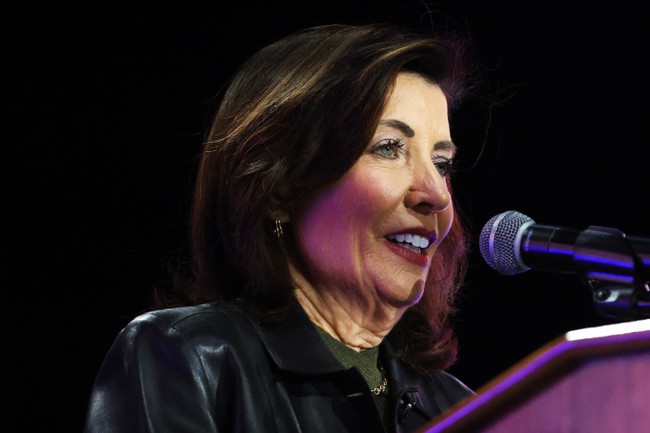
This piece examines New York Governor Kathy Hochul’s plea for wealthy residents to return from Florida to support state programs, contrasts it with migration trends away from high-tax blue states, relays Hochul’s remarks about “captives,” and critiques the policies pushing people and businesses toward lower-tax states while preserving exact quoted passages and media embeds.
Hochul’s Palm Beach Pitch and the Flight from High Taxes
New York is losing residents and businesses to states with lighter tax burdens, and Governor Kathy Hochul is openly worried about the erosion of the state’s tax base. Her recent comments urging wealthy New Yorkers to consider returning from Florida underline how desperate officials have become to keep generous state programs funded. That anxiety is playing out against a broader trend of people choosing lower-cost, lower-tax states for both lifestyle and business reasons.
Hochul made an on-stage appeal that mixes political reality with a touch of entitlement, arguing that high-net-worth individuals are needed to sustain the state’s spending priorities. She framed the problem as competition with states that “have less of a tax burden on their corporations and their individuals,” signaling recognition that taxes matter in migration decisions. At the same time, her language about who should bear the burden has rubbed many the wrong way.
Hochul made the case against caving to Mayor Zohran Mamdani’s demands that she hike income taxes — by saying she not only wants fat cats to stay in the city, but also clawing at those who have moved to states with better business climates like Florida.
“Maybe the first step should be go down to Palm Beach and see who we can bring back home because our tax base has been eroded,” the Democratic governor said at a forum hosted by Politico last week.
The governor doubled down with a follow-up that was frank about her priorities, repeating that New York needs wealthy taxpayers to support its social programs. Her exact phrasing—preserved below—reveals both a pragmatic concern and a tone that many view as tone-deaf. This is the same administration wrestling with budget demands while watching residents relocate.
I need people who are high-net-worth to support the generous social programs that we want to have in our state. Right?
Now, there are some patriotic millionaires who stepped up. Okay, cut me the checks. If you want to be supportive, but maybe the first step should be to go down to Palm Beach and see who we can bring back home because our tax base has been eroded. So I philosophically don’t have a problem, I have to look at the fact that we are in competition with other states who have less of a tax burden on their corporations and their individuals.
The term “captives” that Hochul used to describe workers who once had no choice but to remain in New York drew sharp criticism. She argued that remote work changed everything and that employees who were once bound to city offices no longer are. That admission highlights a policy failure: when economic pull factors in other states outweigh local advantages, people vote with their feet.
“There were people who could only work in an office in Manhattan or work in New York State, and they were captives to our state. They were going to stay. We saw that that’s not the case. Wall Street, businesses looking at Texas?” Hochul also declared.
Responses to Hochul’s remarks were blunt and predictable. Critics pointed out the irony of asking the wealthy to be “patriotic” by returning to pay higher taxes while policy choices continue to push taxpayers away. Some reactions framed the suggestion as tone-deaf reasoning that underestimates how disruptive and costly relocation is for families and businesses.
Relocating a household or company is complex and expensive, and people weigh those costs against long-term benefits like taxes, regulations, and quality of life. For many who left, the move wasn’t just ideological; it was practical. It’s not enough to seek wealthy donors to paper over structural issues—real change needs to reverse the incentives that send residents packing in the first place.
The debate over who foots the bill for big-city social programs matters beyond politics; it affects business climate, job creation, and demographic trends. When leaders treat taxpayers as a captive source of revenue instead of addressing the root causes of migration, they risk accelerating the very exodus they lament. That tension is now playing out loud as governors and mayors try to hold on to people who found better prospects elsewhere.
Local political fights, including calls from some city leaders for higher taxes, sharpen the contrast. Those pushing for expanded programs must reckon with the reality that tax-sensitive residents and employers can and do move. Policies that make staying unattractive will keep motivating relocations unless lawmakers change course to prioritize competitiveness.
In the end, the choice facing officials is clear: either make the state more appealing to live and do business in, or continue pleading for taxpayers to return and write checks. Expect this argument to intensify as migration patterns shape fiscal realities for New York and other high-tax states.
Public reaction has highlighted a broader cultural push-and-pull between big-city policy ambitions and the incentives driving people to greener pastures. That dynamic is central to understanding why governors are now personally recruiting residents to come back. Meanwhile, debates over taxation and economic freedom are only getting louder.
Editor’s Note: President Trump is leading America into the “Golden Age” as Democrats try desperately to stop it.


Ironically, the politicians in NY voted to go “green” and shut conventionally fueled electric generating plants. Sounds good for the climate and maybe create some jobs too. On the not so positive side, this winter proved to be a budget buster for working class New Youkers. My friend in Mahopac, NY is bearing the brunt of the “green” strategy. Her electric bill from December through middle of March totals $5,700! That’s right $5,700. A small businesswoman, whose electric totaled around $2000 per month, received electric bills north of $5,000 per month from December through mid-March. I wonder how people earning $40,000 or so can afford to pay their electric bills and put food on the table for their families.
But the social programs go on. Phones for Illegals. Housing for illegals. Medical care for illegals. And the one’s footing the bill for these social programs can’t put food on the table. But who really is to blame? The politicians or the voters who put them in office? And re-elect the same politicians year after year.
Hochul is the stupidest asshole ever to lead anything why don’t she get on her hands and knees and start begging people to come back to the sh-t hole she created. She has no business being in office she a disgrace to herself and the people of NY. Just another democrat wasting taxpayers money on illegals and lies about it every day. Corruption goes so deep in the democrats party they don’t even try to cover all their fraud anymore they don’t care about laws or the constitution anymore.