
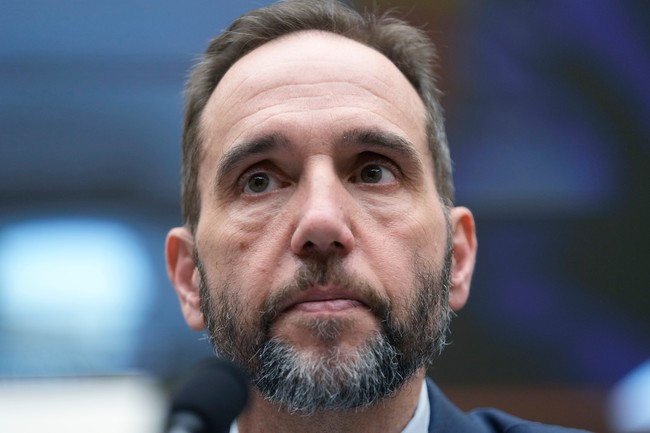
‘Runaway Train’: Chuck Grassley Torches Jack Smith, Accuses Him of Obtaining Texts of Dozens of Lawmakers
Sen. Chuck Grassley and other Republicans are accusing former Special Counsel Jack Smith and his team of sweeping violations while investigating President Trump, alleging they secretly obtained text messages and emails from dozens of members of Congress and bypassed required DOJ safeguards.
The latest accusations paint a picture of investigators who ignored internal protocols and potentially trampled constitutional safeguards in the rush to pursue politically charged cases. Republicans say this is not just incompetence but a systemic effort by parts of the Department of Justice to act as a political weapon. Grassley and Sen. Ron Johnson released a statement outlining what they call evidence that the investigative team obtained text messages from 44 lawmakers without the proper Filter Team review. That finding, if true, raises serious legal and oversight questions about how sensitive materials tied to elected officials were handled.
The charged language from Grassley and Johnson described the probe as a “runaway train.” Their release claims investigators “bypassed a required Filter Team review process, violating investigative protocols and potentially infringing on constitutional guardrails.” For those watching the broader arc of the Trump probes, this is another chapter in a story that already includes disputes over phone records, classified document handling, and aggressive subpoena tactics. Conservatives argue these developments confirm long-standing concerns about politicization inside the DOJ during the prior administration.
Senators and representatives named in the release reacted with anger and alarm, saying an independent judiciary and secure investigative boundaries are essential to preserve separation of powers. Some lawmakers made pointed statements in public and in closed-door sessions, noting that testimony under oath did not match what these records apparently show. The allegation that Jack Smith personally or through his team reviewed lawmakers’ emails and texts is framed by critics as a direct affront to legislative independence and privacy protections deliberately protected by statute and practice.
Sen. Rand Paul highlighted a striking contradiction between Smith’s sworn testimony and the newly surfaced records, emphasizing the gravity of a special counsel telling Congress one thing under oath and another appearing in internal documents. That mismatch, Republicans say, undermines trust in prosecutorial discretion and raises potential obstruction or perjury questions if testimony and actions do not align. For conservative critics this is an indictment not only of an individual prosecutor but of a pattern that showed priority given to political outcomes over process.
https://x.com/ChuckGrassley/status/2077071414230712642?ref_src=twsrc%5Etfw
December 2025: Jack Smith swore under oath that he didn’t spy on text messages belonging to members of Congress.
Today: New evidence confirms he spied on dozens of members of Congress, myself included.
This is a blatant abuse of power, and exactly what our Founders warned about.
Other Republicans, including Sen. Eric Schmitt, have warned that the alleged actions could expose Smith and others to legal jeopardy. The criticism extends beyond a single investigation, touching the broader question of how far executive branch prosecutors may go when political pressure is high. Many GOP lawmakers argue that these actions, combined with other controversial investigative steps revealed over the past year, show an agency willing to stretch and ignore its own rules in politically sensitive matters.
The fallout is not only partisan rhetoric. The release from Grassley and Johnson claims the discovery stems from legally protected whistleblower disclosures and documents provided to the Senate Investigations Subcommittee. Republicans are pressuring for fuller disclosure of what was collected, who reviewed it, and what safeguards were skipped. That push for transparency is meant to pinpoint responsibility and, if warranted, to recommend reforms to prevent recurrence.
Public trust in prosecutors depends on predictable adherence to procedure and scrupulous respect for constitutional limits, especially when investigations involve elected representatives. When those norms appear to be violated, the consequences ripple beyond a single case: institutional credibility suffers, and future enforcement actions are shadowed by suspicion. GOP critics insist accountability here is crucial to restoring confidence that the DOJ will not be used as a partisan cudgel.
The list released by Grassley and Johnson identifies 44 lawmakers allegedly affected by the text-message seizures, a mix of Republicans and a few Democrats, and has been cited repeatedly by conservative commentators as evidence of the breadth of the alleged overreach. The list reads as follows:
1. Senator Chuck Grassley (R-Iowa)
2. Senator Ron Johnson (R-Wis.)
3. Senator John Cornyn (R-Texas)
4. Senator Lindsey Graham (R-S.C.)
5. Senator Josh Hawley (R-Mo.)
6. Senator Mike Lee (R-Utah)
7. Senator Cory Booker (D-N.J.)
8. Senator Cindy Hyde-Smith (R-Miss.)
9. Senator Dan Sullivan (R-Alaska)
10. Senator David Perdue (R-Ga.)
11. Senator Lamar Alexander (R-Tenn.)
12. Senator Martha McSally (R-Ariz.)
13. Senator Rand Paul (R-Ky.)
14. Senator Rick Scott (R-Fla.)
15. Senator Rob Portman (R-Ohio)
16. Senator Roy Blunt (R-Mo.)
17. Senator Susan Collins (R-Maine)
18. Senator Tim Scott (R-S.C.)
19. Senator Tom Cotton (R-Ark.)
20. Senator Cory Gardner (R-Colo.)
21. Rep. Kevin McCarthy (R-Calif.)
22. Rep. Steve Scalise (R-La.)
23. Rep. Jim Jordan (R-Ohio)
24. Rep. Devin Nunes (R-Calif.)
25. Rep. Adam Smith (D-Wash.)
26. Rep. Andy Biggs (R-Ariz.)
27. Rep. Mark Walker (R-N.C.)
28. Rep. Bryan Steil (R-Wis.)
29. Rep. Dan Newhouse (R-Wash.)
30. Rep. Doug Collins (R-Ga.)
31. Rep. Dusty Johnson (R-S.D.)
32. Rep. Elise Stefanik (R-N.Y.)
33. Rep. John Katko (R-N.Y.)
34. Rep. Joshua Gottheimer (D-N.J.)
35. Rep. Karen Bass (D-Calif.)
36. Rep. Ken Buck (R-Colo.)
37. Rep. Lee Zeldin (R-N.Y.)
38. Rep. Mario Diaz-Balart (R-Fla.)
39. Rep. Mo Brooks (R-Ala.)
40. Rep. Morgan Griffith (R-Va.)
41. Rep. Rodney Davis (R-Ill.)
42. Rep. Russ Fulcher (R-Idaho)
43. Rep. Scott Perry (R-Pa.)
44. Rep. Thomas Massie (R-Ky.)
As investigations and oversight hearings continue, Republicans are pressing for clearer answers about the extent of the data collection and the internal decisions that allowed it. The debate now centers on restoring boundaries between law enforcement and political disputes, and on ensuring that future special counsels operate with neutral, verifiable safeguards. For conservative lawmakers and their allies, the goal is twofold: hold any wrongdoers accountable, and change the rules so a repeat becomes far less likely.

Add comment