
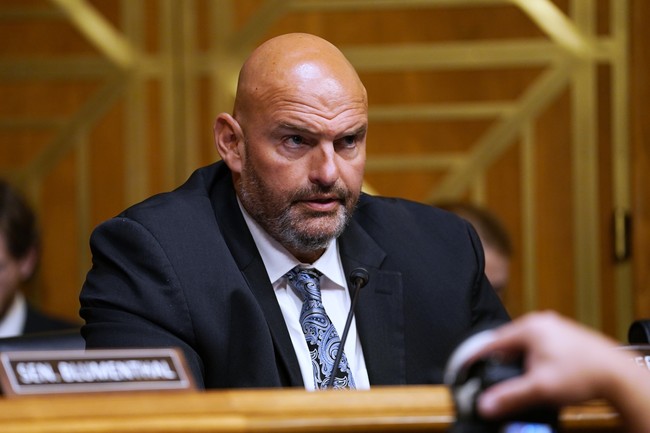
The Democratic Party is visibly fracturing as Senator John Fetterman and Michigan candidate Abdul El-Sayed clash over ideology, campaign tone, and Israel policy, turning an internal dispute into a national story about direction and electability.
This week’s exchange between two Democrats escalated quickly from policy disagreement to personal attacks, and it highlights a broader fight within the party over whether to embrace hard-left activists or stick with more traditional, Rust Belt-friendly messaging. Fetterman has been blunt about the risk he believes El-Sayed poses to winning a crucial Michigan Senate seat, citing El-Sayed’s public alliances and remarks. That critique has prompted sharp pushback from El-Sayed, who returned insult for insult, making the debate as much about temperament as about policy.
Sen. John Fetterman, D-Pa., warned Friday that Democratic Senate nominee Abdul El-Sayed could cost his party a must-hold Michigan Senate seat, escalating a personal feud over El-Sayed’s campaign style, opposition to military aid for Israel and alliance with far-left streamer Hasan Piker.
“He has put, you know, that seat in play,” Fetterman said during an interview with The Washington Post. “And after Bernie Sanders and others created the disaster in Maine, and they pushed garbage person like Platner, and now they’ve pushed an individual like El-Sayed that’s been very proud of his very deeply anti-Israel views and proud to campaign with an avowed communist overall.”
El-Sayed’s response was immediately personal, portraying Fetterman as a relic of a different kind of Midwest liberalism, while Fetterman pointed to real strategic concerns about electability. The back-and-forth is revealing because it underscores a choice Democrats face: double down on ideological purity or pivot to candidates who can win competitive states. From a Republican perspective, this infighting is useful, because it exposes vulnerabilities Democrats might not want voters to see in a general election.
“Fetterman is probably the biggest issue. Fetterman is the sitting counterargument to the kind of Midwest politics that I think really can work,” El-Sayed said. “He’s also just an a——. I try to give him the benefit of the doubt. It’s just he seems miserable, and he seems like he doesn’t like the job.”
Fetterman answered by pointing to El-Sayed’s conduct during the primary.
“He just has like this weird little man syndrome energy just going around insulting people,” Fetterman said. “And, you know, that’s the kind of campaign that he’s run.”
Fetterman’s criticism focuses less on personal flair and more on practical consequences: a Michigan seat that was once reliably winnable for Democrats now looks competitive if the nominee alienates moderate and pro-Israel voters. Republicans see that as confirmation their messaging about Democratic extremism is landing. The concern from Fetterman’s corner is straightforward—nominees who lean into radical views or align with controversial figures risk turning battleground states red.
Beyond electoral math, the clash has real policy overtones, especially on Israel and national security, where Fetterman has publicly affirmed support in ways that put him at odds with vocal anti-Israel elements in his party. That split matters in a general election where foreign policy instincts can influence independent voters and many suburban constituencies. For Republicans, highlighting these differences helps frame the Democrats as divided and out of step with mainstream American sentiment on key issues.
Being blunt, the debate also shines a light on campaign style and discipline. Candidates who trade blows instead of building broad appeal may win primaries but lose general elections, particularly in the Midwest where swing voters prize stability and practicality. Republicans expect to capitalize on any perceived chaos, arguing that a party at war with itself cannot offer steady governance.
If Democrats continue to nominate figures who energize a small base at the expense of broader electability, the party risks handing crucial swing states to Republicans. That is the pragmatic takeaway from this spat: tone and alliances matter, and party leaders are increasingly forced to weigh purity against power. For conservatives watching the race, the best strategy is to stay focused on contrasts that matter to everyday voters—security, jobs, and common-sense governance.
The months before the midterms will tell whether Democratic voters prefer ideological enthusiasm or candidates who can compete statewide. Republicans are gearing up to exploit any openings revealed by this feud, while voters in swing states will decide if the Democratic Party’s direction aligns with their priorities. The Fetterman–El-Sayed exchange is more than a squabble; it is a preview of the choices shaping the 2026 battlegrounds.



Add comment