
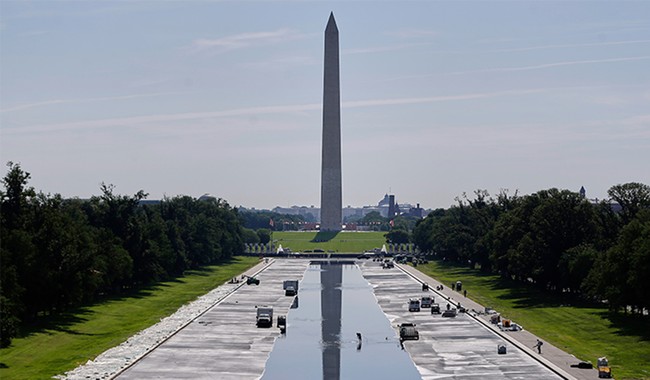
The Reflecting Pool story has turned into a political squabble over algae, a few dead ducks, and who gets credit for fixing a long-running problem; this piece explains the timeline, the technical doubts around the duck deaths, historical context about past repairs, and reactions from media and commentators as the pool appears restored.
Democrats have been loudly criticizing the state of the Lincoln Memorial Reflecting Pool, treating every hiccup as a political opportunity. The fuss centered on an algae bloom and a handful of dead ducks, and opponents seized the moment to attack President Donald Trump for comments praising the pool. That framing ignored the bigger picture about maintenance, leaks, and prior administrations’ work on the site.
It matters that the pool had a history of problems; previous work reportedly cost $34 million and still left leaks and algae returning within weeks. The leaking issue was serious enough to lose 45,000 gallons a day before the recent repairs, and the current attention ignores the fact that those losses and recurring algae predated the current administration. Fixing chronic maintenance issues is not glamorous, but it is necessary infrastructure work that saved water and stopped continual deterioration.
When three dead ducks showed up near the pool, social media and some outlets rushed to blame the hydrogen peroxide treatment used for algae control. Experts familiar with avian management pushed back hard on that theory, arguing the chemical concentration needed to harm birds would be far larger than any treatment applied. That technical reality made the immediate finger-pointing look more like performative outrage than careful reporting.
“I know a few more dead ducks have been found, but hydrogen peroxide remains an extremely unlikely cause,” said Brad Bortner, the former national division chief of migratory bird management at FWS. “They [would] have to pour hundreds or thousands of gallons of industrial-strength hydrogen peroxide into the reflecting pool to reach a concentration that would kill a bird.”
Historical context matters. Under the prior administration, the pool had a mass die-off of 80 ducks linked to a parasite, and recurring algae problems were reported at the time. That reality undercuts the sudden moral panic every time a duck dies or green scum appears. The difference in coverage tends to boil down to who occupies the White House, not to an objective measurement of harm or negligence.
CNN reported on 80 ducks dying in one weekend and recurring algae problems during the Obama administration.
Now one duck dies or algae appears, and it’s suddenly treated like a national emergency.
The difference isn’t the ducks or the algae.
The difference is who’s in the White House.
https://x.com/ginamilan_/status/2069471268798136500
Algae growth is a natural biological process in open, shallow bodies of water, and it will occur even in well-managed pools. Managing it requires regular maintenance, circulation, and occasional treatments, not theatrical accusations. When maintenance is carried out responsibly, those treatments are done at concentrations and volumes that are safe for wildlife and swimmers.
After the latest maintenance work, observers reported the Reflecting Pool looking good again, and that has set off a fresh round of complaints from critics who preferred the crisis narrative. TMZ’s Charlie Cotton posted that “The Reflecting Pool is looking magnificent this morning.” That kind of straightforward observation is now treated like an affront by partisans who want the issue to remain a scandal.
“Credit where credit is due,” he said. Something you’ll never hear from the Democrats.
Photographs and on-the-ground reports showed ducks present and apparently active, which undercuts any claim that the pool had become a toxic death trap. Observers did note an unexplained line or discoloration at one spot in the pool, with speculation ranging from sediment to a cut in the liner, but those are technical issues that can be inspected and fixed. Sensationalizing the unknown does little to help resolve it.
Republicans and fiscal conservatives can point to the practical outcomes: leaks addressed, water loss reduced, and the pool returned to a state where it reflects the monument and the sky rather than headlines. That is the measure most people care about when it comes to public works—does it function and look right for the public that visits it every day?
Left-leaning commentators who piled on for political points downplayed the history of recurring problems and past administration failures, preferring to spotlight the current president. Meanwhile, the technical experts who study migratory birds and water treatments urged caution before drawing causal lines between routine algae control and isolated wildlife deaths. Those experts framed the story as a matter of management rather than political theater.
With the pool reportedly in much better shape, critics will have to decide if they want to litigate maintenance decisions or accept that infrastructure sometimes needs quiet, effective fixes. In the meantime, visitors can see water that reflects the memorial again and ducks that continue to be part of the landscape rather than the centerpiece of a political fight.



Add comment