
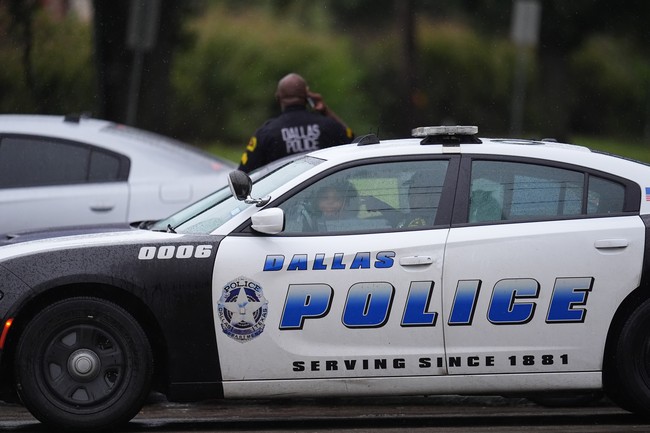
The Dallas Police Department has released body camera footage from a March 11 standoff that ended with the death of Diamon Maziarre Robinson, also known as “Mike King,” a man who worked as a security officer for Congresswoman Jasmine Crockett. The video and newly reported details show how he allegedly impersonated federal agents, ran a fake security business, and contracted real officers for off-duty work before being shot after brandishing a firearm. The situation raises hard questions about vetting, responsibility, and how someone with that profile ended up close to an elected official. This article walks through the timeline, key facts, exact statements made by officials, and the fallout that followed.
The released footage documents a tense, multi-angle standoff between Dallas SWAT and Robinson, who was reportedly wanted on an active warrant for impersonating a federal agent and other fraud-related charges. Police say he ran a sham company called Off Duty Police Services and used forged credentials to secure contracts and hire legitimate officers for off-duty jobs. The SWAT operation ended when Robinson displayed a firearm and was shot and killed on scene.
Court records show Robinson’s legal troubles extend back years, with arrests for theft, a probation violation, and tampering with government records among the entries noted by investigators. Dallas Police have said an active warrant involved theft of checks at a hotel where he once worked security, and that he was wanted for impersonating a police officer. Officers also recovered multiple firearms during their inquiry, one of which matched the handgun Robinson was holding during the confrontation and which was reported stolen.
The suspect in this case has been identified as Diamon Robinson. But Crockett and many local law enforcement officers knew him as Mike King.
Police said he was using a fake name to run a bogus security company. That company, Off Duty Police Services, secured contracts and often hired real Dallas police officers.
But the ruse began to unravel for Robinson in late February after the Irving Police Department released information about a black SUV with a stolen federal government license plate. A Dallas police officer remembered seeing that vehicle while working an off-duty job.
Officials emphasize that the agencies Robinson claimed to represent do not exist, and his identification cards portrayed him as a “Special Dignitary Police” officer — a title with no basis in federal law enforcement. Dallas Police Deputy Chief William Griffith put the point bluntly: the IDs and agencies were fabricated. That kind of deliberate impersonation carries serious public-safety and legal implications beyond simple paperwork fraud.
The case looks less like a one-off mistake and more like an organized scheme to exploit trust in law enforcement. Investigators say Robinson operated with a replica undercover vehicle bearing stolen federal plates and often wore what appeared to be police uniforms while representing himself as a federal agent. Police recovered 11 firearms tied to the investigation, underscoring how dangerous the operation could have been if left unchecked.
According to court records, Robinson had a criminal history that included multiple arrests for theft, a probation violation, and tampering with a government record.
He had an active warrant for theft of checks at a hotel where he worked security in the past. He was also wanted for impersonating a police officer.
Police said he was not any type of federal law enforcement officer.
“So the agencies that he reported to work for do not exist. Special Dignitary Police, that agency does not exist in the federal government. That’s who he portrayed to be, who his IDs that he had put together showed him to be, but those agencies does not exist,” said Dallas Police Deputy Chief William Griffith.
This is a vetting failure, plain and simple. If someone with this level of documented misconduct could secure a role providing security for a member of Congress, the system that allowed it needs immediate scrutiny. The questions here are direct: who approved the vendor, who verified credentials, and why did those checks not catch obvious red flags?
After several days without comment, Congresswoman Crockett issued a statement defending the contracting process and blaming systemic loopholes rather than individual decisions. Her team framed the episode as an exploitation of gaps in vetting and called for stronger protections from the Capitol Police for members facing credible threats. That statement omitted a full explanation of how Robinson was selected and what internal checks were performed.
We are saddened and shocked by some of the concerning revelations. Our team followed all protocols outlined by the House to contract additional security. We were approved to use this vendor who also provided security services for additional entities in the local community and worked closely with law enforcement agencies including Capitol Police.
The fact that an individual was able to somehow circumvent the vetting processes for something as sensitive as security for members of Congress highlights the loopholes and shortcomings in many of our systems. This is incredibly alarming, especially for those members who receive high volumes of credible and sophisticated death threats. This situation reiterates the need for Capitol Police to provide security for members of Congress, especially under this administration’s new normal of inciting attacks on those who dare to speak out. We are fortunate that this is someone who used those loopholes without malice. Furthermore, after an initial review of the limited criminal history of Diamon Maziarre Robinson in Dallas County we’ve been unable to locate any violent offenses.
Republicans and law-and-order advocates will rightly demand accountability, not platitudes. This episode reveals how dangerously thin some vetting processes can be when contractors can impersonate officers, recruit real cops, and traffic in stolen plates and guns. The public deserves answers, and the people who entrusted a member of Congress with their safety deserve better protections and clearer standards going forward.
As a former public defender, I’ve always believed people are more than the worst thing they’ve ever done. I believe in redemption. The man we knew showed up with respect, care, and commitment to protecting others.
We’re still learning the full story, but today we mourn a life lost. This is a tragic ending that we wish had been avoided for all.
The investigation continues, and additional evidence from the bodycam footage will be examined. Meanwhile, lawmakers and constituents should push for real fixes to vetting and contracting rules so that elected officials and the public are not put at unnecessary risk. The answers will determine whether this was an extraordinary breakdown or a warning sign of systemic weakness.
Add comment