
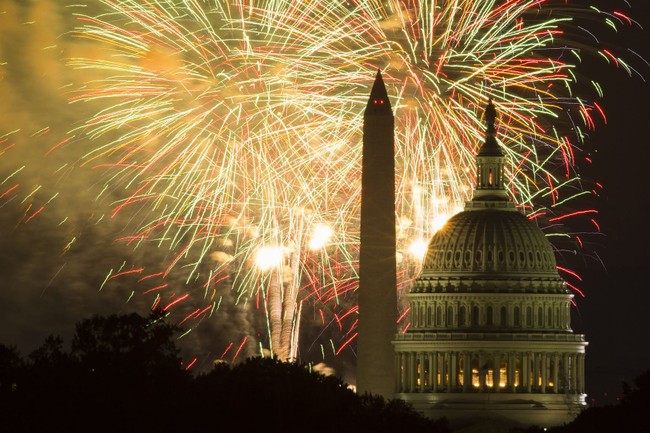
The nation’s 250th birthday kicked off with striking projections on the Washington Monument, a spectacle that mixes history, pride, and a clear reminder of what America has achieved and why conservatives believe its legacy must be defended.
The Washington Monument became the canvas for “The Illumination of America” on New Year’s Eve, showcasing narrated visuals that trace our founding, expansion, industry, and present. Those projections run in the evenings through Jan. 5, giving people a chance to witness a vivid, civic celebration in the heart of the capital. The Freedom 250 organizers called it the “world’s tallest birthday candle.”
Narrated videos that will appear on the monument will focus on discovery, the American Revolution and independence, Western expansion, the Industrial Revolution and the modern times and future for the U.S.
The sequence on the monument is designed to remind viewers how America was built: by brave pioneers, inventive industrialists, and generations who risked everything for self-government. It’s a visual argument for gratitude rather than guilt, and for honoring the institutions that allowed liberty to flourish. For those who missed the fireworks, these projections act as a concentrated, dignified display of national memory and aspiration.
Other events Freedom 250 will hold to remember America’s birthday include a Great American State Fair in June and a parade of ships from more than 30 countries in New York Harbor for the Fourth of July.
Americans deserve public celebrations that spotlight achievement and resilience, not ceremonies that apologize for our history. Too often the cultural conversation tilts toward self-blame, and that perspective treats America as an experiment that has failed to measure up. Conservatives see it differently: we view the country as a remarkable success with flaws to correct, not a project to be erased.
That contrast is striking in current political rhetoric from the Left, which increasingly embraces collectivist language. One city official recently declared, “We will replace the frigidity of rugged individualism with the warmth of collectivism.” Those words are a blunt rejection of the individual liberty and personal responsibility that underpinned American growth. To many conservatives, replacing rugged individualism with collectivism is not just a policy choice; it is a shift in civic identity that risks weakening the freedoms that made prosperity possible.
History shows the consequences when nations abandon individual rights in favor of centralized control, and those outcomes are not mere abstractions. Collectivist experiments in the twentieth century produced suffering on a massive scale, and critics warn that embracing those ideas here would be a dangerous gamble. Defending America’s institutions and culture means affirming the principles that encouraged entrepreneurship, protected property, and sustained civic order.
The monument projections focus on several key chapters: discovery, revolution, westward movement, industrialization, and modern America. Each segment makes a case for continuity — the idea that today’s prosperity stands on the shoulders of those earlier struggles and innovations. Celebrations like these encourage pride in shared achievement without ignoring the hard work left to do.
Conservatives argue that patriotism should be positive and forward-looking, not defined by self-flagellation or cultural surrender. Public displays that celebrate American innovation and sacrifice reinforce a civic narrative that inspires responsibility and service. In a time when civic confidence is under strain, events like the illumination can help restore a sense of common purpose.
The Freedom 250 events planned for the year, from fairs to maritime parades, are intended to be inclusive spectacles that invite participation and reflection. For people who worry about the cultural drift toward collectivism, these celebrations offer a chance to reassert the value of individual effort and national pride. They also provide an opportunity to teach younger generations why institutions like free speech and free enterprise matter.
As the nation marks its 250th year, Conservatives will keep pointing to the achievements that made America a beacon for the world. Public art, historical projection, and civic pageantry are small but potent ways to remind citizens what is worth preserving. The Washington Monument projection is one vivid moment in a year meant to stir gratitude, renew commitment, and strengthen the argument that America’s best days depend on defending liberty and responsibility.



Add comment