
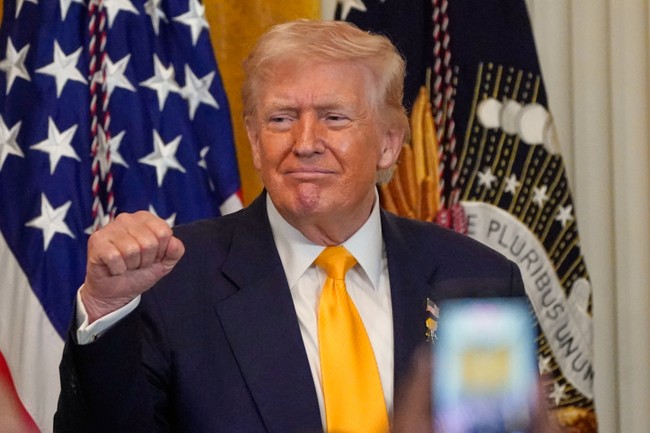
President Donald Trump warned that the U.S. is watching Iran’s nuclear material closely and said he has plans to secure it — a direct, forceful message that puts Tehran on notice and reshapes the negotiating landscape.
Trump’s comments came in a televised interview where he made clear the nuclear materials remain a top priority, and he emphasized surveillance and readiness over empty promises. The tone was blunt and unapologetic, aimed at signaling both patience and a willingness to act if diplomacy fails. This approach changes the calculus for Iranian leaders who have long relied on ambiguity and stalling to advance their programs.
The administration’s stated goal is to prevent Iran from ever obtaining a weapon, and Trump framed that as nonnegotiable. He argued that Iran signs deals and then breaks them, so the U.S. must be prepared to secure the material itself if talks don’t deliver. That hardline posture is meant to reduce risk to American forces while keeping all options visible to adversaries.
“We’ll get that at some point,” Trump, 79, told TV’s “Full Measure with Sharyl Attkisson” in an interview that dropped Sunday. “We have it surveilled. You know, I did a thing called Space Force, and they are watching.
“If somebody walked in, they can tell you his name, his address, the number of his badge,” he said of the technology’s capability. “We have that very well surveilled. If anybody got near the place, we will know about it, and we’ll blow them up.”
Behind the rhetoric is a practical admission: recovering nuclear material directly is hard and risky, so the U.S. prefers to extract compliance through leverage and pressure. Trump’s public signal serves two purposes: it reassures domestic audiences that the threat will be neutralized, and it warns Tehran that delay has consequences. By telegraphing capabilities like Space Force surveillance, the administration tries to force Iran’s hand without shooting first.
Negotiations have centered on limiting material and access, but Tehran’s pattern of deception makes any bargain fragile. Trump explicitly highlighted that pattern, saying Iran “makes a deal, and then they break it,” and portraying the regime as unreliable in both word and deed. That skepticism underpins a strategy focused on intelligence, deterrence, and the credible threat of kinetic action if necessary.
Trump acknowledged the difficulties of negotiating with Iran because “they make a deal, and then they break it.
“They’re militarily defeated. In their own minds, maybe they don’t know that, but I think they do, because I deal with them. And we cannot ever let Iran have a nuclear weapon,” the president said.
Those warnings aren’t idle. American leaders believe that showing strength and readiness can shorten the path to a peaceful resolution, or at least constrain Iran’s options. Trump has used feints and public signals before to pressure adversaries, and this could be another instance of pushing Tehran into a more favorable, enforceable arrangement. The idea is to make any attempt to hide or move material extremely costly.
Iran’s recent provocations at sea and with proxy attacks have already frayed whatever room for maneuver existed, putting them on the back foot. Attempts to test blockades or seize shipments only raise the stakes and invite a stronger response. From Washington’s perspective, repeated miscalculations by Tehran create a narrow window where decisive pressure can produce meaningful outcomes.
Publicly naming surveillance capabilities is risky but calculated: it forces Tehran to assume the worst and perhaps accelerate negotiations under terms the U.S. can verify. The message is simple for adversaries to understand — American intelligence reaches deep, and the use of force is a real option. For allies and partners, the message is equally direct: the U.S. will not let Iran cross the nuclear threshold.
Trump’s posture mixes deterrence with a promise of action that aims to protect American lives while denying Iran pathways to a bomb. It’s a step away from endless diplomacy that ignores bad behavior and toward a stance that ties tangible consequences to Iranian choices. That combination of surveillance, pressure, and readiness is the foundation of the administration’s stated plan to secure nuclear material.



Add comment