
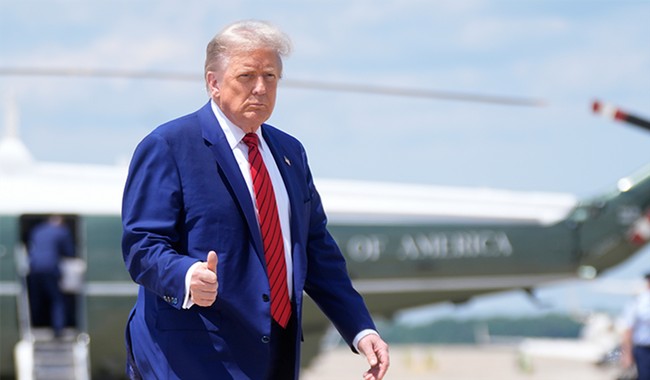
President Donald Trump arrived in Japan on his Asia trip, meeting the new Japanese prime minister, exchanging warm personal moments and significant gifts, and signing a framework on critical minerals alongside multi-billion dollar investment commitments to the United States.
Trump visited Japan after stops in Malaysia where he helped broker a peace agreement and signed trade deals, including arrangements for critical minerals. He also attended the ASEAN Summit and used the trip to press U.S. interests in the region. The Japan stop continued that mix of diplomacy, trade focus, and public engagement.
He met Prime Minister Sanae Takaichi, Japan’s first female prime minister, in a warm first encounter that combined personal rapport with policy commitments. The two leaders signed a framework agreement on critical minerals and announced billions in planned investments for the U.S., signaling a deeper economic tie on resources key to national security. The meeting emphasized both friendship and practical cooperation.
Those early exchanges were friendly and immediately cordial, with Trump complimenting the strength of their handshake and both leaders commenting on light moments. They even shared interest in the U.S. World Series, which became a conversational touchpoint. Japan also offered symbolic gifts to celebrate America’s 250th anniversary.
The compliments started as soon as the two leaders met on Tuesday morning. “That’s a very strong handshake,” Trump said to Takaichi.
She talked about watching the third game of the U.S. World Series before the event, and said Japan would give Washington 250 cherry trees and fireworks for July 4 celebrations to honor America’s 250th anniversary next year.
Takaichi emphasized her ties to the late Japanese Prime Minister Shinzo Abe, her archconservative mentor who had forged a friendship with Trump during his first term through their shared interest of golf.
The personal side of diplomacy showed up again when Takaichi presented Trump with a meaningful memento: former Prime Minister Shinzo Abe’s putter. That gift underscored Abe’s enduring influence and the personal bonds among these leaders. Trump responded by speaking warmly about Abe and lamenting his assassination, while noting Abe’s praise for Takaichi.
Beyond the ceremony, Trump and Takaichi shared a few lighter moments, including watching parts of the World Series together and enjoying the informality of mutual interests. He even invited her aboard the USS George Washington to join him in visiting American service members stationed at Yokosuka. The visit to the base produced audible cheers and an energetic reception.
At the Yokosuka Naval Base, Trump greeted troops and made a lively entrance that played well to the crowd, demonstrating the public side of alliance-building. He also broke into a brief bit of the “Trump dance,” which drew laughs and light applause from those gathered. The interaction blended ceremony with a populist, performative element.
Takaichi clearly engaged with the visit; she actively participated in events and showed visible enthusiasm during public moments, even jumping up and down at one point. She also nominated Trump for the Nobel Prize, an action that highlights the political theater that often accompanies high-profile state visits. The nomination added another symbolic note to an already personal meeting.
Media coverage focused on the friendly tone and symbolic gestures, while the policy side advanced with concrete agreements on critical minerals and investments that matter for industry and defense supply chains. Those deals address supply vulnerabilities and lock in commitments that could benefit U.S. manufacturing and security. The public warmth between the leaders helped frame those agreements positively.
Trump also met with Mrs. Abe during the visit, maintaining a personal connection with the late prime minister’s family that he has kept since Abe’s death. Those private ties supplement the official diplomacy and reflect the longstanding relationships at play. Visits like this blend the private loyalties of leaders with public policy goals.
From Japan, Trump’s itinerary continues to South Korea and then on to China, where a meeting with President Xi Jinping is scheduled later in the trip. The sequence keeps the spotlight on regional security, trade, and resource diplomacy, with each stop building on the last. This Asia tour is shaping up as a focused push to secure partnerships and economic commitments.
The trip mixes ceremonial moments, like the cherry trees and Abe’s putter, with hard-nosed deals on critical minerals and billions in investment pledges. Public appearances, base visits, and personal exchanges all support the broader aim of strengthening ties and advancing American interests abroad. The outcome will be measured by how those agreements translate into tangible supply chain improvements and economic activity back home.
Add comment