
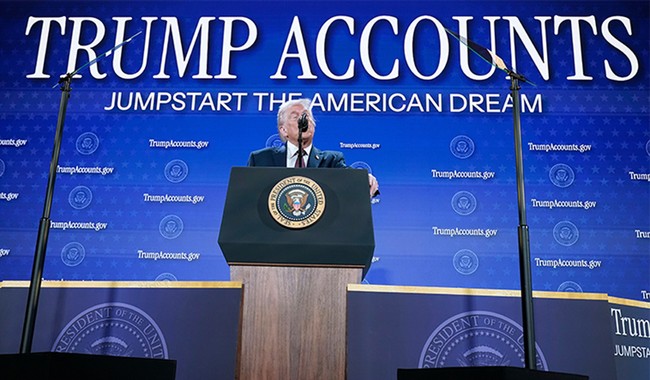
The piece looks at the Super Bowl ads and highlights one in particular—the Trump Accounts commercial—that frames a policy as an investment in children and the American Dream, contrasting it with other halftime controversy ads and personal testimonials while arguing these accounts teach investment and ownership over consumption.
I didn’t watch the whole Super Bowl, but I always scan the commercials afterward to see what stuck. Social media makes it easy to catch the creative spots without sitting through the entire broadcast.
The NFL can try to push narratives, but when dollars speak, messages that resonate still find airtime. The Trump team used this moment to place multiple ads that aimed to counter the halftime spectacle and promote their priorities.
Some of those ads were direct responses to cultural moments, while others were personal endorsements tapping recognizable faces. Robert F. Kennedy Jr.’s coalition ran a simple testimonial from Mike Tyson urging people to “Eat Real Food,” and the administration released a strongly patriotic clip to respond to the halftime show choices.
The savings accounts, which will officially launch on July 4, which just happens to also be the 250th birthday of the United States of America, will operate similarly to individual retirement accounts. Money for the accounts was allotted in the One Big Beautiful Bill Act, which Trump signed into law last summer, establishing the accounts and providing the funding for them. Although they won’t launch until July, parents can begin registering their children now at TrumpAccounts.gov.
[…]
Trump Accounts are available for American children born between January 1, 2025 and December 31, 2028; the children must have a valid Social Security number to be eligible. Once they are registered, the children will then be given a stock market account with a one-time deposit of $1,000 from the U.S. Treasury.
The ad that stood out was the one about Trump Accounts, and not because it dove into policy weeds. It skipped the technicalities and showed, in simple human terms, what giving children a financial stake can mean for their lives and attitudes about ownership.
The commercial frames the program as more than a bank account; it’s a tool to teach ownership, patience, and the value of investing. That messaging matters in a country where the idea of upward mobility is supposed to be open to everyone, not confined to those born into advantage.
WATCH:
There is something distinct about the way the ad centers children and their futures. Instead of selling stuff, it sells a different mindset: think like an owner, not only a consumer. That shift is critical if the goal is to rebuild generational wealth and foster a culture of investment rather than perpetual spending.
These Trump Accounts promise a one-time $1,000 seed in a stock market account for eligible children, and while a thousand dollars alone won’t erase inequality, it creates a practical opening. Money plus guidance can start young people down a path of financial literacy and long-term planning that many Americans never experienced in their families.
The piece argues that planting this investment seed can be especially transformative in communities historically tracked into consumer roles. Teaching investment strategies and ownership helps change expectations about what is possible and who can build wealth across generations.
Private supporters, including well-known entrepreneurs, have backed the concept, which underscores how public policy and private capital can be pitched together to scale impact. That mix fuels the commercial’s optimistic tone: Americans investing in themselves, and in the country’s future.
Beyond the politics, the ad tries to make saving and investing feel patriotic and practical at once, tying the program’s launch to a symbolic date and presenting it as a national commitment. For many viewers, that was the ad’s biggest strength: it reframed policy as promise, and promise as an invitation to own a piece of the nation’s future.
Framing matters. An account that begins on July 4 and is described alongside retirement-style growth and stock market participation is designed to teach a generation to see long-term value. If children learn early to steward assets, they’re more likely to participate as stakeholders in the economy instead of only as consumers.
The commercials around the Super Bowl did a lot more than provoke cultural debate; some of them seeded ideas about how to change behavior and expectations over time. The Trump Accounts ad aimed to do that by appealing to pride, ownership, and the idea that policy can create real, tangible opportunity for the next generation.



Add comment