
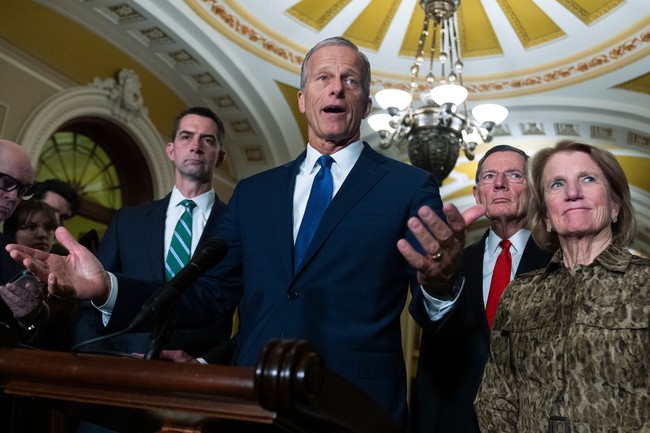
The Senate has finally approved a $70 billion package to fund ICE and CBP for the next three and a half years, ending months of Democratic obstruction and shifting the debate back to Congress and voters.
Democrats spent months blocking funds for Immigration and Customs Enforcement and Customs and Border Patrol, turning funding fights into political theater instead of governance. Their tactics helped create chaos and even contributed to the longest government shutdown in history, proving they prioritize points over public safety. Republicans pushed hard to restore consistent funding so the agencies can do their jobs without being held hostage by partisan games.
The stalemate played out with a series of amendments aimed at reshaping the package and putting vulnerable Republicans in tight reelection spots. Some of those amendments sought to limit operational authority, prevent certain funding uses, or insert unrelated legislation into the bill. Many of those efforts failed because a functioning border strategy requires stable resources and clear policy, not endless bargaining and headline-chasing.
“Democrats would not agree to anything, and eventually they walked away altogether, presumably because they thought that it would serve them better to have an issue for November,” Senate Majority Leader John Thune, R-S.D., said.
Senate Republicans framed the vote as a defense of law enforcement and national sovereignty, insisting that ICE and CBP need predictable funding to protect communities and enforce immigration laws. The package covers operations and personnel for a multi-year stretch, which gives border agencies planning certainty and the ability to respond to surges. That kind of stability matters for law enforcement morale and effectiveness.
On the Senate floor, Democrats kept pushing amendments that would have hamstrung enforcement or tied the hands of agency leaders at critical moments. They also tried to force political theatre by dragging in bills meant to appeal to specific constituencies rather than address security gaps. Republicans argued that those moves were designed to score points for November, not to secure the border.
Many of the amendments pushed by Democrats put Republicans in tough reelection bids, including Sens. Susan Collins, R-Maine, Jon Husted, R-Ohio, and Dan Sullivan, R-Alaska, into politically challenging positions.
That line of attack was predictable: drag vulnerable members into awkward votes and try to fracture the GOP. Still, GOP leadership held together enough support to pass the package, proving that party discipline can produce results when the goal is governing, not grandstanding. The end result is a multi-year commitment to the men and women on the front lines of border enforcement.
Debates also touched on a variety of specific proposals, from prohibiting certain funds to fighting proposals tied to unrelated bills. Lawmakers argued about how best to allocate resources for detention, surveillance, personnel, and technology, with Republicans emphasizing operational needs and Democrats often pushing constraints. Ultimately, the package focused on equipping ICE and CBP to perform core duties rather than accommodating every political demand tossed into the ring.
“It’s not that tense,” Sen. John Kennedy, R-La., said. “I mean, I’ve seen worse. Nobody’s stabbed anybody yet.”
That quip captured the tone in places: raw, combative, but functional. There were sharp exchanges and strategic maneuvers, but the Senate managed to complete the work Republicans insisted was necessary for border security. Passing the bill was a pragmatic move to avoid leaving frontline agencies underfunded while political games played out.
With Senate approval secured, the measure moves to the House where Republican lawmakers are expected to act quickly to finalize the funding. For the foreseeable future, ICE and CBP will have the resources to carry out enforcement, detention operations, and critical border security missions without facing immediate funding cliffhangers. This multi-year funding gives agency leaders room to plan and adjust to challenges like smuggling networks, migrant surges, and cross-border crime.
Republicans framed the passage as a direct rebuttal to endless obstruction, arguing that voters want results and safe communities. The message from the GOP was consistent: defend the agents who enforce the law, prioritize national security, and stop letting partisan brinkmanship put public safety at risk. Lawmakers on the right also stressed accountability and oversight while making clear that funding is essential to carry out the law.
https://x.com/mychaelschnell/status/2062821357671350715?ref_src=twsrc%5Etfw
The vote shows what conservative governance looks like when the focus is on law and order rather than scoring headlines. Providing steady funding for ICE and CBP is a practical step that protects borders, supports officers, and helps enforce immigration laws. That was the core objective of the Republican push throughout the long negotiations and floor fights.
Now that the Senate has acted, attention will shift to implementation and to ensuring funds are used to strengthen operations, not to fund political experiments. Republicans in Congress will need to follow through with oversight, push for efficient use of resources, and keep pressure on an enforcement agenda that puts American citizens and communities first. The debate will continue, but for now the agencies have the backing they need to do their jobs.


Add comment