
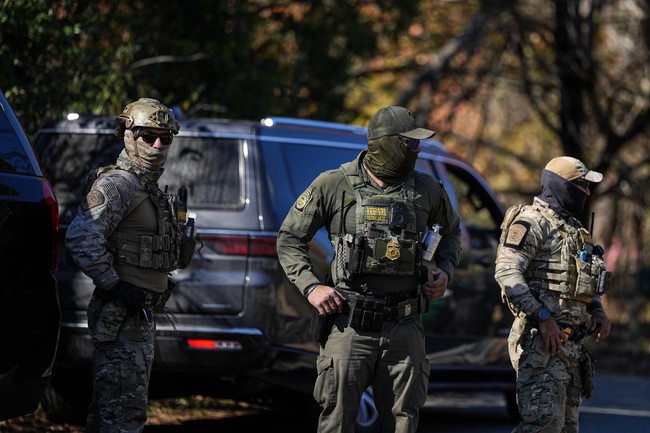
The Department of Homeland Security launched a targeted operation in Charlotte this month aimed at cracking down on criminal illegal immigration, drawing local disruptions and a dramatic confrontation that culminated in the arrest of a U.S. citizen who allegedly used his vehicle against law enforcement. The operation, known publicly as “Charlotte’s Web,” has resulted in a significant number of arrests and a heated public debate about law enforcement presence in urban neighborhoods. Videos and official statements circulated showing agents working in neighborhoods, commercial areas, and construction sites, while residents and businesses reacted with concern and calls for safety. Local officials and DHS representatives framed the sweep as a response to organized criminal activity and human trafficking routes concentrated around major highways.
The operation began in mid-November and quickly became visible in the University City and Central Avenue corridors, areas with heavy residential and commercial development. Businesses in affected neighborhoods temporarily adjusted hours or closed, citing safety concerns for employees and patrons as agents moved through locations with suspected illegal activity. Social media and neighborhood apps filled with messages from residents arranging assistance for neighbors who preferred to stay inside rather than risk encountering enforcement actions. The visible presence of agents sparked both relief among advocates for stronger border enforcement and anger from activists who framed the effort as intrusive.
Federal officials reported a growing tally of arrests as the operation continued, and DHS provided footage and statements describing a dangerous incident near a Home Depot in the University area. According to DHS, a U.S. citizen in a large van drove at law enforcement while they were conducting the operation, fled, and engaged in a high-speed chase through a densely populated area. Agents said the suspect attempted to ram law enforcement vehicles during the pursuit and that a firearm was found after his arrest. One law enforcement officer suffered an injury during the event, which underscored the risks agents face while carrying out these missions.
This afternoon in Charlotte near University City, a United States citizen weaponized his vehicle, driving a large van at law enforcement while they were conducting an operation. He immediately fled the scene, starting a dangerous high-speed chase through a densely populated area. During the chase, he attempted to ram into law enforcement vehicles— posing a serious public safety threat. As agents were boxing him in— the driver proceeded to ram law enforcement vehicles in an attempt to escape. When the driver was arrested, a firearms was found in the vehicle.
One law enforcement officer was injured.
The perpetrator has prior arrests for resisting law enforcement, public disturbance and intoxication/ disruptive conduct.
Shortly after the incident, video footage surfaced showing the suspect being apprehended near UNC-Charlotte, which added a raw, immediate element to an already tense situation. The footage appears to document the end of the chase and the nearby scene where officers took the suspect into custody. Local reports later identified the arrestee by name and indicated felony charges were filed based on an indictment describing reckless driving maneuvers and direct contact with federal officers. The indictment outlined allegations that the suspect attempted to locate and document Border Patrol activity and then escalated into a dangerous confrontation.
The arrest has fed into two opposing narratives: one that emphasizes the necessity of enforcing immigration and public safety laws, and another that criticizes the methods and scope of enforcement in diverse neighborhoods. Supporters of the operation argue it targets criminal networks and human traffickers exploiting transit corridors, while opponents question the disruption to immigrant communities and the potential for civil liberties issues. City life in the affected corridors includes heavy pedestrian and vehicle traffic, dense housing, and numerous small businesses, meaning any enforcement action carries heightened public safety considerations. Officials pointed to those risks in explaining the operation’s focus on zones where criminal networks were believed to be active.
Authorities later named the suspect taken into custody and detailed the charges and alleged behavior. The indictment claims he drove aggressively, swerved through traffic, crossed medians and sidewalks, and collided with a vehicle carrying federal officers. Investigators say he was boxed in and then captured, and that a firearm was found in a bag inside his van. Statements in the indictment also say the suspect communicated an intent to document agent locations and posted images into a private online group before the incident escalated.
The indictment says agents tried to make contact with Martinez to warn him to stop following Border Patrol operations. Martinez then drove away “aggressively and at a high rate of speed,” and avoided officers by “swerving in and out of traffic, crossing medians and sidewalks, as well as driving into oncoming traffic down North Tryon Street.”
Authorities say in the indictment that at one point, Martinez drove the van into a SUV that had four federal officers inside and hit the SUV’s right-front fender.
Martinez was later caught after being boxed in by other vehicles, and he was taken into custody. Officers said they found a firearm in a bag in the vehicle.
Authorities said Martinez told agents “he was attempting to locate Border Patrol to confirm their locations and upload pictures into an invitation-only Instagram group chat.” Martinez said he took photos of Border Patrol officers at a U.S. Post Office on N. Tryon Street and then started following them to the parking lot. Martinez allegedly circled the parked vehicles twice and took pictures. One officer “grabbed the handle of Martinez’s van and attempted to open the door, [and] Martinez accelerated the van away while the Border Patrol Officer pounded on the sprinter van.”
The University area named in the filings is a hub of new construction and ongoing development, which historically draws a sizable workforce from diverse sources. That demographic reality, combined with major highways nearby, makes the area a logical target for operations aimed at dismantling organized criminal activity, according to DHS. Officials also cited concerns about human trafficking and gang activity as part of the rationale for the Charlotte sweep. Those concerns drive federal enforcement priorities and explain why operations of this scale are deployed in inland cities as well as border communities.
Public reaction has been mixed, with some residents relieved that federal agents are addressing violent and organized offenders, and others alarmed by the reach of enforcement into residential neighborhoods. The incident involving the van underscores risks to both officers and civilians when confrontations escalate on busy city streets. DHS officials emphasized the operation was time-limited and focused on criminal aliens who pose threats to public safety. The agency indicated similar operations would continue in other cities as part of broader enforcement efforts.
According to DHS, “Charlotte’s Web” will conclude Friday of this week, with the next operation said to be in New Orleans.



Add comment