
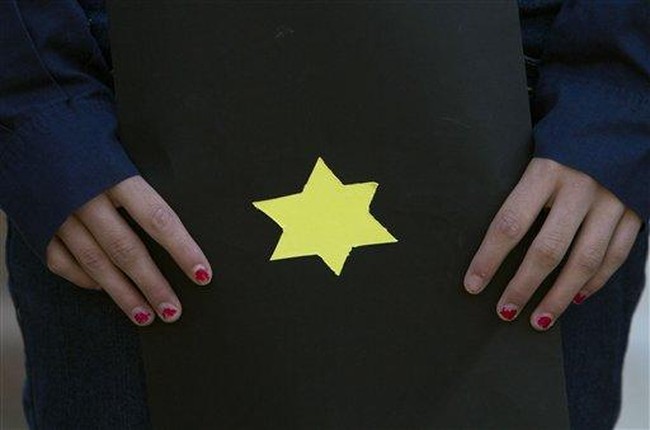
The arrest of a British Jewish lawyer for “antagonizing” pro-Palestinian protesters while wearing a Star of David highlights growing concerns about selective law enforcement, public safety, and free expression at demonstrations. This piece examines the incident, the reactions it provoked, the police explanation, and what it suggests about how protests are policed in Britain and beyond.
The scene was a protest outside the Israeli embassy in London where pro-Palestinian demonstrators had gathered. According to reports, a Jewish lawyer was detained after officers said he repeatedly breached an order to keep opposing groups apart, but many observers see the arrest as emblematic of a deeper problem: the criminalization of visible Jewish identity in tense protest environments.
People on different sides of the debate reacted strongly, and the story quickly became a flashpoint. Critics argue police prioritized placating a hostile crowd over protecting an individual wearing an openly Jewish symbol, suggesting law enforcement may be treating victims differently depending on the ideology of nearby demonstrators.
A contemporaneous account described the arrest and detention in stark terms. The article included the following passage exactly as reported:
Police officers from London’s Metropolitan Police arrested a Jewish lawyer for openly wearing a Star of David necklace, alleging that doing so “antagonized” pro-Palestinian protesters, and that the symbol could “cause offense.”
The lawyer claimed … he was handcuffed and detained for almost 10 hours in an attempt to “criminalize the wearing of a Star of David.”
He was arrested at 7 p.m. on August 29 at a pro-Palestine protest outside the Israeli embassy in London, and claims he was monitoring the event for unlawful behavior by the protesters, and to scrutinize the actions of the police officers at the scene.
That passage struck a nerve because it frames the arrest not as a response to violent behavior but as a preemptive move to avoid upsetting a crowd. Observers noted the paradox: instead of protecting someone singled out by their faith, police actions made that person the subject of enforcement.
Commentators asked bigger questions about priorities and standards. One column posed this pointed query: “Can Britain be saved from itself?” The piece argued the sight of a Star of David was treated as a potential provocation, and instead of shielding the lawyer the police handcuffed him and moved him away from the scene.
The article reproduced this argument in full, preserving the original language:
Can Britain be saved from itself?
[…]
After all, the mere sight of that necklace could cause the mob to become angry, even violent, and instead of protecting the lawyer from possible violence by the mob, the Metropolitan Police arrested him.
This Jewish lawyer, wearing his Star of David on a chain, was apparently deemed so dangerous by the police that they had to arrest him, and put handcuffs on him, before whisking him away in a police van.
But it was not he from whom the police expected violence; it was the pro-Palestinian mob chanting outside the Israeli Embassy. The mere sight of his Star of David could provoke that mob into violence.
Instead of protecting the peaceful lawyer who was doing nothing more than wearing his Star of David, the police chose to arrest him for wearing that symbol of his faith.
Further reporting described the lawyer as filming the protest on his phone to document “incidents of criminal behavior.” The account raised sharp alarms about double standards when chants and slogans that some view as calls for violence go unchallenged while visible Jewish identity is treated as a hazard.
The story quoted that account verbatim to reflect the original framing and language regarding the chants and conduct observed:
The lawyer was peacefully recording on his iPhone what he described as the pro-Hamas protesters’ “incidents of criminal behavior.” Was it vandalism just outside the Embassy, destroying the grounds or graffiti on its walls? Or was it the mob’s cry that “From the river to the sea/Palestine shall be free,” which, properly understood, is a call for Israel to disappear, and to be replaced by a 23rd Arab state? Or was it “Death, death to the IDF” or “globalize the Intifada”? Or Oxford student Sam Williams’ latest contribution: “Gaza Gaza make us proud/Send the Zios under the ground.”
Were these chants not incitement to violence against Israelis and Jews? Apparently, the police had no problem with such behavior, but the lawyer, who shouted nothing, threatened nothing, and simply caught on camera instances of the mob violating the law, was arrested for coming too close to the protesters, while wearing his Star of David necklace, the mere sight of which could provoke the mob to violence.
The Metropolitan Police reportedly defended the arrest as enforcement of a public order separation requirement rather than punishment for wearing religious symbols. Still, critics see that explanation as insufficient given the optics and the lengthy detention described.
This incident fits into a broader pattern flagged by advocates and community leaders who say antisemitic intimidation at demonstrations too often goes unchecked. They emphasize the duty of police to protect the rights of individuals to wear visible religious symbols without fear of arrest or harassment.
The debate now centers on accountability and clear doctrine for managing protests where opposing groups are present. Many insist police must prioritize the safety of those at risk rather than taking steps that make a potential victim into the focus of enforcement, and they call for robust defenses of free expression and equal protection in public spaces.


Churchill must be spinning in his grave because of the blatantly Antisemitic actions taken by British law enforcement. Hard to believe these folks actually had a global empire at one time. Now they are protecting the radical Islamic empire surging in the UK