
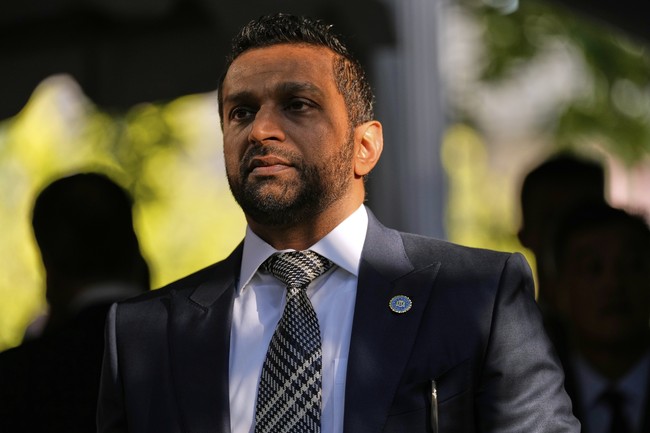
Kash Patel has filed a defamation suit in D.C. federal court against The Atlantic and reporter Sarah Fitzpatrick, accusing them of publishing a malicious, anonymously sourced hit piece that Patel says is false and intended to ruin his reputation; the complaint seeks $250 million and claims the outlet ignored warnings and refused reasonable time to respond. The case spotlights the tension between aggressive national-security reporting and the standards required when a public figure alleges actual malice. Patel’s legal team argues the publication relied on partisan, unnamed sources and ignored facts that contradicted its claims, while The Atlantic says it will defend its reporting. What follows is a clear, plain account of the lawsuit, the key allegations, the outlet’s response, and the legal standard that will decide whether this goes beyond protected speech.
The complaint filed by Kashyap P. Patel accuses The Atlantic Monthly Group LLC and Sarah Fitzpatrick of publishing a sweeping, false article on April 17, 2026, that Patel says was aimed at destroying his public standing and forcing him from office. The filing asserts that Fitzpatrick could not find anyone willing to speak on the record to support the piece, and that the reporting rested entirely on anonymous sources with partisan agendas who were not positioned to know the facts. Patel’s team contends The Atlantic published with actual malice after being told the central allegations were categorically false and after being supplied with contrary public information.
From the 19-page complaint:
Kashyap P. Patel, the Director of the Federal Bureau of Investigation, brings this lawsuit to hold Defendants The Atlantic Monthly Group LLC and its staff writer, Sarah Fitzpatrick, accountable for a sweeping, malicious, and defamatory hit piece published on April 17, 2026. Defendants are of course free to criticize the leadership of the FBI, but they crossed the legal line by publishing an article replete with false and obviously fabricated allegations designed to destroy Director Patel’s reputation and drive him from office. Indeed, Fitzpatrick could not get a single person to go on the record in defense of these outrageous allegations, instead relying entirely on anonymous sources she knew to be both highly partisan with an ax to grind and also not in a position to know the facts. Defendants published the Article with actual malice, despite being expressly warned, hours before publication, that the central allegations were categorically false; despite having abundant publicly available information contradicting those allegations; despite obvious and fatal defects in their own sourcing; despite The Atlantic’s well-documented, long-running editorial animus toward Director Patel; despite a request for additional time to respond that Defendants refused to honor; and despite deliberately structuring the pre-publication process to avoid receiving information that would refute their narrative. Defendants cannot evade responsibility for their malicious lies by hiding behind sham sources.
Patel is seeking $250 million in compensatory, special, and punitive damages, a figure that signals the seriousness with which his lawyers view the alleged harm. The complaint emphasizes that The Atlantic gave the FBI Office of Public Affairs only two hours’ notice before publishing what it called a bombshell, an approach Patel’s team says violates basic journalistic norms and prevented an adequate response. According to the complaint, a pre-publication request for corrections and more time was refused, and litigation followed shortly after the piece ran. The lawsuit was filed in the U.S. District Court for the District of Columbia and was brought by litigator Jesse R. Binnall among others.
The Atlantic, for its part, issued a concise statement defending the reporting and vowing to contest the suit in court. The outlet’s posture is predictable: stand by the journalist and insist the story meets editorial standards, while framing the lawsuit as meritless litigation aimed at chilling the press. From a Republican vantage point, the escalation from investigative piece to high-stakes court fight highlights a broader frustration with media behavior when coverage targets figures tied to the Trump era. Critics argue this is not merely an editorial dispute but a test of whether powerful outlets can be held accountable for reckless reporting against public officials.
Statement from The Atlantic:
“We stand by our reporting on Kash Patel, and we will vigorously defend The Atlantic and our journalists against this meritless lawsuit.”
Commentators and conservative hosts picked up the story immediately, focusing on the speed and style of The Atlantic’s outreach for comment and the anonymous sourcing. One critic called the less-than-two-hour window given to the FBI “completely absurd,” contrasting it with a customary 24-hour rule of thumb that allows subjects to respond and provide documentation. That criticism underscores a central factual dispute: did The Atlantic deliberately limit Patel’s ability to rebut, or was the rush a product of a breaking-news cycle?
“It is completely absurd to give the FBI director less than two hours to respond to the Atlantic’s 10,000-word magazine article,” Pappert said, noting how the typical rule of thumb is giving parties 24 hours to respond to media requests for comment.
Because Patel is a public figure, his case hinges on the standard established in New York Times Co. v. Sullivan, which requires proof of “actual malice” – that false statements were published knowingly or with reckless disregard for the truth.
Leahy argued that the standard may be met in this case.
“I think Kash Patel has a very strong case here for defamation. It requires a false and defamatory statement of fact, not pure opinion, publication to a third party. They have actual malice, which includes reckless disregard for the truth,” he said.
The legal bar for public-figure defamation is high, and Patel will have to prove that The Atlantic either knowingly published falsehoods or showed reckless disregard for the truth. Still, the complaint lays out a paper trail the plaintiffs say shows pre-publication warnings and contradicting public records that the outlet ignored. If the court allows discovery, Fitzpatrick may face depositions and testimony under oath about her sourcing decisions and editorial process.
This lawsuit raises broader questions about accountability in modern journalism and how major outlets handle reporting that relies on unnamed sources. For conservatives and others skeptical of elite media, the case is a chance to press for clearer standards and to challenge what they see as unfair, rushed narratives that harm reputations without solid, on-the-record evidence. The next steps will play out in court, where the dispute over facts, sourcing, and editorial choices will be tested under oath rather than in the court of public opinion.



Add comment