
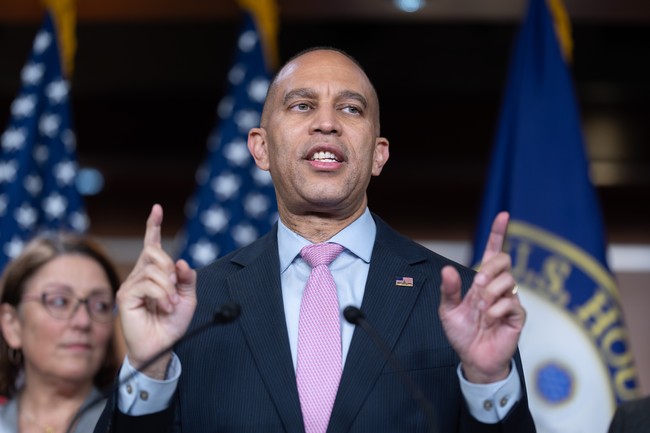
The indictment announced by the Justice Department and FBI accusing the Southern Poverty Law Center of fraud and money laundering has prompted a fierce response from House Democratic Leader Hakeem Jeffries, and that reaction raises questions about priorities, accountability, and the direction partisan leaders will take if they regain power.
The indictment lists 11 counts, including wire fraud, bank fraud, and a money laundering charge tied to allegations that the SPLC solicited donations by claiming to fight extremism while diverting funds to paid informants. Prosecutors say some of that money went to paid “field sources,” including individuals labeled “Fs” who were allegedly embedded in extremist groups. One allegation in the charging document claims significant payments to individuals tied to the 2017 Charlottesville event, a claim that underscores the severity of the accusations.
“F-37 was a member of the online leadership chat group that planned the 2017 ‘Unite the Right’ event in Charlottesville, Virginia, and attended the event at the direction of the SPLC,” the indictment reads. “F-37 made racist postings under the supervision of the SPLC and helped coordinate transportation to the event for several attendees. Between 2015 and 2023, the SPLC secretly paid F-37 more than $270,000.00.”
Instead of addressing those allegations head on, Jeffries declared the indictment “baseless and illegitimate” and framed the action as a partisan attack. His remarks were forceful and framed the investigators as political operatives targeting perceived opponents. That posture matters because a congressional leader’s primary public role includes defending institutions and ensuring law enforcement can operate without threats or intimidation from elected officials.
The so-called indictment against the Southern Poverty Law Center announced by Todd Blanche and Kash Patel is baseless and illegitimate.
These partisan hacks who continue to weaponize the criminal justice system against perceived opponents will never intimidate us.
And all of them will be held accountable for their corrupt behavior no matter what it takes.
Those words from Jeffries do not engage the claims about millions of dollars and alleged secret payments; they attack the motives of prosecutors without challenging the factual assertions. When a grand jury returns an indictment, the process is not theatrical. It requires evidence presented under oath to impartial jurors who decide whether probable cause exists. To call the result a “so-called” indictment before the legal process plays out is to politicize an investigative milestone.
Beyond rhetoric, the substance of the indictment demands scrutiny. If the allegations are true, donors were told their money supported anti-extremist work while funds quietly flowed to informants who posed as members of the groups they were monitoring. That raises questions about donor transparency, nonprofit governance, and how watchdog organizations account for the risks of covert operations. Those are not partisan issues; they affect public trust in institutions that claim moral authority.
Jeffries’ promise to “hold all of them accountable” suggests a tit-for-tat posture that mirrors the very behavior he condemns. If one side weaponizes investigations as political theater, the natural response is retaliation instead of restraint and oversight. A cycle of investigations and counter-investigations serves no one except the lawyers and the media; it distracts from policy and public safety priorities that matter to everyday Americans.
The political stakes are obvious. Republicans view Jeffries’ defense of the SPLC and his attack on law enforcement as emblematic of a broader choice facing voters: whether Congress should pursue governance and public safety or default to perpetual partisan combat. From a Republican perspective, the indictment and the reaction to it reveal an opposition strategy that prioritizes protecting allies and punishing opponents rather than ensuring accountability across the board.
Practical concerns also follow from this dispute. If congressional leaders rush to discredit investigations into serious allegations, they risk eroding the rule of law and undermining public confidence in impartial justice. Conversely, if the case proves overstated or politically motivated, then accountability should extend to prosecutors and investigators who abuse their authority. That is why clear, transparent proceedings matter more than immediate partisan declarations.
At the center of this story are donors, alleged payments totaling significant sums, and the reputational fallout for organizations that claim to fight extremism. Those are issues voters and oversight bodies should examine carefully, regardless of political allegiance, because they touch on trust, governance, and the proper role of advocacy groups in public life.


Add comment