
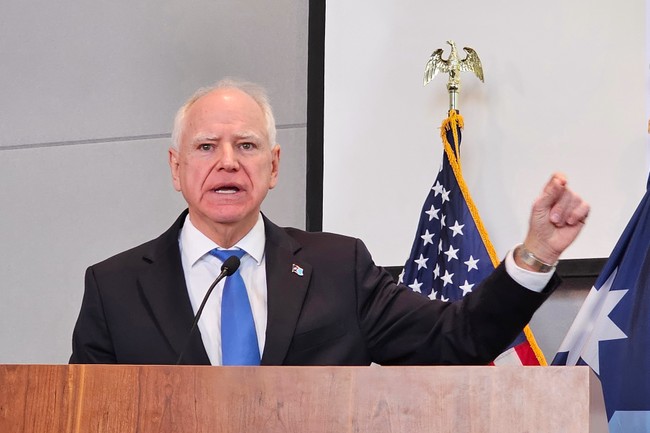
Minnesota Governor Tim Walz, once a national punchline after a vice presidential-style debate setback, now faces a widening fraud scandal in his state and a focused Oversight Committee probe led by House GOP Chair James Comer, who says “The walls are caving in on Tim Walz.”
Tim Walz ran for governor and flirted with national ambitions despite public embarrassments, and Republicans are now making him answer for alleged failures in state oversight. What started as political theater has shifted into serious scrutiny over billions lost to fraud, and Comer is turning up the heat with aggressive investigations. The discussion is no longer about debate clips; it is about accountability for taxpayer money and the political choices that allowed these problems to fester.
The fraud revelations in Minnesota are not small-time. Reports suggest massive losses tied to faulty oversight of social programs, and investigators are tracing how funds meant for citizens ended up siphoned away. From a Republican perspective, this is a clear example of what happens when the state prioritizes electoral calculations over basic governance. Voters want services that work, not excuses, and the fallout threatens the political fortunes of local leaders who enabled the system.
House Oversight Chairman James Comer has framed the inquiry bluntly and publicly, emphasizing the human costs of the scandal. “The walls are caving in on Tim Walz,” Comer said, pressing the point that this is a failure of leadership rather than an isolated administrative lapse. Comer argues the fraud affected everyday Minnesotans because services were cut as money vanished, and he is pushing for answers from state officials who he says ignored warning signs. That plain-spoken line resonates with voters who see waste and want corrective action.
A widening federal investigation into Minnesota’s massive fraud scandal is drawing in whistleblowers, mayors and state lawmakers amid growing scrutiny of state officials, House Oversight Chairman James Comer told Fox News on Tuesday.
“The walls are caving in on Tim Walz,” Comer, R-Ky., said on “America’s Newsroom.”
“This massive amount of fraud is affecting and impacting every citizen of Minnesota because they’re having to cut services because so much of the money for social programs was wasted and defrauded by this Somali population.”
Comer has repeatedly said Walz told the Oversight Committee not to worry, claiming the governor would handle the situation internally. Republicans view that as a deflection, not a solution. Comer responded directly: “No one in America believes that…. We are going to investigate this,” and the committee has expanded its probe accordingly. The tone from Republicans is simple: federal oversight is warranted when state leadership fails to protect taxpayer funds.
Beyond the immediate allegations, Comer has highlighted political dynamics that may have allowed fraud to persist. He has alleged that Democratic leaders in Minnesota were hesitant to act because of the electoral importance of certain communities. According to Comer, those political calculations meant enforcement took a back seat to vote tallies, which, in his view, created an environment where bad actors could exploit programs. That allegation cuts to the heart of debates over whether political considerations should ever override law enforcement and proper stewardship.
According to Comer, those appeals went nowhere because Democratic leaders feared the political consequences of taking action. He said Minnesota’s Somali community plays a central role in the state’s Democratic electoral math. “This Somali population has become a massive part of the Democrat base in Minnesota,” Comer said. “It’s the whole key to the business model of success for the Democrat Party in Minnesota — and on the presidential scale to win the state of Minnesota and get those Electoral College votes.”
For Republicans, the story is also political opportunity. Weakness at the top of a state government opens space for accountability narratives and electoral gains, especially when the losses involve essential services. Comer’s investigation aims to expose missteps, assign responsibility, and ensure reforms that protect taxpayers. That approach appeals to voters who expect transparency and results rather than spin.
Walz’s past national profile, including a widely discussed debate performance, no longer dominates the conversation; instead, attention has shifted to tangible consequences inside Minnesota. GOP leaders are framing the scandal as symptomatic of broader Democratic governance failures, arguing that lax oversight and poor incentives produced predictable waste. That framing is meant to persuade swing voters that a change in priorities — toward fiscal responsibility and stricter program controls — is overdue.
Comer’s public comments and the Oversight Committee’s expanding work make clear this will not be a quiet investigation. Whistleblowers, local officials, and federal investigators are all part of the unfolding picture, and Republicans will continue pressing for answers. The political stakes are real: the fallout could reshape how Minnesotans view their leaders and influence races up and down the ballot.
To the extent this becomes a national story, Republicans expect it to highlight contrasts in governing styles and priorities. Accountability, in their view, is not partisan rhetoric but a necessary response to mismanagement that harms ordinary citizens. That is the argument Republican investigators are taking to the public as they pursue the next steps in the probe.
Comer, what the hell else do you need to see! Lock his evil ass up NOW!!!
I think these damned to hell politicians love to hear themselves talk!!!