
The article reports that ICE is preparing to open eight large detention and processing facilities capable of housing nearly 100,000 people, highlights a recently acquired site in Surprise, Arizona, and argues from a Republican perspective that aggressive enforcement and deportations are necessary to restore border control and protect American citizens.
President Trump ran on stopping illegal immigration, and the administration has moved fast to make that pledge real. The border has been tightened and close to two million people have been removed from the country by one route or another. That progress matters, but the piece argues it is only the start of what must be a broader, sustained effort to secure our borders and enforce immigration law.
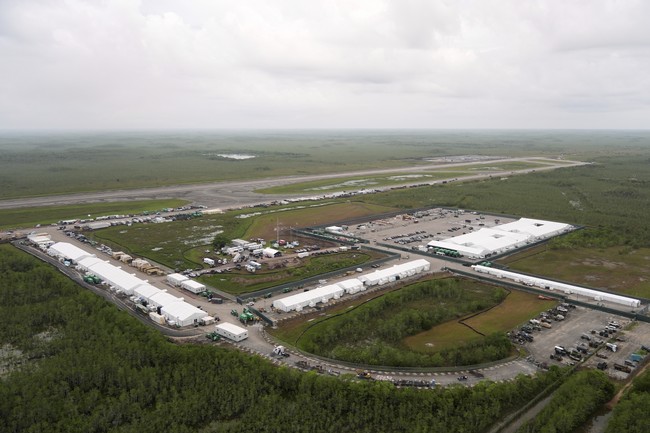
Immigration and Customs Enforcement is reportedly planning a major expansion, aiming to stand up eight massive detention or processing centers with capacity approaching 100,000 beds in total. One example already under way is a regional processing site in Surprise, Arizona, where a warehouse is being converted to house 1,500 detainees. Those figures matter because they show the federal government preparing to scale up operations to match the scale of the problem.
Here is the agency’s statement as reported: “U.S. Immigration and Customs Enforcement said it would add a processing facility with about 1,500 beds in Surprise as part of the agency’s efforts to expand detention space.” The report adds: “The agency, through an unidentified spokesperson, acknowledged the move in a Jan. 30 email.” Those lines were presented verbatim in the original reporting and are retained here exactly as quoted.
Local officials have pushed back. Arizona’s Attorney General expressed objections to the Surprise facility, but this is a federal enforcement mission. The argument in favor of the facilities is straightforward: if you voted for strong border controls, federal agencies need the capacity to detain and process people who entered or remained in the country illegally. State objections do not change the federal responsibility to secure the border and enforce immigration laws.
The reality on the ground, according to the argument put forward, is stark: decades of lax enforcement have allowed mass illegal migration to grow into an enormous problem. The piece claims as many as 20 million people may be in the United States without legal status after years of non-enforcement under Democratic leaders. From this view, the sheer scale requires a rapid, large-scale federal response, not piecemeal local resistance or delays.
Deportations so far have removed nearly two million people, voluntary and involuntary, and while that is framed as a positive step it is described as only a beginning. The administration, the article suggests, has only a limited window — three years in office — to make substantial progress. That political reality drives a sense of urgency: build facilities, move detainees through the process, and return those who lack a legal claim to remain.
The tone is unapologetic about the goals: a nation without enforceable borders is not a functioning nation, and protecting citizens’ liberty and property is the central duty of government. From this perspective, prioritizing removals of dangerous or criminal elements and creating processing capacity are necessary steps to restore order. The language is blunt because the author believes the underlying choice is existential — either enforce the border or accept its collapse.
Practical objections like local political complaints are presented as secondary to national security and the rule of law. The argument insists federal law and policy should guide enforcement, and that voters who backed stricter immigration measures expect results. Converting warehouses into processing hubs is framed as a sensible use of federal authority and resources to tackle a national problem at scale.
The piece invokes a classical allusion to underline the effort required: “It may remind one of the labors of Heracles, but it has to be done.” That comparison is used to stress the difficulty and necessity of the work rather than to romanticize it. The author repeatedly urges speed and decisiveness, arguing enforcement must continue without delay to finish a task the piece considers core to national survival.
Editor’s Note: We voted for mass deportations, not mass amnesty. Help us continue to fight back against those trying to go against the will of the American people.



Add comment