
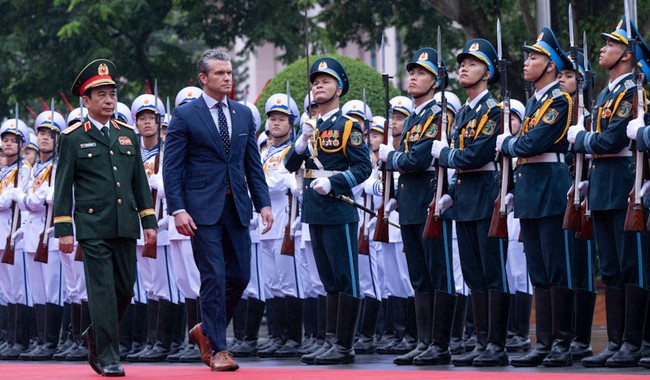
Pete Hegseth’s visit to Hanoi aimed to deepen defense ties, acknowledge the Vietnam War’s legacy, and test whether the United States remains a reliable partner in Southeast Asia as regional tensions rise. The trip came during a sensitive moment: 30 years of diplomatic relations, two years since ties were elevated to a Comprehensive Strategic Partnership, and growing Vietnamese interest in diversifying military suppliers. Hegseth pledged equipment transfers and cooperation, while Hanoi balances Chinese economic pressure, potential Russian arms purchases, and concerns about regional flareups. The outcome remains unclear, but the visit exposed both opportunities and limits in U.S.-Vietnam engagement.
Pete Hegseth arrived in Hanoi after attending the ASEAN Defense Ministers’ Meeting in Kuala Lumpur, using the trip to press for closer defense cooperation. The visit deliberately acknowledged the painful history of the Vietnam War while signaling willingness to work together on current security issues. Hegseth’s public gestures were meant to reassure Vietnam that Washington wants a steady partnership even as U.S. strategy shifts. The optics mattered: official ceremonies, military-to-military conversations, and promises of materiel all sent a clear message.
The talks emphasized defense trade, information sharing, and logistics support, with concrete items mentioned as part of modernization efforts. Hegseth noted the transfer of three patrol boats to the Vietnam Coast Guard and the delivery of three T-6 trainer aircraft out of 12 ordered. Vietnam has also been eyeing medium and heavy lift helicopters and cargo planes to boost its maritime and territorial surveillance. These kinds of transfers are practical first steps that can build trust without committing the United States to permanent basing or large troop presences.
At the same time, Hanoi is actively diversifying its suppliers and hedging its bets, which complicates any long-term U.S. plan. Reports indicate Vietnam is considering as many as 40 Russian Su-35 fighters and Russian air defense systems, while also exploring options from other countries. That search for alternatives reflects a sober national calculus: Vietnam wants to modernize quickly and minimize dependence on any single external patron. Washington’s challenge is to be compelling enough diplomatically and commercially to be chosen over other suppliers.
Discussions were not limited to hardware. Unexploded ordnance cleanup, recovery of U.S. service member remains, and remediation of Agent Orange dioxin were all on the table, and rightly so. These are human-security issues that carry weight in Hanoi and in Washington, and they help show a U.S. willingness to address the war’s lingering harms. Addressing those problems can open political space for deeper cooperation without forcing Hanoi into a public confrontation with Beijing.
Regional instability is another pressing factor that shaped the visit’s urgency. Thailand and Cambodia recently experienced a border conflict that could reignite, and Vietnam might be pulled into wider hostilities depending on how these disputes evolve. China’s massive economic footprint in Vietnam gives Beijing leverage through trade, materials, and investment, and that leverage complicates Hanoi’s freedom of action. China also asserts competing claims in the South China Sea, a flashpoint where diplomatic and military signals matter.
Within Washington, there are questions about whether current strategic thinking aligns with what partners in Asia need to hear. Some officials favor a posture focused on defending the homeland and building influence closer to the Western Hemisphere, while others argue for more active support in the Indo-Pacific. Those policy debates matter to partners like Vietnam, which want clarity on whether the United States will be a dependable supplier and security partner over the years. Mixed signals will push countries to diversify and seek alternative arrangements.
The visit was cordial and contained tangible cooperation promises, but the real test is whether Hanoi will conclude Washington is a reliable long-term partner. Equipment transfers and cleanups help, yet Vietnam’s talks with Russia, Finland, Turkey, Israel, and even North Korea show a pragmatic, nonaligned streak. If the United States wants deeper ties, it will need sustained political will, attractive defense trade offers, and consistent strategic messaging that respects Vietnam’s sovereignty and security concerns. Until then, the jury is still out on how much Hegseth actually accomplished.
The Schumer Shutdown is here. Rather than put the American people first, Chuck Schumer and the radical Democrats forced a government shutdown for healthcare for illegals. They own this. Help us continue to report the truth about the Schumer Shutdown. Use promo code POTUS47 to get 74% off your VIP membership.


Add comment