
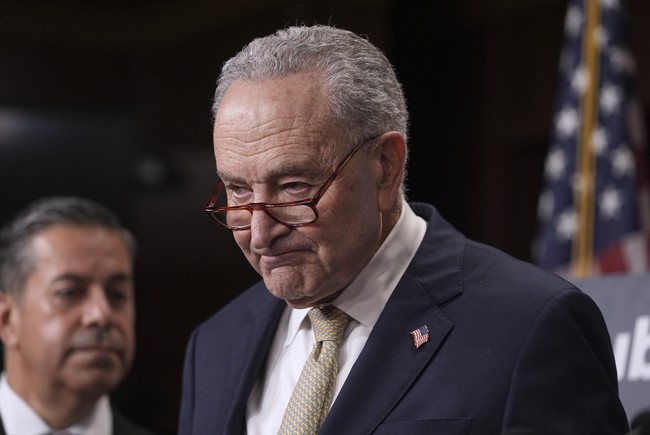
The Schumer Shutdown has put Democrats in a corner, and Republican leaders say the public sees who’s responsible; a clean continuing resolution is on the table, unions and nutrition advocates are pressuring senators, some Democrats are already breaking ranks, and the political blame game is heating up as SNAP and federal pay become immediate, tangible issues.
Democrats pushed the country into a shutdown and now face the consequences in plain sight. They needed 60 votes in the Senate and failed to deliver them, leaving Senator Chuck Schumer and his allies to shoulder responsibility. The optics are bad for the party that promised to govern, and Republican leaders are pointing out the math to keep that message simple and direct.
On the House side, Speaker Mike Johnson has been clear about where accountability lies and has framed the debate as a matter of responsibility versus theatrics. Republicans offered a clean continuing resolution that would reopen the government, and the contrast between pragmatic governance and political posturing has become sharper. When voters see a simple, no-frills bill to reopen services, it undercuts the argument that Republicans are the cause of the disruption.
Pressure is mounting from familiar places that normally lean left, and that makes the situation stickier for Democrats. The American Federation of Government Employees urged a clean CR, and experts warned about food assistance running out. “We’ve heard from unions. We hear more from the nutrition people, they’re worried about running out of nutrition,” said one senator, and that sort of testimony carries weight with constituents who depend on these programs.
SNAP benefits are an immediate, human consequence of political brinkmanship, and Republicans are using that reality to expose Democratic choices. When benefits and essential services are at risk, it becomes hard for leaders to hide behind ideology. The debate is no longer abstract budget talk; it involves grocery bills, school lunches, and families juggling expenses, and voters notice whose decisions put those needs at risk.
Business groups have joined the chorus calling for an end to the shutdown, warning that the economy could lose momentum if it drags on. Retail leaders and trade organizations urged lawmakers to support reopening the government to avoid harming commerce and the broader recovery. That kind of economic warning helps change the narrative from partisan fight to practical harm, and it amplifies the Republican argument that governance means preventing avoidable economic damage.
Even within Democratic ranks some cracks are already visible, and that will only increase the pressure on their leaders. A handful of senators voted to pay federal employees and the military, signaling discomfort with total party-line resistance. When incumbents start to break, it shifts leverage and forces leaders to make politically delicate exits that still satisfy their progressive base.
Republicans argue the right path is straightforward: pass a clean continuing resolution, keep the government open, and fund essential programs so Americans aren’t hurt by partisan fights. That stance is framed not as capitulation but as choosing functioning government over theatrical obstruction. It’s a message aimed squarely at voters who want results and at Democrats who must weigh base appeasement against tangible harm to constituents.
The fallout includes contentious rhetorical moves from both sides, but the numbers matter most in this fight. A shutdown driven by a failure to secure 60 votes in the Senate puts the onus on the party that controls that chamber’s procedural levers. Politically, that’s a vulnerability Republicans will exploit as they highlight how legislative rules and choices led to this moment.
Unions, nutrition advocates, and business coalitions are all making the same basic demand: reopen government and prevent harm. Their combined voices create cross-pressures that Democratic senators can’t ignore if they hope to keep re-election prospects intact. That convergence of labor and commerce is a potent signal that the shutdown’s effects are broad and indiscriminate.
Republican messaging underscores competence and immediacy, framing the clean CR as a simple fix that Democrats rejected for political theater. The strategy aims to keep attention on concrete consequences for everyday Americans instead of allowing the debate to drift into abstract partisan talking points. In the weeks ahead, who blinks first will shape not only policy outcomes but political narratives going into future campaigns.
Editor’s Note: The Schumer Shutdown is here. Rather than put the American people first, Chuck Schumer and the radical Democrats forced a government shutdown for healthcare for illegals. They own this.


Add comment