
I will explain how the White House rebutted a media report about Kash Patel, show the response from Press Secretary Karoline Leavitt, include the viral photo and social posts she used, outline the earlier related media claims about a cabinet shake-up, and place the original embeds near their prior locations.
The media cycle churned out another story claiming turmoil inside the Trump White House, this time suggesting FBI Director Kash Patel was on his way out. The outlet framed the angle as growing frustration from President Trump and his aides, a narrative the administration immediately rejected. The press secretary called the reporting out as false and used a simple, smiling photo to make the point. That picture, the administration noted, came straight from the Oval Office during a meeting with the president and his law enforcement team.
MS NOW — the outlet formerly known as MSNBC — published the piece that set this off, asserting that “President Trump is considering removing Kash Patel as FBI director in the coming months, as he and his top aides have grown increasingly frustrated by the unflattering headlines Patel has recently generated.” That line became the centerpiece of conservative rebuttals, who argued the story relied on anonymous sourcing and rumor. The White House responded quickly and publicly, refusing to leave the claim unchallenged. Officials insisted the article misrepresented what’s happening inside the administration.
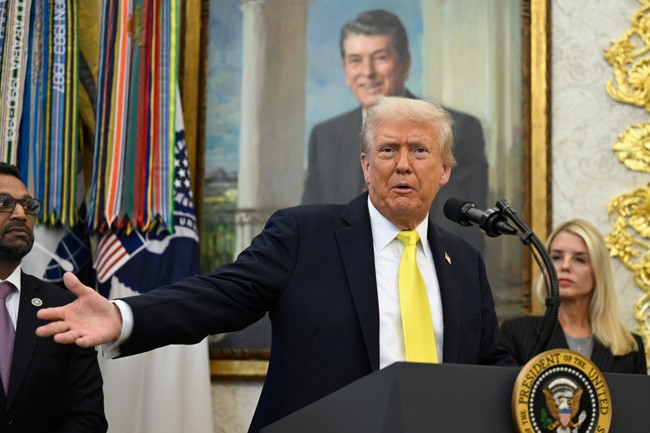
Karoline Leavitt fired back with a post that included a photo meant to be direct evidence against the report. “This story is completely made up,” Leavitt wrote. “In fact, when this Fake News published, I was in the Oval Office, where President Trump was meeting with his law enforcement team, including FBI Director Kash Patel.” She emphasized the timing, noting she was present when the article appeared, which undercut the outlet’s timeline. The image she shared shows both men smiling and giving thumbs up, a simple visual contradiction to claims of imminent removal.
Leavitt added a colorful bit of context about the president’s reaction to the headline, writing, “I read the headline to the President, and he laughed. He said: ‘What? That’s totally false. Come on, Kash, let’s take a picture to show them you’re doing a great job!'” That quote captures the administration’s strategy: treat sensational media claims as opportunities to display unity. The post closed with the blunt exhortation: “Do not believe the Fake News!” That phrase has become a common refrain when the White House wants to dismiss coverage it sees as politically motivated.
The photo itself was precisely the kind of image the White House wanted out there — two figures in the Oval Office smiling broadly, thumbs up, a tableau meant to neutralize whisper campaigns. The optics are straightforward and hard to spin into a narrative of internal collapse. Supporters pointed to the image as proof the story was manufactured, while critics claimed a single photo doesn’t resolve deeper policy or personnel disagreements. Even so, in the immediate battle over headlines, the picture performed the job the press secretary intended.
The “fake news” flap came on the heels of another contested report about a potential cabinet shake-up as President Trump nears the one-year mark of his second term. That earlier story suggested turnover could be coming at multiple agencies, with the Department of Homeland Security mentioned among the possibilities. The White House again pushed back forcefully, calling the reporting baseless and accusing outlets of chasing drama to boost ratings. The pattern is familiar: outlets publish sourced claims about personnel moves, and the administration counters with denials and visual demonstrations of continuity.
Leavitt addressed a specific correspondent’s post that read, “NEW: The White House is preparing for possible turnover in the Cabinet after President Trump reaches the one-year mark of his term. At least one of the agencies that could see change is the Department of Homeland Security.” The administration’s reply was categorical: “This story is 100% Fake News, and the White House repeatedly told this to CNN in the strongest possible terms.” The press secretary framed the narrative as a ratings-driven fabrication, arguing outlets manufacture crises to capture attention. Her message was unapologetic and aimed squarely at undermining the credibility of that coverage.
She continued, “The truth is: President Trump could not be happier with his Cabinet,” she added. “Shame on you, CNN.” Those lines mirror the broader Republican skepticism of legacy media reporting and underscore a political strategy that treats hostile coverage as another front in the culture war. For the administration, pushing back quickly and publicly is now standard operating procedure whenever a damaging story starts to circulate.
That immediacy matters because moments like this test how news spreads and how audiences decide what to believe. A single viral image, posted by the press secretary from inside the Oval Office, became the administration’s quickest and most digestible rebuttal. Whether that suffices to settle disputed reporting is another question, but it does show how visuals and direct statements can shape the immediate narrative. In Washington, optics and rapid response often determine whether a story sticks or fizzles out.

Add comment