
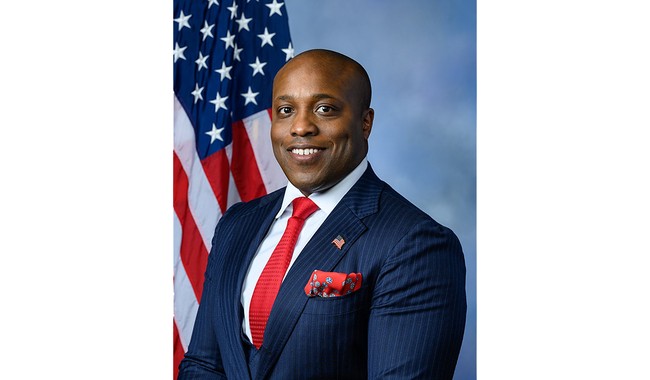
Republican Rep. Wesley Hunt forcefully rebutted Democrat Rep. Jasmine Crockett’s claim that voter ID laws amount to a “poll tax,” using personal examples and plain language to argue voter ID protects election integrity without discriminating against anyone.
Wesley Hunt, a West Point graduate and former Army officer turned congressman, has developed a reputation for sharp, confident media performances. He speaks directly and frames arguments in terms voters understand, which is exactly what he did when confronted with Crockett’s “poll tax” comparison. That exchange has been circulating because it cuts through partisan nonsense and returns the debate to practical reality.
The clip shows Hunt calmly dismantling the poll tax allegation by pointing to the simple fact that identification is ubiquitous in American life. He underscored that his own extended family, like millions of others, possesses the documentation needed to vote, and he highlighted how readily available those documents are from birth. That line of argument reframes the issue away from abstract historical claims and toward how modern systems actually operate.
Here, :
Hunt’s body language and measured tone matter as much as his words; he comes across as confident, unflappable, and unusually prepared for the kind of theater that often unfolds on camera. He didn’t stoop to name-calling or theatrics; instead he relied on everyday examples and common sense. Voters respond to that approach because it addresses their real concerns about fairness and integrity without political posturing.
Question: Jasmine Crockett said that voter ID was like a poll tax. What are your thoughts on that?
Rep. Wesley Hunt: Voter ID is like a poll tax? Let me tell you something. I have a very big family, and my family is all black, and every single member of my family has what? A form of an ID that can allow you to vote in an election. I have a three-year-old little boy. I have a five-year-old daughter and a seven-year-old daughter. You want to know what the first thing they were given when they were born? A birth certificate and a Social Security number. So if you think this is a poll tax, again, it’s the dog-whistling back to this Jim Crow 2.0 argument that I have already proven is null and void; it doesn’t exist today. “It’s time to move on. The days of the poll tax and the days of Jim Crow are over.
The quote lands because it is personal and relatable, not because it’s performative. Hunt connects voter ID to birth certificates and Social Security numbers to show how ordinary and accessible identity documents are. That practical framing is meant to defang the charged rhetoric Democrats lean on when they try to paint routine safeguards as discriminatory. By using his own family as an example, he makes the abstract concrete.
On substance, the argument in favor of voter ID is straightforward: ensuring that people who cast ballots are who they claim to be is a common-sense step to protect elections. Republicans see this not as suppressing voters but as strengthening confidence that outcomes are legitimate and that every legal vote counts. Hunt’s response speaks to voters who want rules that are fair and verifiable without unnecessary barriers.
Democrats continue to deploy historical analogies to Jim Crow that assume modern ID requirements are purposefully exclusionary. Hunt rejects that narrative directly, calling it a return to “Jim Crow 2.0” alarmism that doesn’t reflect how access to identification works today. He shifts the conversation back to evidence and lived experience instead of relying on fear-based messaging.
Polling data repeatedly shows broad public support for basic voter identification. Many Americans, across party lines, agree that some verification at the polls is reasonable to maintain trust in results. That public sentiment is what Republicans point to when arguing that voter ID is a mainstream policy rather than a fringed partisan demand.
The larger political effect matters: Democrats’ insistence on framing ID laws as modern poll taxes risks alienating moderate voters who see safeguards as sensible. Republicans argue that painting every security measure as racist or discriminatory cheapens real historical injustices and undermines constructive debate. Hunt’s exchange is an example of Republicans pushing back on that tactic with clear language and personal testimony.
Messaging in 2026 will hinge on straightforward presentations of policy impacts and practical examples, not on hyperbolic historical parallels that sound out of touch. Wesley Hunt’s rebuttal performs that duty well, pivoting from accusation to everyday realities that voters can evaluate for themselves. The back-and-forth between these two members of Congress captures how polarized rhetoric meets grounded rebuttal on the national stage.
Crockett can’t even speak or write English properly and has a hard time reading how did this DEI ever become a government official. She’s a corrupt ghetto hood swamp creature who made herself rich on taxpayers money with her private dealings. Funny how all democrats became multimillionaires in 4 years of the Biden democrats administration. How do all these democrats became millionaires on government salaries. The all should have forensic financial investigations into all their finances and assets. Corruption at its finest being a democrat.