
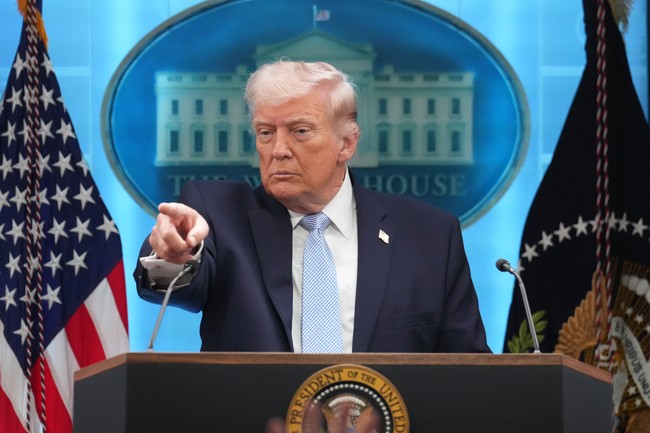
President Trump blasted CNN for running what he called a fraudulent report that attributed a triumphant statement to Iran, and he says federal authorities are now probing whether a crime was committed in the publication of that claim. The dispute centers on conflicting Iranian statements about a ceasefire and a 10-point plan, and on whether a low-credibility outlet was the original source of the version CNN carried. Trump made his accusation public on social media, called for a retraction and apology, and suggested the network may have amplified propaganda without proper verification. The episode has widened the gap between the White House and mainstream outlets while raising questions about media standards in wartime reporting.
Trump publicly accused CNN of amplifying a fake version of an Iranian statement and demanded the network retract it with apologies, framing the matter as potentially criminal. He said the item “was linked to a Fake News site (from Nigeria) and, of course, immediately picked up by CNN, and blared out as a ‘legitimate’ headline.” In the president’s view, this wasn’t a simple reporting error but a serious lapse that could have real-world consequences if it misled policymakers or the public. His message was blunt and unapologetic, insisting authorities review the chain of publication.
His post included this exact language: “The alleged Statement put out by CNN World News is a FRAUD, as CNN well knows.” He followed that up with another direct line: “Authorities are looking to determine whether or not a crime was committed on the issuance of the Fake CNN World Statement, or was it a sick rogue player?” That sort of rhetoric is consistent with an administration that treats media failures as not only ideological but potentially unlawful. The president said the network was being “ordered to immediately withdraw this Statement with full apologies for their, as usual, terrible ‘reporting.'”
CNN’s live coverage had posted an update attributing to Iran’s Supreme National Security Council a claim that Tehran had forced the United States to accept a 10-point plan and achieved a decisive outcome. The council text made strong, wartime assertions: “The enemy, in its unfair, unlawful, and criminal war against the Iranian nation, has suffered an undeniable, historic, and crushing defeat.” It also warned, “Our hands remain on the trigger, and at the slightest mistake by the enemy, a full-force response will be delivered.” Those passages read like classic wartime propaganda, designed to rally a domestic audience and deter rivals abroad.
Even if Tehran issued more than one statement, the core complaint here is journalistic: did CNN verify the document before treating it as authoritative? Critics on the right argue the network should have flagged the language as unconfirmed or traced the original source rather than amplifying a headline. From the conservative perspective, the media routinely acts with bias and sloppiness when it suits a narrative, and this episode fits that pattern. Running potentially propagandistic language without clear sourcing risks inflaming tensions and confusing Americans about the true state of diplomacy.
The broader context involves a reported two-week ceasefire, an agreement to open the Strait of Hormuz temporarily, and plans for further talks in Islamabad, according to other official communications attributed to Iran. Those diplomatic moves matter more than competing press accounts, yet the confusion over which statement is genuine threatens to obscure practical outcomes. If the White House and its allies are negotiating under different assumptions than those reported on cable news, the danger is operational as well as political. Conservatives emphasizing national security want clarity, not theatrics from media outlets.
Alongside the dispute over published statements, the administration is pursuing a separate matter: the leak of a sensitive rescue operation related to a downed F-15 and a missing American crew member. Officials say that disclosure endangered lives and complicated a rescue effort, and the president vowed to find whoever leaked the information. From a Republican viewpoint, leaks that tip off adversaries are not merely unethical; they can be criminal and must be stopped to preserve the safety of servicemembers and the integrity of missions. The combination of sloppy reporting and damaging leaks feeds a narrative that media recklessness is a national security issue.
Social media amplified the controversy quickly, with opposition lawmakers and some commentators treating Tehran’s statement as proof of a diplomatic shift, while others pointed to the potential for staged messaging from the regime. The result is a chaotic information environment where truth is contested on multiple fronts: the original Iranian communications, the outlets that carry them, and the platforms that spread them. That chaos benefits bad actors who want to manipulate perceptions, and it punishes officials trying to manage real-world crises. For conservatives watching, the takeaway is simple: the press should be held accountable when its reporting could have life-or-death implications.
READ MORE:
Questions now center on whether CNN will retract the contested update and how investigators will trace the document’s origin. The administration is pressing for answers, describing the probe into publication and leaks as urgent and necessary to protect national interests. Meanwhile, the debate over media responsibility and national security promises to keep this story alive in political and press circles alike. The stakes are high whenever the press reports on wartime claims without full verification.
Whatever the outcome of the investigatory steps the president referenced, this episode underlines the fragile relationship between government, press, and public in moments of international crisis. Conservatives argue that bias and carelessness in reporting can have tangible consequences, and they see this incident as another example. The call now is for rigorous sourcing, transparent corrections when errors occur, and accountability that matches the seriousness of the situation. Only reliable information will keep the public informed and leaders able to act decisively when it matters most.



Add comment