
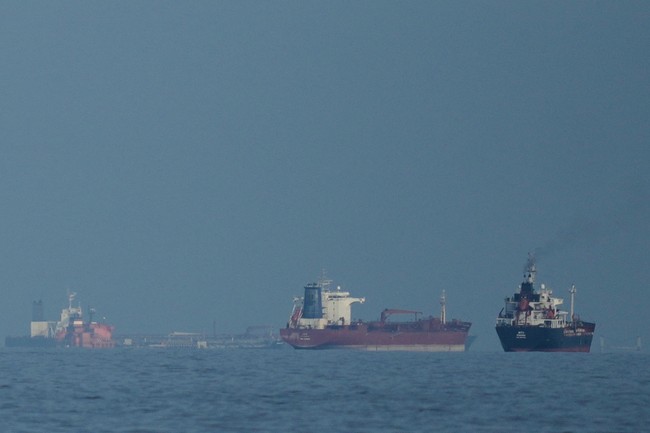
Reports say an anchored vessel near Fujairah was seized and is now heading toward Iranian waters, with UKMTO and ship-tracking data cited and some outlets suggesting the ship might be a floating armory storing weapons for private maritime security. Attribution is unclear, the seized vessel’s identity is uncertain, and U.S. officials had not commented at the time of reporting, while the incident adds to a string of confrontations in the Strait of Hormuz that threaten commercial shipping and regional stability.
Tensions around the Strait of Hormuz have been rising again, and this latest seizure highlights how fragile maritime security remains. According to the United Kingdom Maritime Trade Operations centre, an anchored ship was “taken by unauthorised personnel whilst at anchor” 38 nautical miles northeast of Fujairah and is “now bound for Iranian territorial waters.” The ambiguity about who did the taking is itself a problem—shameless aggression in the region needs a clear and firm response.
A ship off the UAE coast near the Strait of Hormuz has been taken by unknown people and is now headed towards Iranian waters, a UK maritime agency said on Thursday.
The vessel was “taken by unauthorised personnel whilst at anchor” 38 nautical miles or 70 kilometres northeast of Fujairah, and “is now bound for Iranian territorial waters”, according to the United Kingdom Maritime Trade Operations (UKMTO) centre.
The UKMTO did not identify the vessel or who was behind its capture and said it was investigating. It also advised ships in the area to report any suspicious activity.
Other reports suggest the ship may be the Honduras-flagged Hui Chuan, and risk-management sources say its operators described it as a floating armory. If correct, that shifts the stakes: a floating armory implies a cache of weapons intended for hire by commercial escorts and security firms operating in piracy-prone waters. Those weapons could be deadly if they fall into the hands of a hostile state or proxy.
British authorities did not release information on who the ship belonged to or who seized it. Despite the lack of official corroboration, the BBC reported that the Honduras-flagged Hui Chuan was seized in the Strait on Thursday.
Citing the risk-management company Vanguard, the BBC reported that the ship’s operators told Vanguard that the Hui Chuan was operating as a “floating armory” for ships in the Strait to defend themselves from pirates.
Ship-tracking services showed the vessel’s last broadcast was northeast of Fujairah, and BBC Verify noted operators told Vanguard about the floating armoury role but stressed that they could not confirm what was onboard or who used it. The uncertainty means intelligence and maritime patrols have to work harder to determine facts on the water. Waiting for full confirmation is prudent, but policymakers and operators must plan for worst-case scenarios now.
BBC Verify has checked ship-tracking data from MarineTraffic which shows the vessel – identified by Vanguard as the Honduras-flagged Hui Chuan – last broadcast its location 70km (40 miles) north-east of Fujairah in the UAE on Wednesday.
Hui Chuan’s operators told Vanguard it was operating as a floating armoury which stores weapons for security firms who protect ships at sea from attack by pirates.
BBC Verify cannot confirm what was on the ship or who it was used by.
From a security standpoint, a seized vessel loaded with weapons is an unacceptable escalation. Even relatively unsophisticated arms like heavy machine guns and rocket-propelled grenades can cripple unarmored commercial vessels and threaten nearby aircraft. Congress and the administration should be clear-eyed: when Iranian proxies or state-linked forces disrupt global shipping lanes, the costs should rise, and American interests must be defended decisively.
The seizure follows recent incidents where Iran boarded and detained ships transiting the Strait, and it comes with the broader backdrop of Iranian harassment across the region. That pattern shows a mix of opportunism and intent to coerce international shipping and regional allies. It is a test of resolve for the United States and its partners to protect freedom of navigation.
At the time of the reports, there was no official comment from the U.S. administration, and President Trump was abroad engaging in talks with foreign leaders. Still, silence or delay from Washington cannot be an invitation to further coercion. Republican principles favor a robust posture when American commerce and regional stability are threatened.
Commercial operators in the Gulf need updated guidance and enhanced defensive measures while navies and intelligence services race to confirm the vessel’s identity and cargo. Private security at sea has filled a safety gap, but the presence of floating armories in contested waters creates a new vulnerability that adversaries can exploit. The situation demands rapid fact-finding and coordinated deterrence.
Until investigators and maritime authorities publish definitive findings, much will be left to speculation. What is not speculative is the risk: a seized ship bound for Iranian waters with possible arms aboard complicates an already dangerous maritime environment. Policymakers should act promptly to close gaps in surveillance, inform commercial operators, and make clear that attacks on shipping will have consequences.



Add comment