
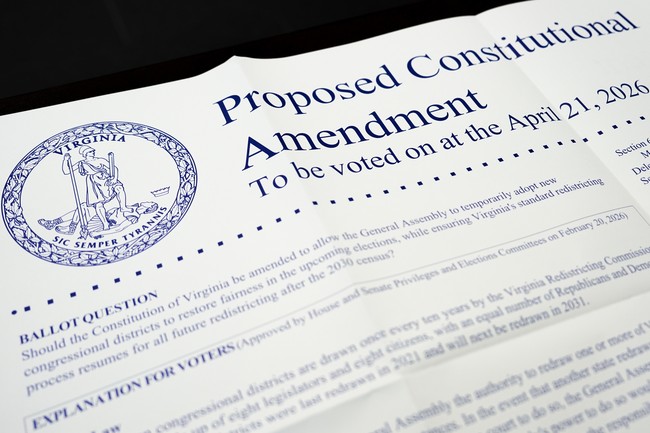
The Supreme Court’s late Friday move to deny an emergency request from Virginia Democrats leaves the state using its old congressional map for upcoming elections, upending Democratic hopes of gaining up to four seats and underscoring a messy clash between state courts, election timetables, and political strategy.
The timing could not be worse for Virginia Democrats and national party leaders who counted on a newly drawn map to shift the balance in 2026. The Virginia Supreme Court declared the referendum and the map “null and void” because the process used to get it on the ballot violated state constitutional rules. That 4-to-3 decision from the state court forced Democrats into an emergency appeal to the U.S. Supreme Court, which was refused on Friday.
The emergency filing argued the Virginia court was “deeply mistaken” and said the decision “overrode the will of the people” by ordering elections under districts voters had rejected. Democrats framed the move as a federal rights issue with national consequences, while critics pointed out that procedure and rule of law matter. From a Republican perspective, this outcome affirms the importance of following proper processes rather than trying to force results through politics.
The U.S. Supreme Court refused Friday to allow Virginia to use a new congressional map that favored Democrats in all but one of the state’s U.S. House seats.
[…]
The new map was drawn by Democrats and approved by Virginia voters in an April referendum. But on May 8, the Supreme Court of Virginia [SCOVA] in a 4-to-3 vote declared the referendum, and by extension the new map, null and void because lawmakers failed to follow the proper procedures to get the issue on the ballot, violating the state constitution.
[…]
In their emergency application, they argued the Virginia Supreme Court was “deeply mistaken” in its decision on “critical issues of federal law with profound practical importance to the Nation.” Further, they asserted the decision “overrode the will of the people” by ordering Virginia to “conduct its election with the congressional districts that the people rejected.”
With the U.S. Supreme Court declining to intervene, Virginia officials faced a hard deadline. Governor Abigail Spanberger said election officials must proceed under the existing congressional plan because early voting and administrative preparations can’t be paused. Organizers and election administrators were warned that making last-minute changes would jeopardize the August primary and fall ballot logistics.
Election bosses had previously said they needed to start implementing changes by mid-May to use any new lines in time for the primary, a timetable that put the cart before the horse when paired with the legal uncertainty. That procedural reality made it practical and sensible to stick with the current map, even as Democrats argued for reversal. The choice reflects the reality that elections run on calendars, and the law can’t be bent to fit political wishes without jeopardizing administration.
Social posts reacted with a mix of schadenfreude and bemusement, noting how the legal maneuvering backfired and how the wrong court may have been asked for relief. Some on X quipped that maybe Virginia addressing the wrong court in their petition might have played a role:
The political fallout will be real. Democrats had hoped the new map would tip several congressional districts in their favor and reshape midterm expectations for 2026. Republicans, meanwhile, see this as a relief and an opportunity to defend seats that might otherwise have been in play under the partisan redraw.
Governor Spanberger said the SCOTUS efforts were “important, but when it comes to the execution of elections, no matter the outcome in that case, we will be running our elections beginning next month with early voting on the current maps that we have.” That practical stance matched what election officials had warned about timing and preparation. Virginia’s Department of Elections also explained in filings that changes would need to begin by May 12 to be ready for the August primary, emphasizing the tight window for any map switch .
Even as Spanberger pledged optimism that Democrats could still flip seats under the old map, Republican officials and observers pushed back, pointing to the effort as further evidence that Democrats prefer results over rules. The tone in conservative circles ranged from dry satisfaction to sharp criticism of the original referendum’s procedural shortcuts. Former Virginia Attorney General Jason Miyares weighed in with a succinct reaction that captured the moment’s political punch:
‘Nuff said.
The larger lesson is straightforward: when political actors try to sidestep established procedures, the courts will often step in, and the timeline for elections tends to favor stability over last-minute partisan gambits. The refusal by the U.S. Supreme Court to grant emergency relief closes a chapter in Virginia politics and sets the battleground for how both parties plan their 2026 strategies.


Add comment