
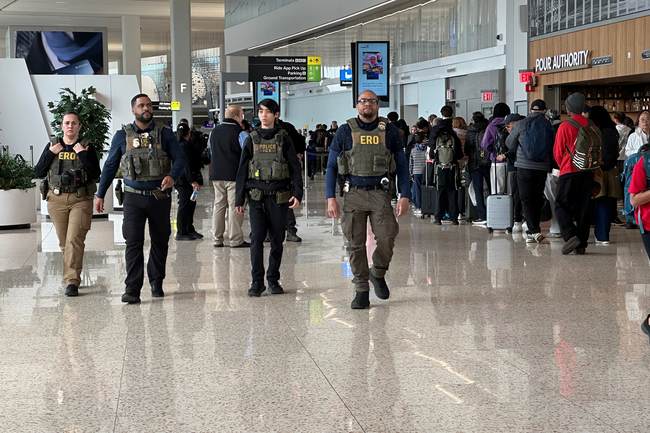
The Supreme Court’s 6-3 decision in Mullin v. Al Otro Lado gives the federal government a clear legal win: migrants standing on Mexican soil are not deemed to have “arrived in the United States” for asylum purposes, clearing the way for border officials to turn people back before they set foot on U.S. soil and reinforcing the executive’s authority to manage ports of entry.
This ruling, authored by Justice Alito and joined by Chief Justice Roberts and Justices Thomas, Gorsuch, Kavanaugh, and Barrett, rejects a broad reading of the Immigration and Nationality Act that would have stretched asylum obligations beyond U.S. territory. The majority held that the phrase “arrive in” carries its ordinary meaning and does not include people stopped short of entry. The decision curtails court-ordered limits on how the government handles asylum seekers at busy land ports and undercuts the lower court’s effort to force inspections for people who remain outside the country’s borders.
The case hinged on two short words in the statute that matter a great deal in practice: “physically present in” and “arrive in.” Advocates representing a class of asylum seekers argued that approaching a port of entry and facing a U.S. officer should count as arrival even if the person never crosses the line. The Ninth Circuit accepted that view, creating a legal mandate that the Supreme Court has now overturned.
https://x.com/townhallcom/status/2070150383268163686?ref_src=twsrc%5Etfw
Justice Alito used a simple, hard-nosed example to make the majority’s point at oral argument, asking whether someone is “arrived in” a house when the homeowner locks the door before they step inside. The opinion rejected the respondents’ expansive reading and emphasized ordinary language, which is critical in statutory interpretation. That textual approach keeps policy choices with Congress and the executive rather than letting courts read extra-territorial obligations into the law.
The majority took care to avoid giving the statute an extraterritorial reach that Congress never authorized, warning that recognizing asylum rights for people still in Mexico would stretch the law beyond its intended limits. Metering, the practice at issue, began as an operational response at crowded ports of entry where Customs and Border Protection had to manage flows of migrants. Under metering, officers turned asylum seekers away and told them to return later, sometimes forcing wait periods measured in days or weeks for those seeking lawful processing.
A lower district court had declared parts of metering unlawful, leading to an administrative change in policy in late 2021, but the government pressed the issue to the high court to restore its ability to control entry points. The administration told the justices that metering is an “important tool” it intended to rely on to manage porous borders and protect ports of entry. The Supreme Court’s decision hands the executive branch broader discretion to decide how and where asylum processing occurs.
Justice Thomas filed a separate concurrence raising concerns about classwide relief and the separation of powers, noting that 8 U.S.C. § 1252(f)(1) can limit the courts’ ability to issue sweeping injunctions affecting immigration enforcement. He warned that any statute that might compel a president to admit aliens over his objection triggers serious constitutional questions about executive authority. That emphasis on executive prerogative aligns with a conservative view favoring clear control over border policy and national sovereignty.
Justice Sotomayor dissented, joined by Justices Kagan and Jackson, arguing the majority’s reading renders “arrives in” redundant and collapses it into the “physically present” clause, which she said violates basic rules of statutory construction. Her dissent charged the Court with allowing the executive to “circumvent all these mandatory procedures by having U.S. immigration officers stand at the border and physically block noncitizens from setting a foot onto U.S. soil.” That is a stark disagreement over where responsibility for asylum processing should sit.
In ordinary speech, no one would say that a person ‘arrives in’ a place — for example, a house, a city, or a country — before the person enters that place. A running back does not arrive in the end zone when he is tackled at the 1-yard line by the defense.
Justice Jackson also wrote separately, questioning whether the case was even properly before the Court once the policy was rescinded, and arguing that the dispute might be moot. The majority, however, chose to decide the legal question, producing a ruling that has immediate policy consequences in multiple states. California, New York, and others that brought port-of-entry challenges will now face litigation under a framework that empowers the federal government to refuse inspection to people who remain outside U.S. territory.
The Court today holds that the Executive Branch may circumvent all these mandatory procedures by having U.S. immigration officers stand at the border and physically block noncitizens from setting a foot onto U.S. soil.
Practical effects will matter quickly: the government’s inspector general previously documented that metering prompted some migrants to attempt illegal crossings rather than wait at ports, highlighting trade-offs between orderly processing and enforcement. With this ruling, the administration regains a legal tool to manage arrivals and protect border infrastructure, while opponents warn it could reduce access to asylum processing at ports of entry. For Republicans and others focused on secure borders, the decision restores a crucial lever to control entry and uphold the rule of law.

Add comment