
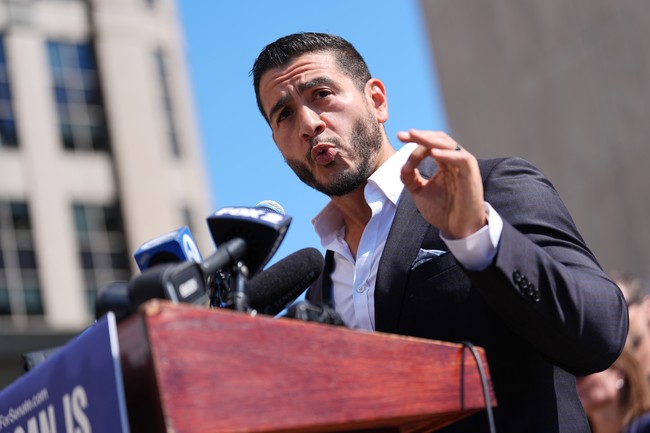
President Trump posted a pair of photos with a short caption, and the internet blew up. One photo showed him with First Lady Melania Trump and the other showed Michigan Senate nominee Abdul El‑Sayed with his wife, Sarah Jukaku. The post sparked a debate about culture, immigration, and what kind of America voters prefer. The back-and-forth turned quickly into a personal jab at the Trumps’ marriage and a broader argument about national identity.
Trump’s simple caption read, “Two VERY DIFFERENT America’s.” That compact line did what he often does: frame a national debate with a single image and a few words. He didn’t spell out every implication, so observers filled in the blanks with questions about religion, assimilation, and political ideology. The result was a spotlight on two competing visions of America rather than just a celebrity snapshot.
El‑Sayed responded on CNN’s “State of the Union,” and he didn’t sidestep the provocation. “Actually, Sarah and I like each other,” El‑Sayed told Jake Tapper. “I don’t know about the first lady and the president, but, from what I have heard, it’s a bit of a rocky road.” His choice to attack the Trumps’ marriage instead of addressing the bigger picture showed a familiar pattern: punchy personal lines over detailed policy answers. That reflex plays well for headlines but not for persuading undecided voters.
What matters politically is the framing. Trump’s post forced a simple choice into the public conversation: which direction should the country head? One portrait represented a patriotic, assimilation-focused concept of America where citizenship and national identity are central. The other picture came to stand for a leftward, DSA-friendly vision emphasizing radical reforms and a looser approach to borders and institutions.
https://x.com/TrumpDailyPosts/status/2086283829803962449
El‑Sayed’s politics are unmistakable and he makes no apology for them. “Yeah, he’s right — you’ve got two different visions of America — one in which your overlords are two people who don’t like each other but joint in the interest of making billions of dollars off of you,” he said. He then offered his own contrast: “two people who genuinely love each other, enjoyed some pancakes together, want to come together to build the kind of America where they can raise a family.” That rhetoric trades on emotion and contrasts, but it glosses over concrete consequences of his proposals.
Conservative observers point out that El‑Sayed’s platform borrows heavily from socialist talking points on healthcare, taxes, and immigration. Those positions promise sweeping institutional change with uncertain results, and they often come with tradeoffs voters are told to ignore. Painting policy choices as moral dramas or personality contests lets radical proposals dodge closer scrutiny.
Meanwhile, stories about the Trumps’ private life have long been a favorite angle for the left-leaning press. Endless analyses about body language, affection, and the so-called “Fake Melania” conspiracy have circulated for years without producing hard evidence. That fixation on personal drama distracts from the real debate about immigration policy, economic priorities, and national identity that the picture pair actually raises.
There’s also a double standard at work when opponents treat the president’s social-media strategy as illegitimate but praise similar tactics from the left. Political theater has always been part of campaigns; using imagery and captions to define the battleground is simply effective messaging. Conservatives argue that when the stakes are national sovereignty and cultural cohesion, framing the fight clearly matters more than avoiding sharp edges.
Both sides benefit from the viral moment in the short term: it draws attention and energizes supporters. But voters who care about results want clarity on policy. They want to know whether border enforcement will be robust, whether illegal crossings will decline, and whether assimilation and citizenship will be emphasized over open-door rhetoric. Those are practical questions that determine the daily experience of American communities.
What Trump accomplished with his post was to make that practical question unavoidable. People who might otherwise drift past campaign tweets had to pick sides: do they prefer tighter borders and a citizenship-centered approach, or a radical remaking of institutions led by the socialist wing of the Democratic Party? That choice is exactly the one that will matter on Election Day, not the celebrity gossip wrapped around it.
In the end, the spectacle of personal attacks and viral photos is less important than the direction set by policies. The image exchange was effective because it forced that policy choice into a single, shareable moment. Voters now have to decide which vision of America they want to defend, and whose leadership will actually deliver it.


Listen to that lying political ideology snake El‑Sayed rant about what he thinks the American working class need when all he is, is a Communist atheist fraud actually Islamist infiltrator enemy within!
Here is what American Citizens better wake up to fast!
This I stated elsewhere on this site.
{McKinney Approves Islamic Center Expansion, Residents Protest}
Quoting: “some attendees voicing support for the expansion.” What the hell is wrong with you people are you suddenly brain dead zombies or willfully stupid morons in that Texas locale? You don’t get it that the Islamist’s are here and are slowly but surely taking over areas of this country to “infiltrate, seduce and conquer America;” being the snake Islam is and straight from Satan a false religion political ideology to conquer all that are not of Islam, then convert and or kill!
I quote: ‘An Iranian Christian who described himself as having survived Sharia law in his home country told the council, “I’m a Sharia law survivor from Iran, an I’m here to tell you, this is a dangerous ideology you’re allowing in their country!”
There you are, one who was a part of that evil world living within that demon infested cult world (country) and *one who knows absolutely for sure what they are and what’s happening!* Listen to him and read all you can that Raymond Ibrahim the expert on all of this evil has written; start to read “Sword and Scimitar” wherein he clearly explains the demonic false religion Islam, he is a top knowledgeable expert from the Middle East!
You folks in Texas better wake the hell up FAST before you all get your heads handed to you on a platter!
The following is a serious piece of information that appeared on Christmas Day between an Islamist who attacked a Christian celebrating Jesus Christ on that very day and this all came out!
Your own words Mr. Islamist; “live the way you want and not dictate as you are just a human and not a messenger of GOD, like Jesus and Muhammad were.” Muslim hoax” I am wondering how you equate a “hoax” with facts of an Islamic Empire!”
Wonder NO MORE, Pay attention and learn of your blaspheming error! You have a huge inaccuracy that needs to be corrected! Saying that Jesus is another prophet like Muhammad is blasphemous. First Jesus was not a mere prophet but was God Himself and therefore the Redeemer and Savior of Mankind as he said.
Muhammad was only a supposed prophet and there is irrefutable evidence in the historical text of the time he lived that points to his being an outright liar and heretic as well as a criminal and child molester along with his being a polygamist!
The following statements are highly accurate and actually proven. “In 632, only months before he died, Muhammad apparently met for the first time with a Christian community as such. An official delegation of Christians, probably led by a bishop, came to Mecca from Najran in Yemen. After engaging the Christians in discussion, the Prophet is said to have realized that Christian teachings are indeed incompatible with Islam, after which the revelation followed that only Islam is acceptable to God as a religion. The Quran also says very specifically that those who refer to Jesus as God are blasphemers, and that Christians saying that Christ is the son of God is an imitation of Jews, who earlier had said that Ezra is the son of God. According to the Quran Jesus was only a servant; Jesus the son of Mary was no more than an apostle of God. Quranic verses dealing with Jesus’ death have been interpreted differently by commentators, but generally they have been taken to mean that Jesus did not die by crucifixion. For Christians the Quran has thus served as a denial of Jesus’ incarnation and death on the cross and of the reality of the Trinity.” (Oxford University Press)
These two points alone put Islam and the Muslims completely at odds with Jesus Christ and all Christians and are the enemies of such!
Muhammad himself began this conflict and was the spoiler and Heretic directly attacking God’s plan as foretold by all the previous prophets going all the way back to Abraham. Things have been in conflict because of Muhammad ever since and are getting worse, this will not resolve until Islam is Chastised or obliterated as a fake religion started by a false prophet and therefore heretic!
In Summary Muslims are in complete denial of what Jesus Christ said and who He was which makes them “Anti-Christ” and “supportive of the Devil and all that is unholy.”
Basically Muhammad started this Blasphemy back in 632 AD and outright declared War on Christendom! Islam you yourself Mr. Islamist, stated “is an EMPIRE” which puts it in the category of being a Nation not a Religion! It is not a religion that is backed up with solid historical evidence and prophecy over time by many prophets other than what Muhammad said, he made it all up, the heretic! Islam seeks to conquer and must be stopped!
Amen.
At least Melania doesn’t have to compete with a goat!