
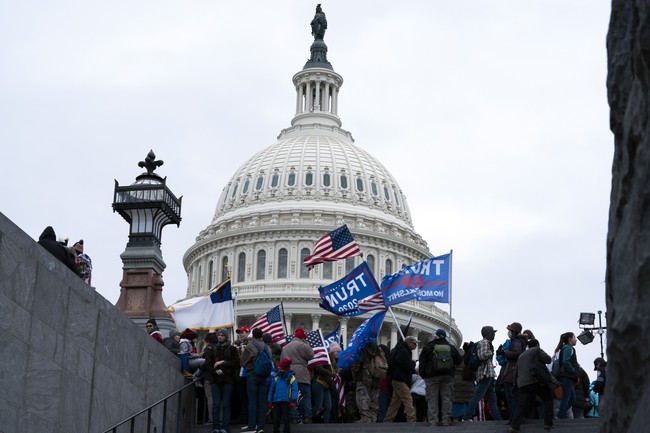
The judge who handled the final Oath Keepers case issued a forceful rebuke of the Justice Department’s decision to drop the indictment, arguing the move undercuts accountability for January 6 while admitting the court lacked authority to block the dismissal. The opinion criticized the government’s justifications as thin and inconsistent, called certain arguments “a head-scratcher,” and warned that erasing convictions weakens the historical record of what happened at the Capitol. Even so, the judge said precedent requires deference to the Executive Branch on charging decisions, so the case was dismissed despite the judge’s strong objections.
An Obama-appointed federal judge used the final Oath Keepers dismissal to deliver an unusually blunt critique of how the Department of Justice resolved that prosecution. He walked through the DOJ’s explanations for dropping the case and found them lacking, questioning whether the dismissal served the public interest. The judge clearly viewed the action as more than a routine legal step and treated it as an event with political and historical consequences.
The Justice Department moved to dismiss after the D.C. Circuit vacated convictions and sent the case back, and some defendants had already received clemency or commutations. The judge noted that the President could have pardoned these individuals but chose different routes for different defendants, and that the government did not explain what had materially changed. That inconsistency undergirded much of the court’s skepticism about the prosecution’s rationale.
In his written opinion the judge questioned nearly every justification the DOJ offered for wiping the convictions clean, describing at least one of their core arguments as “a head-scratcher.” He highlighted that the government did not claim the convictions were legally defective, that evidence was insufficient, or that prosecutorial misconduct had tainted the proceedings. Without such claims, the judge said, the dismissal looked less like correction of error and more like an act of grace.
“The government thus asks to absolve these Defendants of crimes against the United States itself,” the judge wrote. “In this court’s view, that is not in the public interest.” These lines underscore the view that a criminal verdict, once secured, carries importance beyond the individual defendants. The judge emphasized how convictions serve the public by documenting wrongdoing and holding individuals accountable under the law.
The opinion pushed back on the DOJ suggestion that dismissal was necessary to shield defendants from future prosecutorial harassment. The judge called that a strange argument given there was no sign prosecutors planned to recharge the defendants, and he warned the government was “bestow[ing] upon them unearned grace by wiping their records clean.” In short, the court saw the dismissal as an unnecessary erasure rather than a protection of rights.
The judge also observed the government had not argued that dismissal was needed to correct a fundamental error or grave injustice. “Remarkably,” he wrote, “the government does not maintain that dismissal is in the public interest to rectify a fundamental error or a grave injustice.” That absence mattered because, without it, the court struggled to understand the reason for abandoning a hard-won conviction that had been scrutinized on appeal.
https://x.com/scotus_wire/status/2084752202996863049
Despite the strongly worded critique, the judge recognized the limits of his own power and the precedents that govern separation of powers and prosecutorial discretion. “This court does strongly disagree,” he wrote, “But that alone is not a valid basis to deny the motion. The court must give way to the primacy of the Executive Branch in making charging decisions.” That admission illustrates the tension between judicial conscience and legal restraint.
Before signing off on the dismissal, the judge lamented the broader implications for how history will remember January 6. “This is the last of the prosecutions seeking to hold accountable those responsible for the events of January 6. That book is now closed,” he wrote. He warned that the government’s decision “denigrates the work of the prosecutors and law enforcement officers who secured these convictions” and diminishes the serious consequences of actions that challenged a foundational democratic practice.
“Today’s epilogue diminishes the gravity of that day, denigrates the work of the prosecutors and law enforcement officers who secured these convictions, and excuses criminal acts that caused a centuries-long pillar of our democracy—the peaceful transfer of presidential power—to buckle. The court cannot write a different ending.” Those sentences make plain the judge’s sense that the dismissal alters the moral and legal record, even if the court could not prevent it.
The ruling leaves open broader questions about how the Executive Branch will use its charging power in politically charged matters and how courts should respond when they disagree but lack the authority to intervene. It also raises concern among those who believe accountability for violent or disruptive acts at the Capitol should be preserved in the public record. The immediate legal effect is a dismissal, but the political and historical fallout will be debated for years to come.

Add comment