
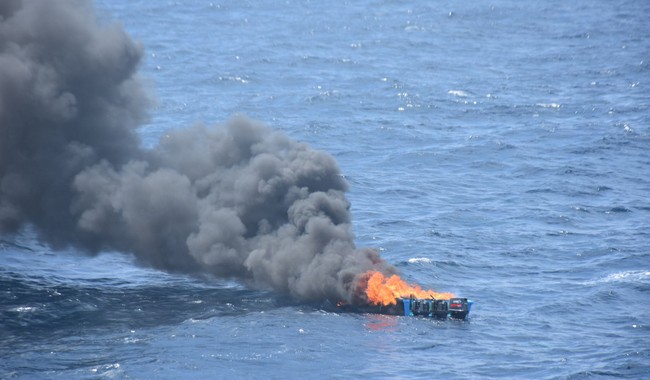
The Pentagon debate over a lethal strike on a drug-smuggling vessel has escalated into a partisan fight, with military legal experts defending the action as lawful and Democrats calling it troubling; this article explains the legal rationale, contrasts it with Democratic criticism, cites historical naval practice, and includes direct quotes and the preserved embed from the original reporting.
Washington has turned this maritime operation into a political battlefield, but the core issue is straightforward for many national security professionals: a vessel moving narcotics and hostile actors toward American shores presents a legitimate military threat. Military attorneys argue the law of armed conflict at sea allows kinetic action against such targets when they contribute to enemy operations or terrorist plots. Republicans and national security conservatives see the operation as a proper execution of theater-level orders to disrupt narco-terrorist networks.
Tim Parlatore, a prominent defense attorney with Navy litigation experience, framed the situation in blunt terms when discussing the strike. He stressed the distinction between lawful targeting and politically motivated criticism aimed at deterring future operations. Parlatore told reporters that the operational goal was to prevent the vessel and its cargo from returning to the fight against the United States and its partners.
“You have a boat full of cocaine and terrorists heading to this country to poison and kill Americans. That’s a legitimate target.” Parlatore said. “You then do battle damage assessment. The boat and the cargo remain legitimate military targets that SOUTHCOM has been ordered to put on the bottom of the ocean.” Parlatore referred to the death of drug traffickers resulting from the second strike as “collateral damage.”
Across the aisle, several Democrats called the footage and the operation deeply disturbing and demanded more transparency from military leaders. Some described scenes of individuals clinging to a disabled hull and accused commanders of bearing responsibility for potential wrongdoing. Those arguments have resonated in committee hearings, but they clash with traditional naval practice and the principles governing hostilities at sea.
SOUTHCOM confirmed the strike destroyed a narco-trafficking vessel and killed four male operatives in international waters, emphasizing the mission’s aim to disrupt cartel trafficking routes. The operation is part of a larger campaign that has seized or destroyed large quantities of illicit drugs and interdicted hostile networks since it began. Supporters insist that disrupting logistics and denying sea lines of operation is a legitimate and necessary form of self-defense.
Republican commentators and military legal experts point to historical precedent to explain why sinking a disabled enemy surface vessel can be lawful even when wounded survivors remain aboard. Parlatore drew a direct comparison to the Battle of Midway, arguing that sinking a crippled warship to prevent its return to combat has long been accepted naval practice. In his telling, the intent was never to target wounded sailors but to remove an asset from the fight, which aligns with the law of armed conflict.
“Take the Battle of Midway. One of the Japanese carriers we blew up was burning, dead in the water, no longer able to fight or launch aircraft, and it was full of wounded Japanese sailors. You know what we did? We kept throwing torpedoes into it until it went to the bottom of the ocean. And that was lawful. The goal was to put the ship down so it couldn’t be towed back, repaired, and put back into the fight. The goal was not to kill all the wounded Japanese sailors on board.”
That historical analogy is intended to clarify the legal calculus: disabling, denying, and destroying an enemy’s capability can be a proportional and necessary military objective. Conservative critics argue that politicizing such operations weakens deterrence and gives adversaries and smugglers room to exploit gaps in enforcement. They warn that second-guessing commanders in real time makes coalition operations and interdiction campaigns less effective against transnational criminal and terrorist threats.
Admiral Bradley has defended Operation Southern Spear, the multinational effort that has reportedly accounted for hundreds of tons of narcotics interdicted or destroyed since its inception. Supporters highlight the strategic value of denying cartels and their partners the ability to move lethal narcotics and manpower by sea. For many national security conservatives, that operational success outweighs partisan theatrics.
Critics will continue to press for more unedited footage and explanations, and lawmakers will debate the legal and moral contours of such strikes. Meanwhile, military lawyers and commanders maintain they acted within the law and with a clear mission: prevent poison and violent actors from reaching American citizens. The clash between operational necessity and political scrutiny will likely shape future rules of engagement and oversight for maritime interdictions.


Start now generating extra home based cash by doing very easy and simple job from home. Last month i have earned $19753 from this job in my part time. This job is just awesome and its earning are greater than 9 to 5 office job. .
Here is I started_______ EarnApp1.Com