
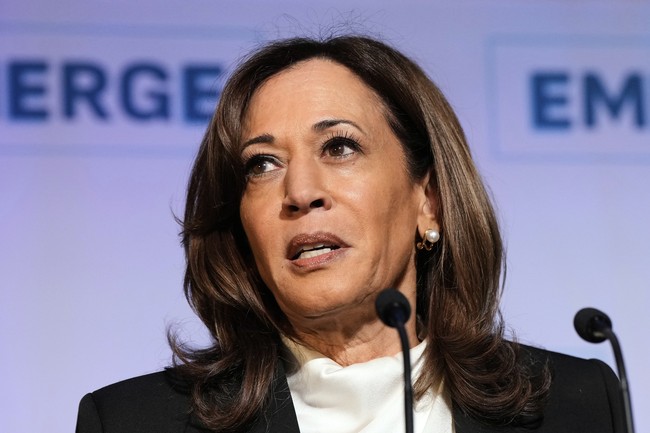
The Democratic National Committee completed an internal post-2024 review but chose not to publish it, citing fears that airing internal disagreements would undercut efforts to present party unity; that decision came amid clear evidence Kamala Harris entered the race with weak favorability and independents already unconvinced, and the Israel-Hamas war only worsened tensions within the coalition rather than creating the underlying problems.
The DNC commissioned an autopsy to explain the 2024 defeat, yet party leaders shelved the report to avoid reopening internal wounds at a moment when unity was being sold as the priority. That calculation was political, not procedural, and it reveals an organization more concerned with optics than accountability. Keeping the findings quiet also meant avoiding public debate about the real causes of the loss.
Kamala Harris was facing trouble long before Gaza rose to the top of the headlines. Her favorability trended negative through 2024, with RealClearPolling averages showing 44.4 percent approve and 50.9 percent disapprove late in the race, a net negative of 6.5 points, and earlier polls showing even worse numbers. Those figures reflect a candidate who struggled to build the kind of positive identity that can withstand a disruptive foreign policy controversy. Voters who already viewed her skeptically were unlikely to be won over by small shifts in messaging.
The autopsy material that leaked or was reported on made clear that the administration’s handling of the Israel-Hamas conflict was judged a net negative for the ticket. Internal reviewers concluded that the White House posture cost support among younger and progressive voters, turning a fault line into a persistent drag on the coalition. That finding is notable because it frames Gaza as an amplifying factor, not the root cause of the ticket’s weaknesses.
The public mood shifted sharply as campus protests and broader activism intensified during 2024. Gallup captured that change in a survey noting, “Fifty-five percent of U.S. adults disapprove of Israel’s military action in Gaza. Among Democrats, 75 percent disapprove, marking a significant increase in opposition within the party compared to prior surveys.” When three-quarters of your own party disapprove of a major foreign policy stance, it creates sustained pressure that can’t be dismissed as a temporary flare-up.
Progressive activists did not confine their dissent to think pieces and private messages; they protested on campuses and pushed elected Democrats to take firmer stands. That internal pressure forced a political dilemma: either recalibrate policy messaging and risk upsetting other constituencies, or hold course and risk alienating a mobilized base. The DNC’s choice to bury the autopsy reflects a desire to avoid that painful reckoning.
Even progressive-aligned post-election assessments acknowledged that the administration’s Israel policy played a role in alienating segments of the Democratic electorate. Admitting that in private reports is one thing; putting it in a public autopsy would have reopened raw disagreements about strategy and values. Democrats worry that airing such splits could weaken their standing in swing districts and make fundraising and turnout harder to manage.
In that fraught environment, the broader structural problem was Harris’s lack of political capital. The candidate’s long-running unfavorable ratings and inability to consolidate independents meant she started the general election on shaky ground. A nominee with stronger approval and clearer personal appeal could likely have weathered intraparty turbulence without it tipping the balance, but that was not the case here.
Gaza acted as a stress test for a ticket already showing strain. It revealed fault lines inside the coalition and accelerated discontent among key cohorts but did not invent the original fractures. The distinction matters: when the underlying structure is weak, even manageable problems can cascade into larger losses. Democrats appear to have recognized that reality and opted for containment over transparency.
Publishing an autopsy that emphasized Israel as a liability risked reigniting a left-wing backlash at a politically inconvenient time. Party leaders calculated that fueling a public fight over foreign policy would harm their short-term unity narrative and potentially deepen the electoral fallout. That choice underscores a fundamental tension in modern party politics: the impulse to present a united front versus the need to confront uncomfortable truths about why voters turned away.
In the end, the autopsy was shelved because the party feared the political consequences of candor. The underlying lesson is plain: when a nominee enters a general election with long-standing unfavorable ratings, external shocks like foreign-policy controversies are more likely to expose weakness than to be the decisive cause. The DNC’s quiet decision to keep the report under wraps tells you where their priorities lay—stability of message over a public accounting of failure.



Add comment