
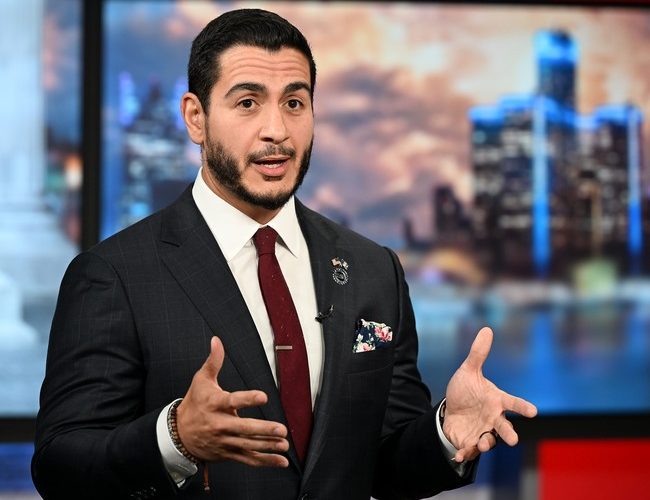
The Michigan Senate contest has tightened into a clear choice between a candidate with military experience and a challenger whose attacks keep tripping over themselves, and this piece looks at polling, political dynamics, and a recent misfire in which Abdul El-Sayed accused Mike Rogers of “frolicking” while sailors were allegedly deprived—an allegation that backfired and handed Rogers a fresh advantage.
The race in Michigan matters for control of the Senate, and former Rep. Mike Rogers looks positioned to make a serious play for the seat. RealClearPolitics’ polling average shows Rogers up by one point, and a separate poll cited him up by four. Given how polling firms can differ, those numbers suggest a competitive race where small shifts matter.
Abdul El-Sayed faces uphill struggles connecting with working-class voters and segments of the black community, weaknesses that surfaced during the primary. His policy stances have pushed some Democrats away, creating space for Rogers to attract swing voters. Connections to controversial online personalities have also become a liability that opponents highlight during the general election campaign.
El-Sayed tried to land a punch by accusing Rogers of “frolicking” at a county fair while sailors on the USS Abraham Lincoln were supposedly going hungry. The phrase was meant to sting, but the visual record from Rogers’ visit showed him meeting voters, shaking hands, and listening to people—not cavorting. The claim read as performative, and that undermined El-Sayed’s point.
El-Sayed’s exact words were: “He’s out here frolicking at the fair while our poor servicemen and women on the USS Abraham Lincoln are starving for food,” followed by “Says he wants to be a US Senator and won’t say a word about them. Disgusting!” Those quotes have circulated widely and became a test of which narrative would stick. When a charge that dramatic meets contradictory evidence, the accuser often loses credibility.
The Department of War pushed back against the more sensational claims about conditions aboard the Lincoln, noting media visits to the ship that included ordinary moments such as a reporter sampling ice cream. That sort of detail undercuts hyperbolic rhetoric about “starving” sailors and shifts attention toward who is making responsible arguments about national security and troop welfare.
Rogers brings firsthand military experience to the contest, having served as a lieutenant in the U.S. Army, which gives him standing when veterans and active-duty families want to judge seriousness about military matters. El-Sayed has no comparable service record to lean on, so blasting an opponent on this terrain invites scrutiny on motive and accuracy. Voters tend to respect accuracy when accusations touch on service members.
https://x.com/AbdulElSayed/status/2088952079578542545
The “frolicking” jab also offered a look at tone. Campaigns often test whether a personal swipe will shift undecided voters, but when the swipe seems petty or hypocritical it can backfire. In this case the charge provided Rogers an opportunity to highlight his focus on issues and veterans, while El-Sayed’s rhetoric looked more like a headline-seeking moment than a substantive critique.
Images and video from the fair and from El-Sayed’s own posts escalated the awkwardness of the accusation, with snippets suggesting behavior that contradicted his moral outrage. Political debates are full of theatrical moments, and candidates who overreach in their attacks risk drawing attention away from policy and into character plays. That dynamic favors candidates who keep their messaging tight and grounded.
Campaigns are also shaped by perception: who appears authentic, who is judged competent, and who sustains momentum as the race tightens. Rogers’ polling edge, however slim, gives Republicans real hope of flipping a seat that could be pivotal for the Senate majority. In a close map, candidates who can combine credible backgrounds with steady messaging gain an advantage as undecided voters make final choices.
Meanwhile, El-Sayed’s misfired language provides a cautionary vignette for his team about avoiding sensational claims without solid evidence. Voters respond to reality checks, and when an attack does not hold up it becomes material for opponents and local media. That kind of self-inflicted trouble can be costly in tight statewide contests where every percent counts.
Visuals and direct quotes continue to circulate online and in local news, keeping the moment alive well beyond the initial post. For Rogers, the episode reinforces a campaign narrative that centers on service and steady leadership rather than on flashy rhetoric. For El-Sayed, the controversy is a reminder that tone and accuracy matter when challenging a candidate with military credentials.


Add comment