
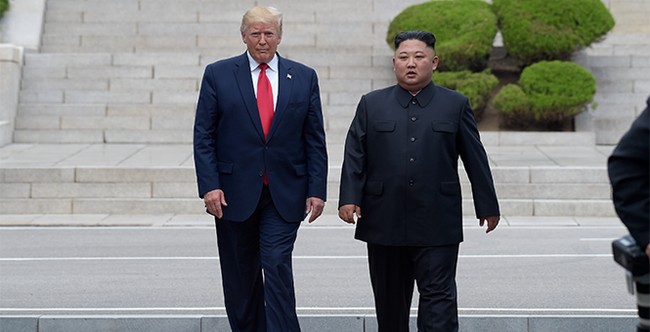
President Trump abruptly ordered a substantial reduction of the planned joint U.S.-South Korea military exercises set to start Monday, citing cost concerns and a desire to avoid sending an unnecessarily hostile signal to North Korea; he directed Secretary of War Pete Hegseth to scale back the ten-day Ulchi Freedom Shield drills while noting South Korea’s refusal to assist with denuclearization efforts regarding Iran.
Just before the scheduled start of the Ulchi Freedom Shield exercises, the White House pivoted and announced a significant pullback. The move was framed as both fiscal prudence and strategic messaging toward Pyongyang, coming as part of a broader approach that ties alliance commitments to burden-sharing.
The president made the directive public in a Sunday evening post, arguing the U.S. has long covered “much of the cost” for these exercises and that they send an inappropriate and hostile signal to North Korea. Because it was too late to cancel the event completely, the instruction focused on substantially reducing the scope and footprint of the ten-day maneuvers.
Trump explicitly linked the decision to his relationship with North Korea’s leader and to South Korea’s response when asked to help with Iran’s denuclearization. He used the opportunity to put allies on notice that U.S. military commitments are contingent on reciprocal contributions, a theme consistent with his foreign-policy posture in this term.
Based on my very good relationship with Kim Jong Un, of North Korea, I am not happy with the fact that the United States has, long ago, agreed to participate in Joint Military Exercises with South Korea. These exercises are not only costly, with much of these costs paid for by the United States of America (as usual!), but send a signal that is totally inappropriate and hostile, to a Country that, as long as Donald J. Trump has been President, has been unthreatening and respectful. Therefore, and based on the fact that it is too late to cancel, I have instructed Secretary of War, Pete Hegseth, to substantially reduce the Joint Military Exercises! While somewhat unrelated (?), I recently asked the President of South Korea if they would like to join us in the Denuclearization of the Islamic Republic of Iran, and they said, “No thanks!” Thank you for your attention to this matter. President DONALD J. TRUMP
https://x.com/RapidResponse47/status/2089099940328796395
The last line of that message drew particular attention: the president emphasized that when the United States asks allies to assist on major security challenges, it expects them to step up. Mentioning South Korea’s “No thanks!” response on the Iran question made a clear point about reciprocal commitments and the limits of U.S. largesse.
Reducing the drills rather than outright cancelling them also recalibrates deterrence signaling while avoiding an immediate escalation. The exercises, rooted in a decades-long defense partnership, have long evolved in name and form, but they remain a visible demonstration of U.S.-ROK interoperability and resolve.
North Korean state media had already framed the joint exercises as a rehearsal for aggression and warned that such activity raises regional instability. Pyongyang’s official statements declared an intent to respond to perceived new levels of threat with new levels of deterrence, promising to “more clearly express its stance on the enemies” and exercise “the right to legitimate self-defense.”
Trump’s action reflects a two-part message: push back on the financial burden placed on American taxpayers and use military posture as a bargaining chip to demand more from partners. For his supporters, the move underscores a commitment to “peace through strength” while insisting allies carry their share of defense responsibilities.
Operationally, a reduced Ulchi Freedom Shield will still allow for essential coordination but with a narrower scope, according to the directive. That compromise aims to preserve necessary training and readiness while addressing political and fiscal priorities laid out by the administration.
As regional actors absorb the change, the administration will likely emphasize strategic clarity: the United States remains committed to deterrence and to alliances, but it expects tangible contributions in return. The decision sets a precedent for how alliance dynamics and burden-sharing may factor into future planning and military cooperation.


Add comment