
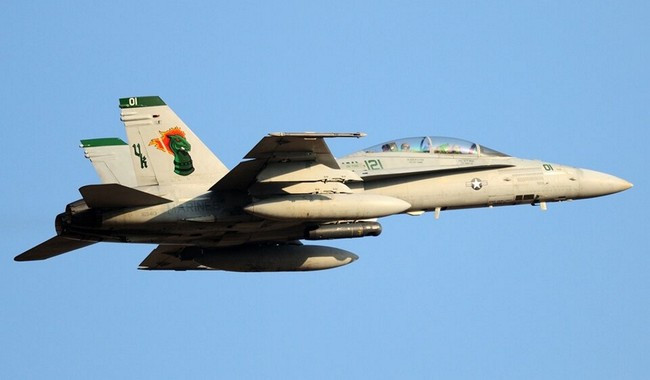
The story recounts a June 13 F/A-18 crash near Rimrock Lake in Washington state, the pilot’s calm response after ejecting, and body-camera footage released by local authorities showing the injured but coherent aviator walking away from the wreckage and describing the scene to deputies.
The crash occurred about 55 miles southeast of Seattle, and witnesses reported a plume of black smoke and a wildfire after the jet struck a mountainside. Yakima County received multiple 911 calls from people who saw the incident, and the pilot himself dialed 911 while moving away from the crash site.
When deputies found him walking down a forest road, the pilot remained remarkably composed despite visible injuries from his descent through the trees. He confirmed he had been flying solo and described the aircraft with a brief, memorable line: “That’s an F — well, it was an F-18.”
He told officers they had been “doing circles over the lake, doing some low-level training,” then “I tucked in, and I’m not sure exactly.” Those statements came through in the body-camera audio released by the sheriff’s office and highlighted how clearheaded he stayed while reporting the crash and nearby fire.
Emergency responders and deputies combed the area and located the pilot, who showed cuts and scrapes consistent with parachute-related encounters with tree branches during his egress. Despite facial lacerations and being shaken, he managed to relay the scene and point rescuers toward the burning wreckage.
The F/A-18 Hornet aircraft slammed into a mountainside on June 13, in the area of Rimrock Lake, about 55 miles southeast of Seattle, sending a plume of black smoke into the air and igniting a wildfire.
The pilot assigned to Marine Aircraft Group 11, 3rd Marine Aircraft Wing, in Miramar, California, is seen with his face bloodied and appearing a little shaken up in the body camera footage released Friday by the Yakima County Sheriff’s Office.
Video of his walk and the surrounding smoke was released on a Friday following the June event, and it paints a vivid picture of a pilot who, even while battered, prioritized reporting the situation and seeking help. The aircraft reportedly impacted steep terrain, which made survival without ejection unlikely.
Authorities described the incident as a “non-fatal aviation mishap” while they investigated the cause, though no definitive public determination has been announced. Military officials have released limited details other than confirming the pilot ejected and survived his fall into the canopy.
https://x.com/CBSEveningNews/status/2088405534688919796
Local responders described multiple witness reports and the pilot’s own 911 call. He told dispatchers, “I’m on the other side of the ridge. I do see a fire burning to the south of the road. I can’t tell how bad that fire is,” which helped orient crews to where both he and the wreckage might be located.
Footage shows responders and deputies near trees and thick brush where the pilot said he came down, and it underscores the difficulty of reaching an aircraft that struck rugged, forested terrain. The crash ignited brush and caused visible smoke that alerted nearby residents and passersby.
Reports indicate the jet involved was an older F/A-18D Legacy Hornet rather than a newer Super Hornet model, though cost figures and model specifics do not change the central fact: a highly dangerous situation ended with a pilot walking away after ejecting. The aircraft’s impact and resulting fire made the scene hazardous for first responders.
‘Hey, buddy, I just crashed,’ the pilot says before the footage cuts to his parachute dangling from a tree.
The pilot told officers he went through trees during his descent after ejecting, as they examined his bloody face, which appeared to have suffered parachute-related lacerations.
The aircraft slammed into a mountainside near Rimrock Lake, about 55 miles southeast of Seattle.
When the aircraft slammed into the mountainside, it sent a plume of black smoke into the sky and sparked a raging wildfire.
Despite the chaos, the pilot’s ability to communicate clearly and to physically move to a spot where deputies could find him reduced the chance of a worse outcome. His actions appear to have aided both firefighting and rescue efforts by giving responders a starting point in rough terrain.
Investigators will need to review maintenance logs, flight records, and witness statements to determine exactly what happened during the low-level training run. For now, the released footage and audio remain a striking record of how the pilot managed a dire emergency and provided crucial information while injured.

Home-based job that pays more than 12,000 Dollar per month by doing simple tasks on a laptop or mobile device part-time. Last month, I earned 24,863 Dollar from this job by working 4 hours per day online. Very simple jobs to do, and the earnings are insane. Everyone can now make more money online by joining the website listed below…..
𝒋𝒖𝒔𝒕 𝒖𝒔𝒊𝒏𝒈 𝒕𝒉𝒊𝒔 𝒔𝒊𝒕𝒆.. Www.PayAtHome1.Com