
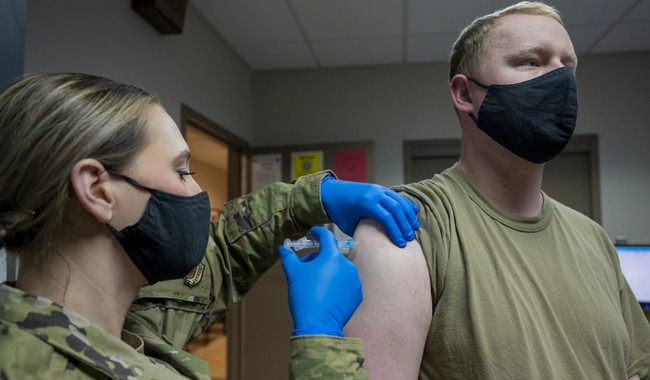
The Department of War’s promised corrections for COVID-era personnel actions have not delivered justice for many patriots, and Brig. Gen. Christopher Sage faces forced retirement on Dec. 31 after being blocked from promotion for challenging abusive COVID practices as a wing commander.
There is a long-standing officer maxim about command responsibility: “You can only blame the last guy for so long. Once you’ve commanded it for 90 days, the unit’s issues are fully your problems.” That saying frames why commanders who act to protect troops should be respected, not punished for exercising judgment. Yet the post-pandemic personnel fight shows how political winds and career protectionism still shape outcomes inside the Pentagon.
After the change in administrations, the White House issued an executive order aimed at reinstating service members removed under COVID vaccination mandates, and the War Department published guidance to implement corrections. Expectations rose that thousands who lost careers unjustly would be brought back quickly. Reality has been slower and messier, with the actual number of reinstatements reported at roughly one hundred in open-source assessments, far short of the promises.
The task of fixing these wrongs was mostly handed to service-level task forces, and the Army’s small directorate has tried to make progress. That team’s public work has been notable because a director used social media to highlight cases and push for action. Still, when a directorate led by colonels must push changes through a bureaucracy run by four-star generals, senior executives, and political appointees, momentum often dies in the middle.
Many reinstated members face hollow remedies: what’s been described as “full back pay” often excludes earnings from civilian work during their separation, and promotions lost during the punitive period are rarely restored. Service members who sought exemptions and remained in uniform were sometimes denied job billets needed for promotion and ended up retiring early. The process, far from encouraging trust, deters many from attempting a comeback.
The pushback within the Pentagon is highlighted by the case of Brig. Gen. Chris Sage, who in 2021 ordered humane treatment for airmen who tested positive for COVID while commanding an air wing in Jordan. He found troops held in tents behind barbed wire and moved them to appropriate quarters, a move that respected dignity and morale. For exercising compassion and asking difficult questions, he became the target of a manufactured investigation that derailed his promotion timeline.
The board for military corrections ruled in Sage’s favor, which normally ends the dispute. Instead, a senior civilian official in the Air Force overruled the board and blocked his elevation to major general. That extraordinary step undermines the trusted channels service members are supposed to rely on for fairness and correction. As a result, unless overturned, Sage faces forced retirement at year’s end for doing what commanders are supposed to do: protect their people.
This is not an isolated morality play; it’s a signal that the culture in parts of the Department of War still defends those who enforced punitive COVID policies and obstructs those who try to fix the damage. Reinstatement has been treated as a checkbox rather than a top priority, and accountability for officials who impeded justice remains largely absent. The consequence is a military less willing to reward integrity and more inclined to protect bureaucratic reputations.
Conservative observers should not assume the military is fixed because recruiting numbers have rebounded. Recruitment can mask deeper cultural rot in personnel management and promotion norms. The institution’s honor is called into question when leaders who resisted abusive orders or questioned policy are sidelined while careerists who enforced them remain in place.
Change requires decided leadership that enforces lawful accountability and prioritizes returning patriots to duty. Sun Tzu reminded commanders to act when the correct course is clear: “When you see the correct course, act; do not wait for orders.” That ought to apply in the Pentagon, where the cost of inaction is the careers and reputations of those who acted with principle during a crisis.
Absent forceful intervention, the status quo keeps producing results that look like slow-motion punishment for dissenters and those who defended their troops. The current pattern rewards compliance and punishes common sense, which corrodes trust in promotion boards and correction mechanisms. It leaves patriots feeling abandoned by the institution they served.
The case of Brig. Gen. Sage is a concrete example of how procedural fixes can be undercut by discretionary power at high levels. If the War Department truly intended to restore honor and careers harmed by illegal or illiberal COVID directives, it would act swiftly to correct such clear injustices and restore faith in its systems. Until then, rank-and-file troops and veterans will watch promotions and retirements and calculate how seriously the Pentagon means reform.
Stories of other service members who faced unlawful COVID-related discipline continue to surface across podcasts and firsthand accounts, showing a pattern of persecution beyond isolated incidents. Those accounts reinforce that the fight over personnel fairness is ongoing and that administrative remedies alone will not repair a culture that still tolerates unjust treatment of patriots.


Add comment