
Checklist: criticize the stunt, explain why it’s harmful, compare to theater and wrestling, defend patriotism, call for accountability.
The State of the Union should be a serious moment for lawmakers to demonstrate respect for the office and the country, not a viral video audition. What happened when Rep Rashida Tlaib chanted “KKK” while others responded with “USA” turned a solemn address into a spectacle that rewarded outrage over responsibility. That behavior cheapens the Chamber and diminishes the public’s trust in representatives who are supposed to legislate rather than perform. Republicans rightly see this as a breakdown of basic standards that elected officials must uphold.
There is a clear distinction between protest and provocation, and Tlaib crossed it. Comparing a patriotic chant to the Ku Klux Klan is not a point of policy debate; it is an accusation that weaponizes history for immediate political gain. The Ku Klux Klan is a real terrorist organization with a long record of violence, and invoking that name in the middle of a national address as a punchline is a cynical move, not a substantive critique.
Watching members of Congress act like fans at a sporting event erodes the dignity of the institution. The “F ICE” style heckle culture translates poorly into effective governance and better fits the arena of professional wrestling than the House floor. Lawmakers are entrusted with serious decisions — budgets, national security, and the rule of law — and trading that trust for a headline undermines their mandate. Constituents deserve more than theater from people who claim to represent them.
The optics matter. For many Americans, standing and chanting “USA” is an affirmation of common bonds, not a license for blind worship. To equate that simple expression of national pride with something as vile as the Klan is to insult millions who serve, sacrifice, and pay taxes for the country’s benefit. It’s also politically tone-deaf in battleground states where persuadable voters reject partisan theater and prefer steady leadership.
There’s a hypocrisy at play when political actors use historical evils as rhetorical grenades while ignoring context and nuance. The parties’ histories on race are complex, but throwing accusations like “KKK” across the aisle without evidence reduces history to a hashtag. That kind of shorthand does nothing to advance racial reconciliation or policy solutions; it only deepens divisions and punishes reasonable discourse.
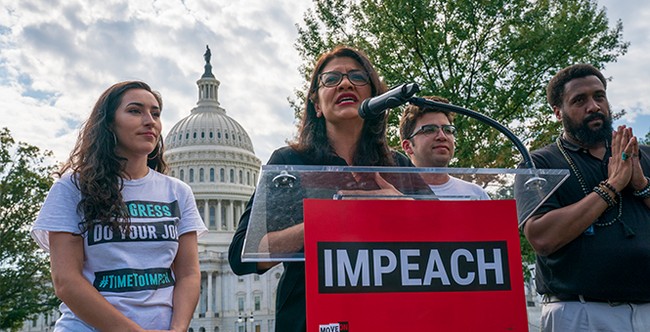
Tlaib didn’t stop at the chant. She wore a pin reading “F ICE,” accused the president of “killed Americans,” and spent chunks of the speech on her phone with Rep Ilhan Omar before walking out. Those actions read less like seasoned political dissent and more like a performance engineered for social media clout and small-dollar fundraising. The public deserves representatives who pursue results, not viral moments that translate into retweets and donation prompts.
If the roles were reversed, consequences would be swift and severe from the press and political leadership, and that disparity breeds resentment. Calls for censure in this instance are not about silencing dissent; they’re about preserving the norms that make deliberative government possible. Discipline isn’t punishment for disagreement — it’s the mechanism that keeps the institution functional and respected by the people it serves.
There is also a larger democratic concern: turning patriotism into a political insult weakens national solidarity. Telling millions that loving their country is synonymous with bigotry is neither persuasive nor productive. It narrows the political audience and alienates voters who are open to policy arguments but tired of identity-driven theatrics.
From a Republican standpoint, insisting on decorum is not about protecting one politician or another; it is about protecting the legitimacy of the House. The State of the Union is a shared national ritual where representatives should demonstrate maturity and seriousness. When members choose to behave like crowd-pleasers instead of public servants, the entire system pays the price in credibility.
Congress must reaffirm that its floor is for governance and reasoned debate, not for stunts designed to inflame and fundraise. Holding members accountable for repeated disruptions would signal that service comes with responsibilities, including restraint and respect for historical truth. The American people deserve lawmakers who choose constructive disagreement over cheap theatrics and who seek to build consensus rather than pursue clicks and culture-war points.



Add comment