
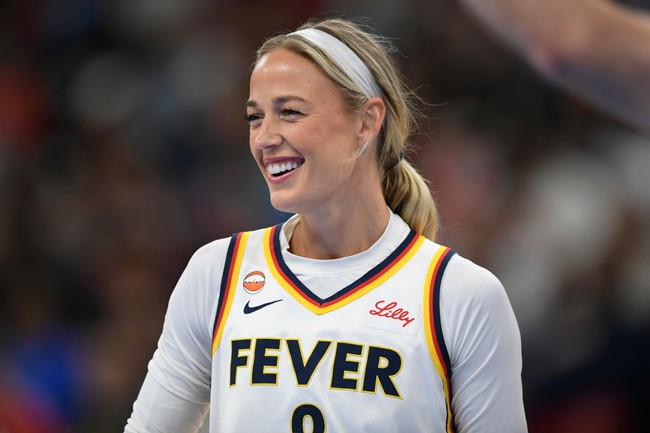
The Chicago Sky’s DiJonai Carrington was ejected after a violent flagrant foul on Indiana Fever guard Sophie Cunningham, Carrington says the contact was unintentional but also warned it could happen again; this article lays out the incident, the reaction, the comments from Carrington, and the context around previous similar calls and public discussion.
DiJonai Carrington Denies Intentionally Fouling Sophie Cunningham — Then Threatens Her Again
The play that ended with DiJonai Carrington tossed from the game was a dramatic and alarming moment on the court, leaving Sophie Cunningham bloodied and the crowd and commentators stunned. Video and replay showed hard contact to Cunningham’s head and neck area during a fast-break layup attempt, and officials ruled it a flagrant foul that resulted in Carrington’s ejection.
In the days after the game, Carrington told reporters the contact was not intentional and called the sequence unfortunate, but she also added a line that read like a warning to Cunningham. ‘‘It was unfortunate that I made contact with her in the way that I did, but it was never intentional,’’ she said. ‘‘And, look, it might happen again. That’s just how I play. I’m gonna always go all out. I’m not gonna just let an open layup happen. But, like I said, I’m never intending to hurt anybody, regardless of the outside noise or whatever the situation may be.’’
That last sentence — “It might happen again” — was seized on by fans and commentators as more than a clumsy choice of words. To many observers, it sounded less like an apology and more like a statement of intent: Carrington accepts aggressive contact as part of her style and warns that similar incidents could follow. The timing and tone of the remarks kept the story alive beyond the single game.
Beyond the words, Carrington’s social media behavior drew attention. After the ejection, she posted the date of the next Fever-Sky matchup, which some interpreted as signaling that she had that specific rematch circled. For people watching the situation closely, the post suggested an ongoing focus on Cunningham rather than a one-off mistake that should prompt reflection and restraint.
Carrington also framed the aftermath through the lens of inconsistency in officiating and league discipline, bringing up claims about unequal treatment tied to names and skin color. ‘‘I would just love consistency across the board when it comes to things like that,’’ she said. ‘‘Whether it’s the foul that I commit, whether it’s the reaction or retaliation, I would just love for it to be consistent across the board, regardless of the name on your jersey or your skin color or the score of the game, whatever.” Those words put the dispute into a broader cultural argument that is already present in the league’s coverage and commentary.
Reviewing recent precedent undercuts the idea that Cunningham received different treatment for similar actions. Last season, Cunningham was assessed a Flagrant 2 foul and ejected for a hard play on Jacy Sheldon, and discipline in that case matched the league’s standard penalties for severe contact. That parity is what neutral observers point to when they question claims of selective enforcement in this particular instance.
https://x.com/Rusty_Weiss/status/2087217490694680826
The broader context includes repeated physical play involving high-profile players, including heavy contact directed at Caitlin Clark and her teammates since Clark entered the league. Some argue that the physicality Clark has endured shows the challenge of policing intense matches, while others say it highlights inconsistent responses by officials and the league office. The debate over where to draw the line between legal aggression and punishable violence continues to simmer.
Whatever the motive behind Carrington’s actions or words, the incident left Cunningham injured and raised questions about player safety and accountability. The WNBA’s response — an on-court ejection and whatever internal review followed — will be judged by fans and players based on whether it deters similar plays or leaves room for repeat offenses.
For now, the key facts stand: a violent clothesline foul that caused visible injury, a player publicly defending her intent while acknowledging the risk of repeating the behavior, and a league that will face scrutiny over how it enforces rules against dangerous contact. Those elements ensure the story will remain part of the conversation every time these teams meet again.



Add comment