
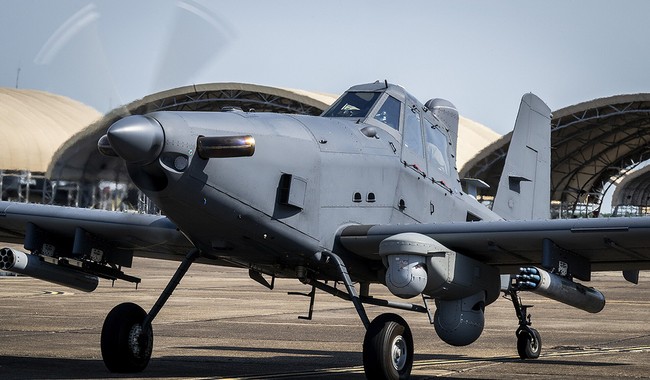
The U.S. Air Force has added the OA-1K Skyraider II to AFSOC’s inventory, a rugged, low-and-slow light attack aircraft that revives an old idea: take a proven agricultural airframe, outfit it for combat, and use it where expensive stealth and high-speed jets aren’t the best fit.
Recent combat over Iran highlighted how high-tech platforms can deliver decisive effects, but it also showed the enduring value of simpler approaches when air superiority is established. Once the heavy hitters clear the field, aircraft that loiter, spot, and deliver precise ordnance at lower cost become invaluable to commanders on the ground.
The A-10 and B-52 demonstrated that dominance at the high end matters, yet close air support often calls for aircraft that can operate slowly and persistently over a target area. The OA-1K Skyraider II fits that niche, trading speed for endurance, payload flexibility, and the ability to support special operations forces in permissive and contested environments.
The Air Force now has 18 new light attack aircraft that are designed to support special operations forces on the ground, and it expects to receive “a handful more” by October, said Lt. Col. Robert Wilson, of Air Force Special Operations Command, or AFSOC.
The single-engine turboprop OA-1K Skyraider II is “essentially a Swiss Army Knife of airborne capability,” that can fly armed reconnaissance, close air support, and precision strike missions, said Wilson, AFSOC’s armed overwatch requirements branch chief.
The Skyraider is designed to support operations that range from counter-terrorism to “aspects of full-on conflict,” Wilson told reporters on Friday. It is capable of carrying weapons, including Advanced Precision Kill Weapon System, or APKWS, laser-guided rockets, and the plane also has rails and pylons on its wings so it can be equipped with more advanced weapons and sensors in the future.
The program delivered 18 aircraft so far, with “a handful more” expected before October, according to AFSOC remarks preserved in the public statements. That pace reflects a pragmatic approach: field capable systems quickly instead of waiting years for exotic platforms to mature. For battlefield commanders, having more options now is far preferable to promises of ideal tools later.
The Skyraider II carries a legacy name tied to the Vietnam-era A-1 Skyraider, an aircraft that outperformed expectations by being simple, tough, and effective at supporting troops. The modern OA-1K draws on that same philosophy, built from a rugged commercial airframe and missionized for combat tasks where loiter time and payload adaptability matter.
Its origins are unglamorous but effective: L3Harris developed the OA-1K from the AT-802 Air Tractor cropduster, turning an agricultural workhorse into a purpose-built armed overwatch platform. That sort of ingenuity—finding a sound base platform and adding the right sensors, weapons, and protections—is classic American problem-solving.
Low-tech solutions matter because counterinsurgency, special operations, and limited engagements rarely reward the most expensive jet in the box. The Skyraider II can carry APKWS and other guided munitions and has wing stations ready for future sensors and weapon sets, making it flexible for evolving mission requirements.
The plane is practical to maintain and operate compared with high-performance aircraft, and its ability to fly slow and low increases situational awareness for troops on the ground. In certain fights that feature dispersed targets and the need for persistent presence, a low-and-slow platform often does the job better than a fast mover that must leave the area to refuel.
There are budget realities, though. The Air Force requested 75 Skyraider IIs at one point, but funding decisions have constrained procurement. Officials noted that under current budget plans, 53 OA-1Ks are funded, a shortfall compared with the program record but still a meaningful capability add for AFSOC.
But due to “resource constraints and competing priorities,” a total of 53 Skyraider IIs are funded under President Donald Trump’s proposed budget for fiscal year 2027, according to AFSOC public affairs.
“The 75 quantity figure is the program record,” Wilson said. “I would say, as the capability sponsor, less than 75 is not desirable. We would like to see it at the program record of 75, but just, just being pragmatic, obviously, with resource constraints that could potentially limit the program less than that.”
History shows the tactic works: even in World War II, improvised aircraft like the Polikarpov Po-2 found ways to harass and surprise superior opponents by exploiting maneuverability and low-speed handling. The Skyraider II channels that same battlefield truth—sometimes the simplest platform with the right employment is the most effective.
Fielding these aircraft reflects a sensible force mix that pairs high-end capabilities with affordable, mission-focused platforms. When you need a plane to stay on station, mark targets, and deliver precise effects for troops on the ground, the OA-1K Skyraider II is a clear, cost-conscious option that complements America’s high-tech arsenal.
It looks like, despite asking for 75 of these, the Air Force will only be getting 53.


Add comment