
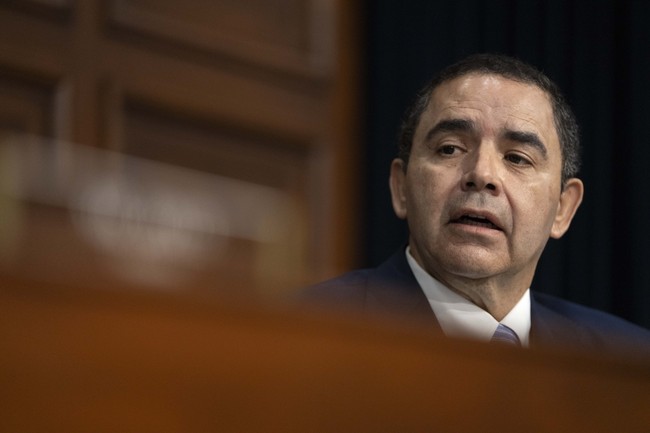
President Trump publicly criticized Rep. Henry Cuellar after granting him and his wife a full pardon, then watching Cuellar immediately announce he would run again as a Democrat; the president called the move a betrayal and warned that future pardons might not come so easily. This article lays out the timeline, the charges that prompted the pardon, the president’s response on social media, Cuellar’s reaction, and the political tensions that followed. It keeps the key quotes, figures, and embed markers intact while stripping external links and credits. Below are the revised body paragraphs recounting the episode and its fallout.
President Trump posted on his platform to express deep disappointment after signing a full pardon for Representative Henry Cuellar and his wife, saying he felt betrayed when Cuellar returned to the Democratic Party. The pardon followed serious federal charges aimed at the couple that included bribery and money laundering among other counts connected to alleged payments from foreign entities. The president framed his action as partly motivated by appeals from the congressman’s family and concern over what he described as politically motivated prosecution.
The indictment named nearly $600,000 in alleged bribes from an Azerbaijani energy company and a Mexican bank, and charged the couple with bribery, conspiracy to commit bribery, money laundering, conspiracy to commit honest services wire fraud, and acting as an unregistered foreign agent. Those allegations were central to the president’s justification for intervening. He emphasized the severity of potential sentences and the family consequences he believed would follow under the prior administration’s Justice Department practices.
After the pardon was announced, Cuellar filed for reelection and publicly stated he would run again as a Democrat, downplaying any idea of personal loyalty to the president. In remarks to reporters after filing, Cuellar said “nothing has changed,” a line that clearly fueled the president’s reaction. Trump made plain that he expected some public indication of gratitude or allegiance after taking what he called a potentially life-saving step on the couple’s behalf.
On his platform the president wrote in strong terms about what he saw as a political double-cross, accusing the Biden administration of wanting to imprison Cuellar and his wife for 15 years. He posted, “Can you imagine? The Democrats, under the Crooked Joe Biden Administration, who always use extreme force and jail-time to destroy their political opponent, wanted to put Congressman Henry Cuellar, and his wife, Imelda, in PRISON, for 15 years, which I predicted these Radical Left Lunatics would do.” Those exact words were central to his post and to the tone he struck afterward.
Continuing his post the president added, “And they never stopped wanting to fulfill this evil quest!” and charged that the Democrats used every tool available to try to destroy Cuellar and his family. He described receiving letters from Cuellar’s daughters that he said moved him to act, claiming he felt sympathy and responsibility to step in. “I signed the papers, and said to people in the Oval Office that I just did a very good, perhaps life-saving, thing,” he wrote. “God was very happy with me that day!”
Despite those statements and the president’s belief that his intervention spared the family from severe legal consequences, Cuellar’s announcement that he would return to the Democratic fold drew an immediate rebuke. The president minced no words, calling the party he rejoined “the same Radical Left Scum” that had sought to punish him and his family. He warned this would affect how future pardons are considered, declaring, “Oh, well, next time, no more Mr. Nice guy!”
The president and his allies noted Cuellar’s past votes and public record as evidence he had never been aligned with the America First movement, pointing out that the congressman had voted to impeach Trump on prior occasions. That history was used to frame Cuellar’s decision as predictable, and to suggest he was not an ally even on the one issue highlighted—border security. The president characterized Cuellar as part of what he calls the institutional left despite occasional issue-based disagreement.
Critics of the pardon said the move raised questions about criteria and consistency when issuing clemency, while supporters argued it was a humane response to aggressive prosecutorial tactics. The exchange underscored raw partisan tensions: one side framing the pardon as an act of mercy and justice, the other interpreting Cuellar’s return to the Democratic ticket as ingratitude and a political slight. Both interpretations fed into a broader narrative about loyalty, power, and the use of the pardon power in polarized times.
For his part, the president made clear his frustration at being repaid with what he saw as an immediate political pivot back to those who had sought punishment. He repeated his view that prosecutors under the prior administration sought to destroy the congressman and his family and expressed a belief that mercy should be met with at least some public acknowledgement. The relationship between executive clemency and political reciprocity now sits at the center of this dispute.
Observers will be watching how this episode shapes future interactions between the White House and lawmakers of differing parties, especially when the pardon power intersects with charged criminal allegations. The incident highlights how personal appeals, prosecutorial decisions, and campaign calculations can clash when politics and the criminal justice system overlap. The president’s post and the congressman’s swift campaign move leave an open question about whether such clemency will be extended in similar circumstances going forward.
The exchange ended with the president signaling a harder line in the future and Cuellar moving forward with his campaign as a Democrat, returning to a familiar partisan alignment despite the recent intervention. That immediate political rebound was the spark that set off the public spat and the president’s vow that his generosity would not be endless if recipients promptly return to opposing him.


Add comment