
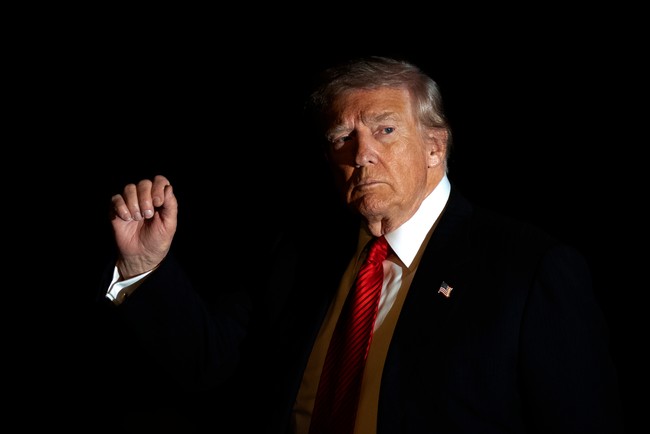
President Trump, speaking at Mar-A-Lago while attending a wedding, delivered pointed comments about Iran and Cuba that mixed firm warning with the offer of negotiation, signaling that the United States holds leverage and may press for concrete outcomes if diplomacy fails.
President Trump was at Mar-A-Lago for a high-profile wedding and used the occasion to address two foreign policy flashpoints: Iran and Cuba. His remarks were short, direct, and meant to telegraph seriousness rather than nuance. The setting matters: he was speaking publicly at a social event, which makes the language calculated for broad effect. That combination of venue and tone sent a clear signal to both domestic and international audiences.
On Iran, the president suggested the administration has forces in place and patience for a deal, but was careful to leave the door open to tougher measures. He pointed to U.S. naval power nearby and hinted that time is limited for diplomacy to work. That posture mixes deterrence with an attempt at negotiation, a classic approach to avoid immediate escalation while maintaining pressure. It’s a posture designed to force opponents to choose between agreement or consequences.
The exchange that followed with reporters highlighted the posture in plain language. A questioner asked about a warning from Iran’s Supreme Leader that a U.S. attack could spark a regional war, and the president replied in a measured but pointed way. The comment left ambiguity on timing and tactics, but removed ambiguity about resolve. That ambiguity is often useful in diplomacy when you want adversaries to assume the worst-case cost of aggression.
On Iran, the Supreme Leader today said the U.S. attack could spark a regional war. Do you have any thoughts about that?
The president answered in a way that blended caution and warning, emphasizing U.S. capability and a preference for a deal. His words made it clear that the United States prefers a negotiated outcome but has not ruled out force if necessary. That stance is meant to keep adversaries guessing while reassuring allies that American strength remains on display. It’s an approach that resonates with those who favor firm American leadership on the world stage.
Why would they say that? Of course they’re going to say that, but we have the biggest, most powerful ships in the world over there, very close. Couple of days. And, hopefully, we’ll make a deal. If we don’t make a deal, then we’ll find out whether or not he was right.
Turning to Cuba, President Trump shifted from military deterrence to humanitarian and diplomatic themes, while still keeping a hard edge about expectations. He described Cuba as struggling and emphasized concern for people separated from family by authoritarian rule. That framing mixes compassion for émigrés with a critique of communist governance, which fits a Republican viewpoint favoring freedom and pushing back against regimes that oppress their citizens. It also signals an interest in practical arrangements that could ease suffering without rewarding the regime unconditionally.
His Cuba remarks stressed negotiations with the island’s leadership and a desire to help people who fled political repression. He noted the loss of Venezuela as a supporter for Havana and suggested that isolation has worsened Cuba’s humanitarian situation. The president made clear he wants those who suffered under Cuba’s rule to be looked after and possibly reunited with family. That kind of messaging aims to combine principles with leverage in talks.
Well, Cuba is a failing nation. It has been for a long time. But now it doesn’t have Venezuela to prop it up. So we’re talking to the people from Cuba. The highest people in Cuba. We’ll see what happens. I want the people that came here, that were horribly treated by Cuba, to be taken care of, to be able to go back, and do what they have to do. You know, they have their family there, they haven’t been able to see them in years. Many, many years. So, I think we’re going to make a deal with Cuba. It’s in bad shape. Cuba’s in bad shape. Cuba has a humanitarian problem.
The contrast between Iran and Cuba is stark: Iran projects regional military threat while Cuba presents long-term repression and humanitarian decay. Both cases, though different in scale and danger, involve adversaries who maintain relationships with hostile actors like Russia. That reality means U.S. policy must juggle deterrence, diplomacy, and support for dissidents and refugees. It’s a balancing act that seeks to protect American interests while offering a path for the oppressed.
What came through most clearly was the willingness to make a deal, but not at any price, and the readiness to show consequences if diplomacy fails. Those are the classic elements of a strategy meant to protect American power and promote freedom abroad. For voters who prioritize strength and clarity in foreign policy, the remarks were straightforward and unambiguous about priorities and means.
I just came across this amazing way to earn $6,000-$8,000 a m0nth 0nline! No selling, no struggle—just a simple system that anyone can follow. Kelly Richards did it, and so can you! Don’t miss out on this life-changing 0pportunity. check it out by Limited time only – grab it before it’s gone!” ..
Here is I started_______ PayAtHome1.Com