
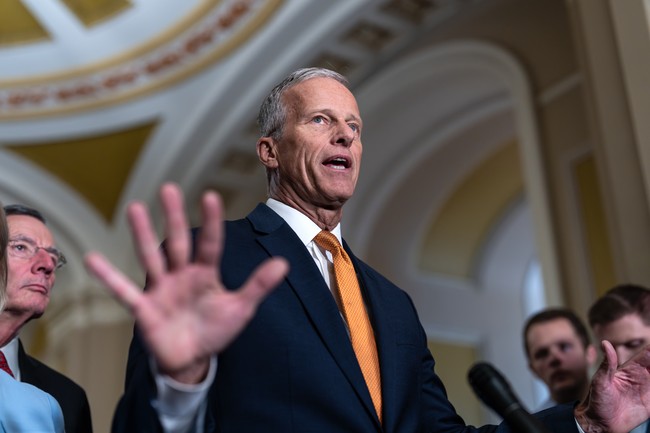
The SAVE America Act, which would require voter ID, cleared the House but is stalled in the Senate where a 60-vote threshold and opposition from Democrats block its path, and Senate Majority Leader John Thune says changing filibuster rules or bringing back a talking filibuster is unrealistic despite pressure from some Republicans.
The Safeguard American Voter Eligibility (SAVE) America Act passed the House in February and aims to require identification to vote, but it faces a Senate where cloture rules mean it needs 60 votes to advance. With Republicans holding a 53-47 majority, getting to 60 is a steep climb and the bill remains stuck instead of heading to the president’s desk.
Many conservatives want a fix: either eliminate the modern filibuster or restore the old talking filibuster so legislation can advance. But Senate Majority Leader John Thune was blunt about the prospects and pushed back on those ideas in public remarks, making it clear leadership won’t flip Senate rules for this bill.
Thune said Monday that changing the Senate’s long-standing filibuster rules to pass the Safeguard American Voter Eligibility (SAVE) America Act is not a realistic option despite a pressure campaign from Trump and some conservative lawmakers.
“Yeah, that’s not going to happen,” Thune told ABC News when asked whether Republicans might change Senate rules to bypass the 60-vote threshold required for most legislation.
Polls show broad public support for voter ID rules, with a February CNN poll finding 83 percent of Americans in favor, which is why many on the right are frustrated the measure can’t move forward. The frustration isn’t just about policy; it’s about principle: voters expect elections to be secure and lawmakers to respond to that mandate.
Some Republican lawmakers pushed for the talking filibuster idea, arguing it would force senators to stand and speak to block bills the old-fashioned way. The modern filibuster, by contrast, allows a simple signal and then regular business continues, which makes the current process feel like a loophole to many conservatives.
Thune warned that returning to a talking filibuster would not solve the problem the way some expect, pointing out that unlimited debate comes with unlimited amendment opportunities. Those amendments could be used to strip or change the bill in ways its backers won’t accept, meaning unity behind both the goal and defending the bill’s language is required.
Senate Leader John Thune announces the votes ARE NOT THERE for a talking filibuster to pass the SAVE America Act — AND he doubts the ability to pass the bill through reconciliation, which would require only a simple majority
Trump mentioned convincing the 4-5 holdouts so this can get done yesterday
THUNE: “The votes aren’t there for a talking filibuster, it’s just a reality.”
On reconciliation: “Very, very difficult” and that “pieces” of the bill could be included — Thune tells Punchbowl
A vote will likely still occur, but it needs 60 votes.
This won’t go over well. That’s a fact.
Thune reiterated the structural reality: unlimited amendments could derail the bill even if debate were restored to its old format, and neither changing the rules nor reconciliation offers a clean route forward. He emphasized that getting the necessary votes on the floor is the true barrier, not just procedural tweaks.
Conservative voters and activists are demanding action because they see voter ID as common sense and broadly popular, and they view Democratic obstruction as defying the majority’s will. For many Republicans, the political remedy is straightforward: win more Senate seats so commonsense reforms don’t hinge on procedural gymnastics.
There’s also the tactical argument that trying to nuke the filibuster or force a rule change could backfire by creating future vulnerabilities when control shifts. That caution helps explain why some Republican leaders, even those sympathetic to the bill’s goals, are wary of rewriting Senate rules to solve a single policy fight.
The debate over filibuster reform, voting rules, and how best to secure elections will continue to roil the party and the Senate until either a path to 60 votes appears or election results change the Senate math. For now, the SAVE Act remains a live political issue, stalled by rules and the absence of decisive Senate support.


Add comment