
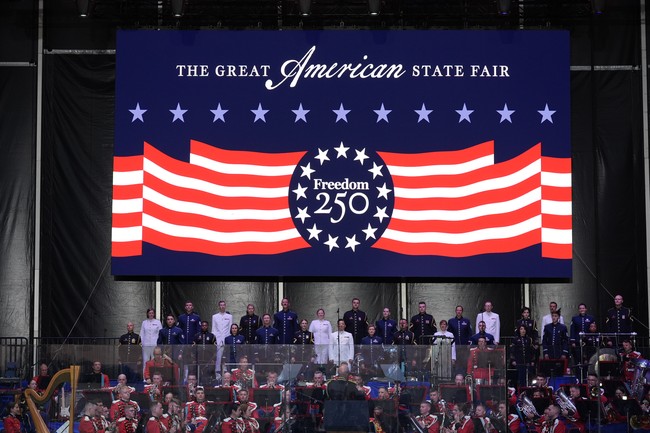
The Great American State Fair on the National Mall has drawn praise for its kickoff, but ten states declined to send official delegations; in response, senators, businesses, and private citizens stepped in to ensure their states were represented, sparking debates about patriotism, politics, and public responsibility.
The Great American State Fair launched on the National Mall as part of America’s 250th birthday countdown, and organizers say the kickoff went well despite loud public debate. Critics who refused to participate were quick to call the event partisan, while supporters argued it was a chance to showcase state histories and industries. That tension set the stage for a patchwork of participation across the country.
Ten states opted not to send official delegations: Connecticut, Illinois, Maine, Massachusetts, North Carolina, Oregon, Rhode Island, Vermont, Washington, and Pennsylvania. That list includes several historically significant states, including four of the original 13 colonies, which raised eyebrows among citizens who expected full participation. The choices by governors and officials drew immediate public attention and criticism from voices across the political spectrum.
10 states—Connecticut, Illinois, Maine, Massachusetts, North Carolina, Oregon, Rhode Island, Vermont, Washington, and Pennsylvania—have confirmed they will not send an official delegation to the “Great American State Fair” on the National Mall in celebration of America’s 250th.
9 of the states are led by Democratic governors, with Vermont being the only Republican-governed state to decline involvement so far.
https://x.com/Jules31415/status/2071196628157935664
Notably, PA Gov. Josh Shapiro tops the list of highest paid governors.
Pennsylvania became a flashpoint when citizens and commentators criticized the governor’s decision not to participate in the national celebration. Many Pennsylvanians felt their state has a central role in the national story and should be visible on the Mall during the country’s milestone year. That critique intensified when state leaders moved quickly to resolve the absence.
Sens. Dave McCormick and John Fetterman teamed up across party lines and worked with business leaders to secure a Pennsylvania presence on the Mall within hours. Their joint effort produced not only a booth but also volunteers and organizations to staff it, showing a practical path around a political deadlock. The senators emphasized that the exhibition would highlight Pennsylvania’s agriculture, industry, and historical legacy.
Pennsylvania’s two U.S. Senators say the state will have a presence at the Great American State Fair in Washington, D.C., days after Gov. Josh Shaprio said President Donald Trump had made the event too partisan, and that there has been insufficient interest.
In a joint statement, Democrat John Fetterman and Republican Dave McCormick said that with help from a number of state business groups, Pennsylvania would be able to join most other states with a display at the event, “to ensure Americans visiting the Great American State Fair can experience everything our Commonwealth has to offer.”
Fetterman put it plainly: “Celebrating America’s 250th birthday and Pennsylvania’s special role in our country is important and bipartisan. We discovered our Commonwealth wasn’t participating in the Great American State Fair on the National Mall and we should be.” His words underscored the idea that state representation need not be a partisan act. McCormick echoed that sentiment, framing participation as an obligation tied to Pennsylvania’s place in American history.
“Pennsylvania is where America’s story began, and there was no way we were going to let the Commonwealth go unrepresented during our Nation’s 250th birthday celebration,” said Senator McCormick. “As the birthplace of American independence, home to the hallowed grounds of Gettysburg, and the engine for the arsenal of democracy, Pennsylvania has a special responsibility to preserve, celebrate, and share that enduring legacy.”
The senators coordinated with the U.S. Department of Agriculture and a coalition of private Pennsylvania groups to staff the booth without using taxpayer funds. Organizations involved included state chambers of commerce, agricultural associations, farm bureaus, and manufacturing groups. The partnership model was meant to show that private initiative can fill gaps when elected officials step aside.
Other states saw individual leaders and private organizations step forward, too. In Washington state, a representative showed up to man an otherwise empty booth and used the moment to criticize the governor’s decision not to participate. In North Carolina, private corporations provided a display after the governor declined to take part, which later drew controversy over imagery shown in one exhibit.
Unfortunately Governor Bob Ferguson chose NOT to have Washington State officially participate in THE GREAT AMERICAN STATE FAIR, but I couldn’t let this stand, so I came down to man the nearly empty booth and show that not everyone in our state puts politics before celebrating our country. Fun to stamp the “passports” – as long as everyone said “Go Sea Hawks.”
Debate over displays and symbolism became immediate and heated, including a dispute about a North Carolina exhibit that featured contentious imagery and prompted calls for removal. Critics argued that had state officials engaged earlier, they might have influenced what appeared in their state’s booth. The episode highlighted how absence can lead to controversy that might have been avoided through direct participation.
Private citizens in Massachusetts, Connecticut, and Rhode Island also filled the gaps left by officials, sometimes anonymously for fear of backlash. Those grassroots efforts drew praise from locals while also raising questions about why elected leaders did not encourage or facilitate citizen involvement. Observers noted that participation by cities and territories remained strong, with many smaller jurisdictions embracing the national celebration.
I’m a not gonna let this go. Here’s a picture of Connecticut’s representation at the National Mall for 🇺🇸 250. A DISGRACE…
@ctdems, Lamont’s RADICAL REGIME, care more about: socialism, bashing Trump, illegal immigrants, taxes; any other STUPID left policy you can think of; than our country or state history — It was George Washington who relied on CT for provisions to win our independence. Ct cities from Bridgeport to New Britain that helped shape National commerce… and manufacturing like in Danbury making hats, or Waterbury making bullets to win WW2. Our history is rich. A tenet of “communism” is to destroy what was. Never forget we are the CONSTITUTION STATE… you can’t tell the story of 🇺🇸 without Nutmeggers. It’s ok to be PRIDEFUL in our heritage. This “display” is just another embarrassment/encapsulation of Hartford’s (@democrats) INCOMPETENCE, hatred — E Pluribus Unam!
Rhode Island’s absence from the Great American State Fair is a small story that reveals a large problem: the people officially representing us don’t appear to feel much obligation to do the job.
The more telling detail may be from Massachusetts, where a private citizen stepped in to make sure her state had at least some presence — but feared to give her name to reporters out of fear of political repercussions… for giving out maple syrup. That is where our political culture is.
Rhode Island’s officials and their media explainers have offered the usual fog: funding constraints, no real loss, nothing to see here. But the question is whether anyone even tried to find citizens or groupswilling to represent the state when government wouldn’t.
The answer matters because it points to the deeper condition: Those who hold power know they are insulated from consequences, while those who might better represent the public learn that stepping forward can make them a target.
That’s a bleak way to mark 250 years of the American experiment.
Despite the absence of official delegations from ten states, many cities and territories participated, and numerous private groups ensured their states were visible on the Mall. The fair runs through July 10, offering Americans from across the country the chance to see state exhibits, meet representatives, and engage with the stories each state brought to the celebration. For some, the event became a test of whether public service means stepping up when national moments call for unity and presence.

Add comment