
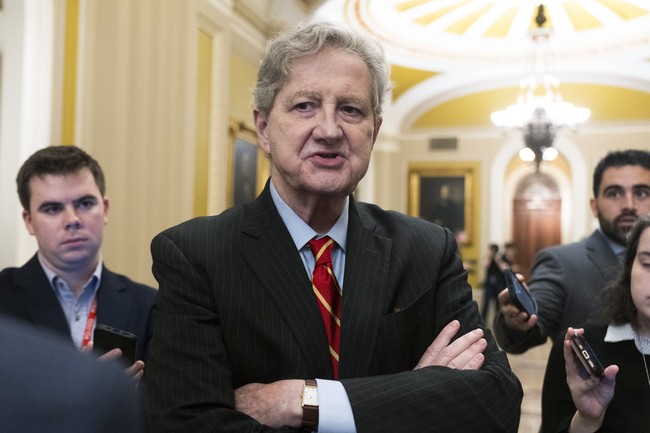
Sen. John Kennedy (R-LA) says he’s running for reelection to the Senate, but he didn’t close the door on a 2028 White House bid — especially if the Republican field fills with candidates he calls “goobers.” He stuck to blunt, no-nonsense commentary on everything from New Hampshire politics to D.C. statehood and Democratic socialism, delivering lines that played well to conservative voters and conservative media alike.
America Has Elected Two Adamses and Two Bushes. Sen. John Kennedy Isn’t Ruling Out Joining the Club.
Sen. John Kennedy isn’t declaring a presidential campaign, and he’s clear about priorities: focus on the midterms and a Senate reelection campaign. He’s candid about donor encouragement to aim higher, but he frames that outside pressure in practical terms and warns against a chaotic primary filled with weak choices.
On NewsNation’s “Katie Pavlich Tonight,” Kennedy’s answers were short and sharp, the kind of plain-spoken take that appeals to grassroots conservatives who want leadership, not theater. He described a New Hampshire stop meant to support former Sen. John Sununu and recounted an event where voters pushed him on 2028 ambitions, prompting a classic Kennedy non-answer that still carried a clear message.
https://x.com/KatiePavlichNN/status/2067074220689895664
Kennedy told the audience he was focused on the Senate but didn’t pretend politics is predictable. He used a line that both deflected and left room: he might step in if the field turns into a parade of poor candidates. That pragmatic posture keeps his options open while reinforcing his commitment to current responsibilities.
I said, look, I’m focused on the midterms. I’m planning on running for the United States Senate, but if you’re asking me, what if a lot of people enter the field, and I think they’re goobers, and I think I can do a better job, would I consider running? And I said, well, sure.
That quote sums up the strategy: prioritize the Senate race and the party’s immediate goals, but don’t rule out a higher bid if the alternative is a weak Republican nominee. Kennedy’s tone makes clear he sees himself as a corrective when the party drifts toward the unserious or the unserious in leadership.
Kennedy also leaned into humor and cultural touchstones to make a point. He referenced a Judds song to answer whether he’d ever entertain the presidency, using that country-pop line to deflate drama and signal an everyman willingness to serve if needed. It was showmanship without surrendering substance, the kind of approach that lands in retail politics.
I mean, I’ve had some people talk to me about that. Doesn’t mean I’m going to do it. But remember that song by the Judds, ‘Why Not Me?’
On other matters, Kennedy didn’t shy from tough stances the party base expects. He warned about the consequences of D.C. electing what he called a “crazy person” for mayor, saying federal oversight exists for a reason and suggesting the federal government would step in where local leadership threatens order. That line hits on conservative concerns about governance and federal prerogatives over the capital.
There are two main candidates, as best I can tell. One is a normal person, one is a crazy person. I hope the normal person wins, though I believe in democracy, and if the people elect the crazy person, they’re entitled to do that, but Congress and the president, the federal government has certain jurisdiction over D.C., and we’re not going to let the crazy person do crazy stuff if the crazy person wins.
He also rejected D.C. statehood outright, invoking the founders and the unique role of the District as neutral federal ground. That position aligns with conservative constitutional concerns and resists expanding partisan power through territorial reclassification.
I wouldn’t support it. I don’t think our founders intended for the District of Columbia to be a state. They meant for it to be neutral territory, if you will.
Kennedy didn’t spare Democrats from blunt characterization either, calling parts of their coalition democratic socialists who prefer ballot-box socialism to revolution. That direct labeling is meant to differentiate mainstream conservatives from left-leaning movements and to energize Republican voters ahead of midterm fights.
These folks — they’re socialists. Democratic socialists. They say they don’t believe in revolution, they believe in socialism at the ballot box.
He followed that critique with a bit of barbed humor aimed at opponents, suggesting their talents might be better suited to entry-level work than running the country. It lands as both insult and political strategy: underline incompetence and contrast it with conservative competence and common-sense leadership.
My advice to them is that their time would be better spent working at Panda Express and trying to work themselves up to management.
No Kennedy interview would skip the lighter personal details, and he brought up “Margaret,” the elliptical machine named after Margaret Thatcher, as if it were another character in his political life. The anecdote reinforces his persona: homespun, slightly theatrical, and unapologetically tough-minded on policy and principle.
Margaret is named after Margaret Thatcher because both kick butt and take names.
I love Margaret like the devil loves sin.
He ends the interview with his stated plan—to run for the Senate—while leaving a narrow opening if the presidential field deteriorates into something he believes the country can’t afford. It’s a cautious posture that keeps his credibility with the conservative base while signaling he could step up if needed.



Add comment