
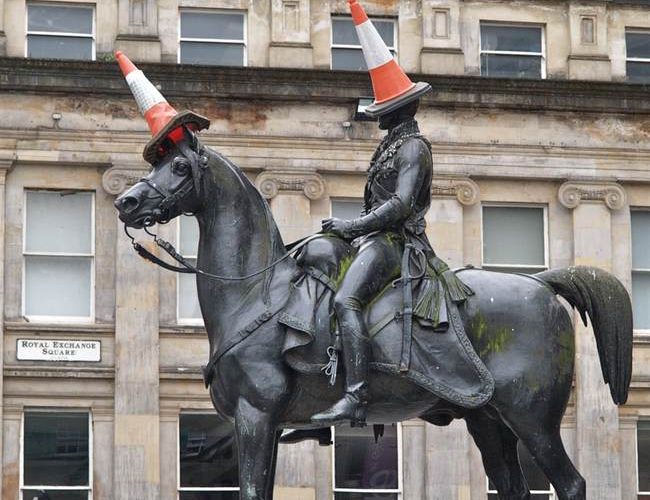
I’ll report on how Scottish fans brought their cone-on-statue prank to Boston during the 2026 World Cup, note the strange but harmless tradition’s roots in Glasgow, describe the Tartan Army’s busy takeover of local bars and landmarks, include exact quoted reporting about the phenomenon, and place the original embed tokens back where they belonged.
There is a curious, cheeky tradition from Scotland: putting traffic cones on statues. It began in Glasgow, where students famously placed an orange cone on the Duke of Wellington’s head, and the practice has become a running joke and a local emblem of irreverence. This year, those fans traveled to Boston for the World Cup and introduced that prank to several well-known city monuments.
The Scottish supporters known as the Tartan Army have been hard to miss in Boston, greeting locals with loud songs, kilts, and a willingness to make mischief. Alongside the revelry they carried an unexpected urban decoration plan: orange traffic cones perched on the heads of public sculptures. For many Bostonians it was funny, for others mildly annoying, and for most just another snapshot of festival behavior during a major sporting event.
Scotland soccer fans have taken over Boston during the 2026 World Cup, and members of the fan base known as the Tartan Army have brought one of their home country’s unique traditions with them.
Since the start of the World Cup, Scotland fans have been a major hit on social media, with viral videos showing them embracing Boston culture.
One piece of Scottish culture that Bostonians may have noticed is the placement of plastic orange traffic cones on famous statues around the city.
The cones have been spotted on the heads the Bill Russell statue outside Boston City Hall, the Make Way for Ducklings display in Public Garden, and more.
Boston’s reaction has been mixed but mostly amused, and the images spread rapidly online. Statues targeted included the Bill Russell monument near City Hall and the Make Way for Ducklings sculptures in the Public Garden, which lent the stunt a lighthearted, almost touristy feel. Videos and photos of fans balancing cones drew laughter and a fair share of headshakes from residents who prefer their monuments cone-free.
Beyond the cone jokes, the Tartan Army made a noticeable impact on the city’s nightlife and hospitality scene. Local bars and breweries reported surges in demand, with some outlets joking that the Scots “drank Boston dry” as they moved from pub to pub. The influx meant packed rooms, louder sing-alongs, and a boost to business for many establishments coping with an unexpected festival crowd.
I can attest that Boston takes its beer seriously, and seeing that consumption spike was a cultural moment: visitors bringing their own chant and cheer to a city already famous for spirited drinking. The Scots arrived in kilts and with a communal energy that quickly turned into memorably boisterous evenings. It created scenes that locals will talk about long after the matches end.
At its core this is a harmless, playful prank tied to fan identity and national humor rather than a deliberate act of vandalism. The cones are plastic, easy to remove, and the mess is minimal compared with other forms of misbehavior sometimes associated with large crowds. When the fans leave, city crews or amused residents can take the cones down and life will return to normal.
The tradition highlights how small rituals travel with people and sometimes attach themselves to new places. A practice born on Glasgow streets became a Boston talking point because a group of visitors chose to carry it with them. These kinds of gestures can be entertaining and reveal how fans shape local color during international events.
There is a visual and social element worth noting: the cone stunt is photo-friendly and easily shared, which helps it spread on social platforms. Videos of the antics circulated quickly, amplifying the impression of the Tartan Army’s presence and turning a local joke into a short-term cultural meme. That reach makes the prank feel larger than the sum of a few cones on statues.
Pranks like this sit in a gray area between mischief and harmless fun, and for now Boston seems to be treating it as the latter. Local authorities and custodians will likely remove any cones placed on monuments, but some Bostonians may choose to leave a few as a wink to the visitors who brought the practice ashore. Either way, pictures of cones crowning public art will be part of this World Cup’s memory of the city.
For those who want to see the antics unfold, here is footage that captures the crowds and the cone placements:
And more clips that show the good-natured chaos and the fan energy in parks and bars across the city:
Finally, here’s an embed that ties back to some of the local commentary and personal perspectives from attendees and residents:



Add comment