
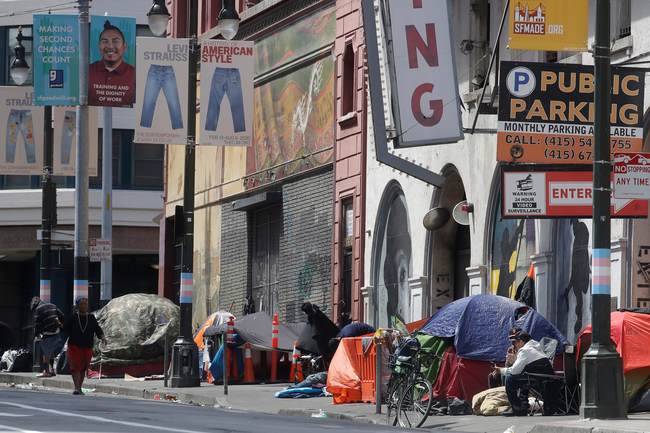
The city my father remembered in 1945 — clean, prosperous, and safe — is gone, replaced by open-air drug markets and gang control in parts of San Francisco. This piece examines how organized Honduran crews and cartel supply lines dominate the fentanyl trade, how political choices and non-enforcement have worsened public safety, and why local government has so far failed to restore order. It keeps the original on-the-ground quotes intact while arguing from a viewpoint that favors stronger enforcement and accountability.
My father spent a weekend in San Francisco late in 1945 and described it as a marvel: Clean, prosperous, safe, and fascinating. Those words stick because they contrast sharply with what a City Journal investigation and reporters on the streets now describe. Neighborhoods once known for culture and commerce have been hollowed out by a mix of homelessness, addiction, and organized drug crews.
A recent investigation found that a Honduran gang, the “Hondos,” has cornered the illegal drug market in much of the city and effectively taken control. If you’re looking to score hard drugs on the streets of San Francisco, the Hondos are your best bet. In 2022, former San Francisco mayor London Breed seemed to admit as much in a radio interview, saying that “a lot” of the city’s drug dealers were Honduran.
Breed faced backlash and was pressured into issuing a public apology, but the underlying reality remains: migrant gangs, primarily from Honduras and supplied by Mexican cartels, run the fentanyl trade in San Francisco. Reports in 2023 showed Hondurans had “taken over the sale of [fentanyl]” in open-air markets, and federal prosecutions reflected that “nearly all” low-level fentanyl and meth dealers were Honduran men without legal status. Those findings map onto what residents and reporters observe on the sidewalks.
The Tenderloin is now a concentrated example of policy failure: homelessness, street-level drug sales, and unauthorized immigration intersect in a way that hands control to criminal crews. On one night observers watched a Honduran crew at the corner of 6th Street and Market working with a clear hierarchy: a shot caller, multiple dealers, spotters, and a homeless mule holding product. When asked to sell, one crew member stood on the sidewalk and nodded, saying, “how much?” in between puffs on his cigar.
That kind of brazenness signals a deeper problem than isolated street crime. Another dealer offered “ISO,” or isotonitazene, described in medical research as up to nine times stronger than fentanyl, and quoted prices like a gram for $30. We also met a dealer who identified himself as a Mexican national and said, “In five minutes, I was already on the other side,” about crossing into the country. Those on-the-ground admissions make clear the human and policy threads feeding the trade.
Police presence often means lights on a cruiser and brief dispersal, not arrests or sustained action. One account detailed an officer who parked, flipped on red and blue lights, and left the vehicle; dealers melted away and reassembled seconds after the cruiser drove off. That scene illustrates non-enforcement: a performative response that does nothing to disrupt supply, protect residents, or stop dangerous sales.
The results are deadly. Since fentanyl became the street drug of choice, overdose deaths have skyrocketed, and supply channels that link cartels to street crews only accelerate harm. Local policy choices matter: permissive approaches, de-prioritization of enforcement, and failure to secure the border all combine to create the conditions where gangs flourish and citizens suffer.
Political responsibility is unavoidable here. When city and state leaders favor soft approaches that amount to tolerance of open-air markets and non-enforcement, they cede public spaces and safety to criminal groups. The primary purpose of legitimate government is to protect the liberty and property of citizens, and in neighborhoods like the Tenderloin that duty is not being fulfilled.
There are moments on the street that force a choice between rhetoric and action. Watching dealers sell fentanyl and stronger analogs in full view of passersby is not just an urban nuisance; it is a public-health emergency and a law-and-order failure. Unless voters demand accountability and elect officials willing to put safety and enforcement first, the decay will continue and neighborhoods that once drew visitors and residents will keep sliding into chaos.


It is a shame what has happened to San Francisco. Lack of politicians who really care about the people. All they care about is lining their own pockets and the hell with everyone else. They need to own up to the major mistakes made with the people running that state, not only San Francisco. Be careful what you ask for. Learn from the past few years and get that state back to the beautiful place it use to be. It is a sin what has gone on the last 10 or so years. It is now a hell hole.