
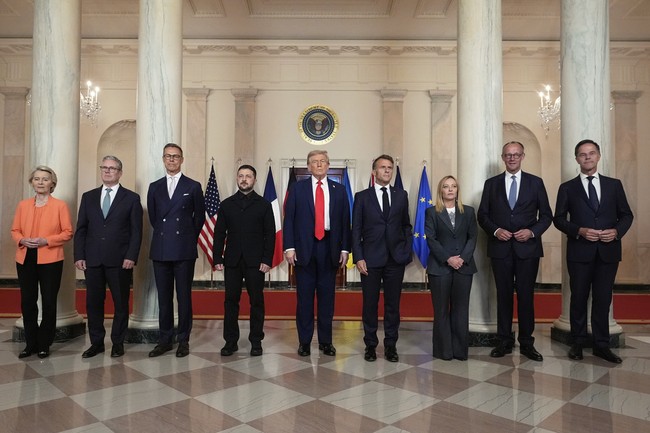
The U.S. relationship with NATO is unraveling as key European partners restrict basic military access and refuse transit and airspace support, prompting sharp criticism from Republican leaders who say the alliance no longer serves American interests unless it becomes reciprocal again.
The gap between Washington and major NATO capitals has widened sharply, with France, the United Kingdom, Germany, and Spain placing limits on base use and even denying cargo transit through their airspace. These moves have exposed the imbalance in burden-sharing, and they have stirred questions about whether continued U.S. commitments to station forces in Europe make sense. When allies block straightforward logistical support in a crisis, it undermines the fundamental expectation of mutual cooperation.
Longstanding U.S. investments in European defense are substantial, and they underpin security across the continent. The United States provides roughly 65 percent of NATO’s total defense spending, and American forces and equipment are the linchpin for deterring aggression in Eastern Europe. If that level of contribution does not guarantee basic cooperation like base access and airspace transit, the argument for keeping troops forward-deployed weakens.
The historical context adds fuel to current frustrations. One of the earlier quoted sections in this piece details sharp criticism of France’s role during Iran’s 1979 revolution and frames the present-day snub as a betrayal of past U.S. commitments to European security. That passage argues America has been bearing a disproportionate cost while European partners “refuse to reciprocate in any real way.” The sense of imbalance runs deep and is now boiling over into public calls for a reassessment.
France, the United Kingdom, and Germany have been asked to do very little in support of this mission. For the most part, the request has simply been for them not to get in the way. This constitutes getting in the way, and it’s a betrayal that should not go unchecked.
Keep in mind, it was the French who gave the Islamist extremists refuge during Iran’s 1979 revolution. They then flew the Ayatollah into the country to take power. Aside from the regime itself, no one else is more responsible for the nearly half a century of death, destruction, and oppression in Iran than France. For them to now snub their noses at the United States, which has committed trillions of dollars over the years to make sure Russia doesn’t run roughshod over Europe, is inexplicable.
(…)
There is no point in being in such a one-sided alliance. America pays for the lion’s share of NATO’s defense spending, all while European nations refuse to reciprocate in any real way. We don’t need France’s support if Mexico decides to invade Texas, but France needs us if Russia marches through Ukraine and into the rest of Eastern Europe.
Marco Rubio voiced that frustration bluntly in a recent interview, arguing that if NATO prevents the United States from using bases in Europe when national security demands it, the alliance has become a one-way street. That critique goes beyond rhetoric; it demands a policy-level response about what mutual defense really means. Allies barring access in a crisis forces a rethink of where and how the United States positions forces overseas.
RUBIO: It wasn’t just about defending Europe. I said it also allowed us to have military bases in Europe that allowed us to project power into different parts of the world when our national security was threatened. If now, we have reached a point where the NATO alliance means we can’t use those bases, that in fact, that we can no longer use those bases to defend America’s interests, then NATO’s a one-way street.
That NATO is simply about us having troops in Europe to defend Europe, but when we need their help, not their help, we’re not asking them to conduct airstrikes, when we need them to allow us to use their military bases, their answer is no? Then why are we in NATO? You have to ask that question. Why do we have billions and billions of dollars, hundreds of billions of dollars over the years, trillions of dollars, and all of these American forces stationed in the region if we can only use, in our time of need, we’re not going to be allowed to use those bases?
So I think there’s no doubt, unfortunately, after this conflict is concluded, we are going to have to reexamine that relationship, we are going to have to reexamine the value of NATO and that alliance. Ultimately, that’s a decision for the president to make.
Alliances are meaningful only when they are reciprocal and reliable. Rubio made clear he is not demanding European combat action in every case, but he expects basic cooperation: access to bases, permission to transit airspace, and the ability to move materials quickly. When those fundamentals are denied, the strategic calculus shifts and Washington must consider alternatives.
The Ukraine conflict illustrates how the United States has voluntarily accepted burden and risk for the sake of deterring broader aggression in Europe. Ukraine is not a NATO member, and there was no treaty obligation to act, yet the U.S. provided massive financial and military support to blunt Russian expansion. That willingness to step up contrasts sharply with current allied reluctance to facilitate U.S. operations in other theaters.
President Donald Trump has reinforced the message that NATO’s future depends on whether European partners start acting like partners. He framed past U.S. support as conditional, noting that allies benefited from American commitment even when the direct obligation was unclear. That stance signals a move toward tougher negotiations over burden-sharing and clearer limits on unconditional access.
“Ukraine wasn’t our problem. It was a test, and we were there for them, and we would always have been there for them. They weren’t there for us.”
NATO now faces a clear choice: either accept the security umbrella that allowed European nations to prosper or insist they shoulder a fair share of the burden. If European capitals prefer to limit U.S. access and still rely on American deterrence, Washington can respond by recalibrating forward presence and cooperation. For Republicans focused on national interest and returns on strategic investments, the current imbalance cannot stand.
Editor’s Note: For decades, former presidents have been all talk and no action. Now, Donald Trump is eliminating the threat from Iran once and for all.


Pack all the no king communist up and send them to the communist country of their choice. No assets can be take with them. NEVER EVER to be able to return!!!!
My income reached $17,620 last month, thanks to a flexible online job. It’s astonishing how easy it is to get started and see real results. I spend my mornings working and still have the whole day to relax. The extra money has made a big difference in my financial situation. It’s a fantastic way to boost your income without overworking yourself..
Visit This…… PayAtHome1.Com
Robert Hampton; that’s the way it is, I agree!
Pack all the no king communist up and send them to the communist country of their choice. No assets can be take with them. NEVER EVER to be able to return!!!!
Robert Smith; exactly we must put all of the communists in our Constitutional Republic under God where they belong, and that’s as far away from America as possible!
I vote not one cent to NATO
Doris; agreed, absolutely nothing, zilch or ZERO!
“America has been bearing a disproportionate cost while European partners “refuse to reciprocate in any real way.” Ya Thunk?
These ‘one way’ countries need a kick in their posteriors. Pull every American military unit out of these nonsupporting ‘European countries,’ and let them SWING IN THE WIND! America might consider support on an individual country basis, but not any NATO country that fails to reciprocate that support! As is said far too often in America today, “You Just Can’t Make This Schiff Up.”
Firewagon; now that’s a proper game plan and it should be America’s next move in the global political arena! And that’s no Bull-Schiff!!!
France, England, Poland, Czechoslovakia, Denmark, Hungary, Netherlands, Norway, et al haven’t learned the lesson of 1938 when, with a solid show of power, they may have averted or substantially delayed Hitler’s war plans. Instead, their weakness only emboldened him, and World War II was the result.
NATO was formed to prevent the Soviet Union from expanding its conquests beyond “the iron curtain” of Eastern Europe (East Germany, Poland, Hungary, Czechoslovakia, Romania, et al.
Now, when the US and Israel have taken decisive action to prevent Iran from becoming a nuclear power and its support of terror throughout the world, what do our NATO partners (?) do, they refuse their help in the most minimal of ways. The US is not asking for military support but logistical support and it’s being denied by those who should know better.
“Those who don’t know history are doomed to repeat it,” Edmund Burke.
France and England have certainly forgot their history and not learned that lesson.
luffa; you are absolutely correct and give a fine explanation of the truth that is so sorely lacking in the hearts and minds of so many former allies! This is what liberalism and willful ignorance with complacency has provided to multitudes as they set themselves up for destruction!
The darkest enemies are licking their chops waiting for the time when they can conquer and control them all like so many sheeple being led to their slaughter!!!