
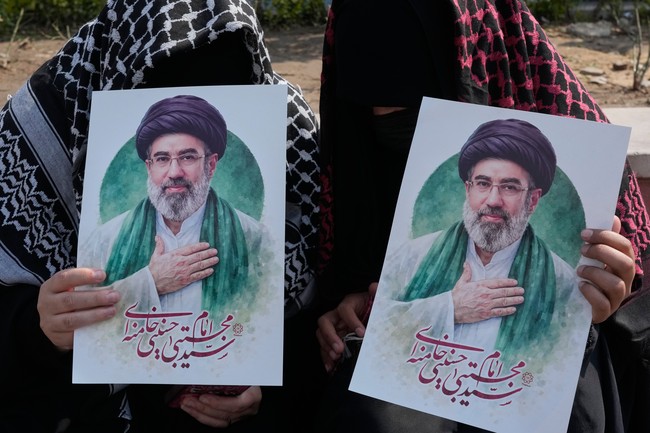
This article reviews reports that Iran’s reported new Supreme Leader, Mojtaba Khamenei, is staying hidden in an undisclosed location and relying on couriers for communication, how that has affected negotiations with the United States, and why Republican observers view this as evidence of regime disarray and opportunity for decisive U.S. policy.
Multiple outlets have circulated claims that Mojtaba Khamenei went into hiding during the opening phase of Operation Epic Fury, and that his access to reliable communications is severely limited. Recent intelligence assessments portrayed to reporters suggest he is alive but operating from a highly secured, secret location. The key detail that has drawn attention is the use of a network of messengers rather than direct electronic lines, a throwback method meant to reduce the risk of targeted strikes.
The lack of normal communications has real consequences for diplomacy and bargaining over a potential ceasefire or framework agreement with Tehran. U.S. officials say even senior Iranian figures struggle to relay clear, timely instructions up the chain of command, producing delays and confusion in talks. From a Republican perspective, this chaos undercuts the credibility of Iran’s negotiating posture and argues for a firmer stance rather than concessions that reward disorganization.
Embedded reports include a blunt, quoted summary that captures the bureaucratic disaster: The exact quote presented by sources reads, “UPDATE—CBS reports Iran’s Supreme Leader Mojtaba Khamenei is hiding in a secret location, communicating only through a network of messengers to avoid assassination by Israel.” That passage, and the follow-up reporting, emphasize that U.S. intelligence judges him reachable only through a labyrinth of couriers, a system with slow, dated responses.
A quoted section of the reporting further notes, “US intelligence says even senior Iranian officials cannot contact him directly, causing major delays in US-Iran negotiations. Officials described the regime’s underground communications as chaotic and ‘almost like watching a sitcom.'” Those words paint a picture of a fractured command structure and reinforce the view that Tehran’s leadership is under intense pressure and scrambling for control.
Sources say Mojtaba is exercising caution because of what happened to his father, former Supreme Leader Ayatollah Ali Khamenei, who was killed in a joint U.S.-Israeli strike in February. Quoted reporting states, “U.S. intelligence shows that Iran’s supreme leader is effectively holed up in an undisclosed location with little access to the outside world and is only reached by a labyrinth of couriers, according to U.S. officials with knowledge of the matter.” Those words, presented without interpretation, underscore the severity of the regime’s operational security concerns.
Within Iran, the reported reliance on messengers means only broad negotiating parameters are being passed down, and many tactical details stall. “Every piece of information he receives is dated and there’s a lot of latency to his responses,” an official told reporters, which explains why routine dealmaking can take days rather than hours. From a Republican standpoint, delay is not a reason to negotiate timidly; it is a reason to press demands while Tehran is disorganized.
There have also been unverified claims about Mojtaba’s health after the strike that killed his father, including reports he was injured and possibly disfigured. Those accounts remain uncertain, and officials caution against treating rumors as fact. Still, the broader pattern is clear: leadership under duress, severely hampered communications, and a closed chain of decision-making that makes any deal with Tehran problematic unless it addresses the asymmetry and threat posed by the regime.
The practical effect on U.S. diplomacy has been visible: negotiators report delays, contradictory statements coming from Tehran’s side, and a struggle to get enforceable commitments in writing. That dysfunction reduces the value of incremental agreements unless they include ironclad verification and consequences. Republicans argue that Washington should use the leverage that comes from Iran’s disarray to insist on terms that truly secure American interests and regional stability.
The image many commentators use is of leaders living in isolation, sometimes going weeks without sunlight, relying on old-fashioned couriers to relay instructions. That scenario raises hard strategic questions about how the U.S. should proceed: exploit their weakness to dismantle capability, or risk stabilizing a brittle regime through a flawed deal. For those who favor a robust approach, the current chaos is evidence that decisive pressure, not hasty compromise, is the right policy choice for protecting American security and allies.


Add comment