
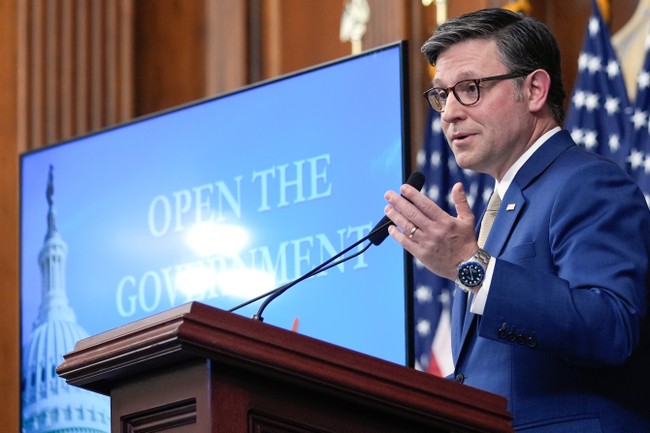
Mike Johnson has taken the punchy, unapologetic approach voters wanted, calling out Democratic leaders for failing to stop what he calls the Schumer Shutdown, and using plain facts and forceful rhetoric to put the blame where he believes it belongs. This piece lays out how Johnson has paired words with action, why Democrats are hesitant to negotiate, and how media reactions are shifting under the pressure of real political consequences.
Republican voters long complained about politicians who loved talking more than doing, and Speaker Mike Johnson has leaned into that frustration. Instead of empty speeches, he pushed a clean continuing resolution through the House and has publicly forced votes in the Senate that expose where Democrats stand. That mix of legislative moves and blunt messaging is designed to show results and pin responsibility on Democratic leaders.
Johnson’s tactic is straightforward: make the political cost of holding the government closed higher for Democrats by naming who he thinks is driving their hesitation. He argues that the party’s left flank and rising figures in New York have produced fear among establishment Democrats, preventing sensible negotiation. That framing turns a procedural dispute into a story about leadership cowardice and ideological control.
He hasn’t stopped at headlines or floor speeches; Johnson repeatedly highlighted how the House passed the clean continuing resolution on September 19th and then pushed the Senate into votes that would force Democrats to either support reopening the government or own the shutdown. For many Republicans, this is the kind of accountability that had been missing in previous cycles. It’s meant to reassure the base that Republican leaders can act, not just rail.
Johnson’s message has been blunt about who he sees as responsible, naming specific Democratic leaders and pointing to New York politics as a reason they won’t act. He frames it as a fear of retribution from the party’s far-left activists rather than a concern for SNAP recipients or public safety workers. That accusation is intended to present a moral choice: put political ambition ahead of basic government functions, or step up and govern.
Because the fear that Mamdani and all that he represents will be risen to power, that he’ll elected the mayor of America’s largest city, the once cradle of capitalism, that we’re going have a Marxist, a communist, running the largest city. Now this terrifies the establishment old guard Democrats in Washington, and the leaders of both chambers are among those most terrified. They’re both from New York. Leader Hakeem Jeffries is the Democrat in the House, and Leader Schumer in the Senate. They’re both from New York, and they’re terrified. You’ve watched their actions carefully. Many of you have not reported on it enough.
Poor Hakeem Jeffries had to ultimately, finally, he was forced to endorse Mamdani, and he’s terrified that he now owns the results of that. Chuck Schumer’s been dancing around the issue, but he knows he’s darned if he does, darned if he doesn’t. They’re both terrified, and so that is the fear. This is a fact, and you should print it this way. Schumer and Jeffries, and their colleagues, fear political retribution from the Far-Left activists in their party more than they fear the consequences of keeping the government closed for weeks on end.
They fear that personally, for their own political future, and they care more about that than they care about SNAP benefits flowing to hungry families, about air traffic controllers being paid so they can keep the skies safe, border patrol, troops, and all the rest. It pales in comparison, and this is a simple summary that is a simple fact. It is extremism on the Left that is the direct cause of American suffering right now.
Those words are meant to force a public reckoning about priorities: elected officials who put factional politics ahead of government operations. Johnson’s approach leaves little room for plausible deniability because he matched rhetoric with specific votes and documented procedures. For Republicans watching, it looks decisive and aimed at exposing who is willing to bear the political cost of a shutdown.
Media coverage has shifted in spots, and even networks normally sympathetic to Democrats have begun asking tougher questions about who is responsible for the impasse. When outlets frame the issue as Democratic leaders refusing to act because of internal party pressures, the political dynamics change fast. That helps the GOP argument that responsibility rests with the Democratic leadership in Congress.
Johnson’s leverage is largely rhetorical and procedural right now, not unilateral; he cannot force the Senate or the White House to change course. Yet he can and has used the House’s actions and public messaging to shape how the story is told. If public opinion keeps moving and outlets keep spotlighting Democratic reluctance, that could increase pressure on them to change their stance.
Editor’s Note: The Schumer Shutdown is here. Rather than put the American people first, Chuck Schumer and the radical Democrats forced a government shutdown for healthcare for illegals. They own this.
Watch:
And just to demonstrate how Johnson’s message is getting through even with some in the notoriously Democrat-compliant press, take a look at these two segments from CNN, for instance, where the anchor herself is now putting the onus on Democrats to reopen the government:


Add comment