
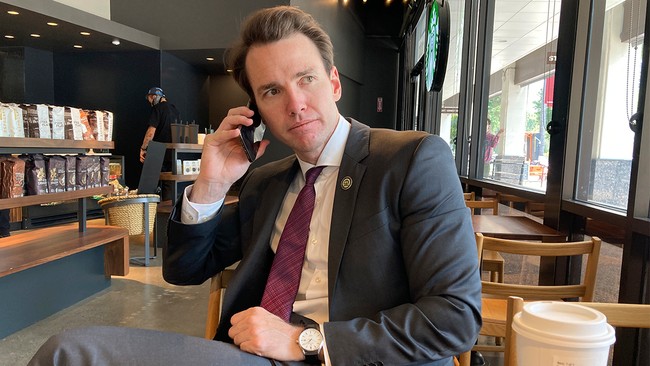
The California primary count is still unfolding, but one thing is clear: Kevin Kiley, running as an Independent, appears to have clinched a spot in the general election for the newly drawn District 06, a result that underlines the unusual dynamics of California politics and the power of voters who want effective representation over partisan theater.
Decision Desk HQ now reports that GOP Rep. Kevin Kiley is victorious in the primary and will advance to the general election: Kiley’s decision to run as an Independent after redistricting shows a willingness to adapt and put service ahead of party labels, which many voters in his district found appealing. That momentum matters in a state where party machinery often dominates, but where practical, results-oriented candidates can still break through.
The race for the second spot on the November ballot remains competitive, with Democrat Richard Pan and Republican Michael Stansfield still locked in a tight contest for the remaining place; their totals are too close to call at the time of this writing. With the jungle primary system in place, the configuration of the top two matters a great deal, especially if two conservatives advance and prevent a Democrat from taking the seat outright. Voters who want a representative focused on local issues rather than ideological purity have shown they can make that choice.
https://x.com/DecisionDeskHQ/status/2063040212008128794
As returns trickled in, the picture looked favorable for Kiley. With 46 percent of the vote estimated to be in, Decision Desk HQ showed Kiley in the lead: That early advantage reflected both name recognition from his prior service and a message that resonated with constituents tired of one-party maneuvers.
Kevin Kiley (I): 21,781 (24.9%)
Richard Pan (D): 19,897 (22.7%)
Michael Stansfield (R): 18,767 (21.4%)
One columnist explained why California’s electorate can be unpredictable: many Californians are not strictly aligned with national party brands and prefer representatives who tackle problems and deliver results. That idea helps explain how a candidate like Kiley, who has a record of pushing conservative reforms in the legislature and then serving in Congress, can appeal to this broader slice of voters. Practical governance and accountability still matter to people juggling high costs of living and daily concerns about schools, housing, and public safety.
What people fail to realize about the state of California is that, despite the deep blue progressive governance that has dictated much of its policies, many Californians are neither team red nor team blue. They just want life and their state to work and their elected representatives to work for them, and not just for themselves.
That is the factor that could guarantee Kiley pulls off a win in this newly reconstituted district. With 45 percent of precincts reporting, Kiley is leading the race and will more than likely make the Top 2 for the November election.
Observers who follow California politics pointed out that Kiley’s roots in state government and his time in Congress gave him a platform to critique the state’s direction while offering concrete policy alternatives. Those critics of Sacramento’s status quo appreciate a candidate who calls out bad policy and then proposes alternatives that emphasize common-sense reforms. That approach can win over swing voters who feel ignored by the political class.
Some analysts tied Kiley’s independent label to the fallout from recent redistricting, claiming that the new map was engineered to dislodge certain conservatives. That claim fed a narrative that motivated his supporters to rally behind him as a defender of local interests against partisan redistricting. Running outside the traditional party badge gave Kiley freedom to argue directly to constituents rather than being boxed in by intra-party fights.
Veteran commentators also highlighted a strategic upside for conservatives if the second-place finisher remained a Republican: a November runoff between two right-leaning candidates would shut Democrats out of the final contest and preserve a conservative seat. That scenario would be a clear repudiation of attempts to reshape districts for partisan gain and a win for voters who prefer policy over politics.
…[H]e’s currently leading the vote count. In the jungle primary system, that would mean that if his lead holds, he would head to a run-off.
Here comes the good part: the second leading vote-getter is also a Republican — Michael Stansfield. If that stays the case, it would ensure that there were no Democrats in the final two, and no Dem could capture the seat.
At the moment, final tallies are still pending and the situation could change as more ballots are processed, but the early returns are encouraging for those who backed Kiley’s pragmatic conservative message. The coming weeks will tell whether the top two hold their positions or whether a late surge reshapes the field, but the contest already highlights how independent-minded campaigning can succeed in California’s unusual political landscape.


Add comment