
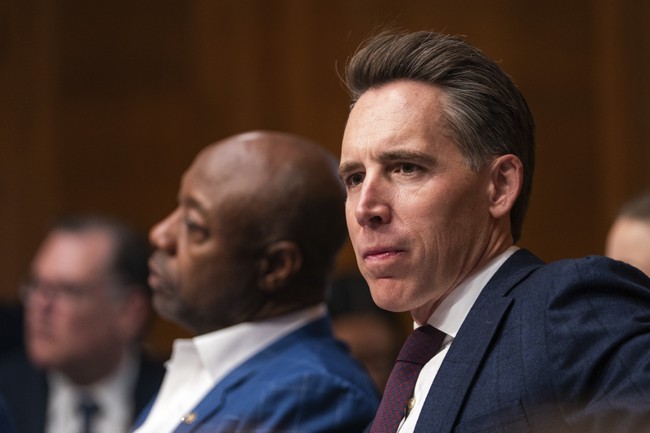
Sen. Hawley Confronts a Refusal to Answer a Simple Biological Question
The Senate hearing turned into a spotlight moment when Sen. Josh Hawley pressed an invited expert repeatedly on whether men can get pregnant, exposing an evasive answer that many conservatives see as emblematic of a wider problem: when ideology or caution trumps clear, evidence-based statements from medical professionals.
The exchange opened a debate about honesty, medical authority, and public trust in expertise at a time when Americans want straightforward answers from doctors and officials. Hawley’s line of questioning aimed to test whether scientific clarity still guides public testimony or whether political sensitivities now silence ordinary factual statements. The witness’ refusal to give a direct yes-or-no response became the story, not because the question was complicated, but because the witness framed the question as political rather than factual.
Watching the clip, conservatives felt vindicated that someone finally called out equivocation dressed up as nuance. The hearing was not a stunt; it was a demand that a credentialed medical witness answer a basic biological question plainly. When that doesn’t happen, it feeds a growing skepticism about who to trust on matters of health, safety, and public policy.
What happened in that hearing matters beyond a single exchange. Americans rightly expect doctors to tell the truth plainly and to rely on clear scientific definitions when testifying before Congress. When experts dodge simple questions by citing identity language or claiming the question is political, it raises concern about whether medical testimony is being shaped by social considerations rather than by biology and clinical practice.
HAWLEY: Since you bring it up, why don’t we just start there? Dr. Verma, I wasn’t sure I understood your answer to Sen. Moody a moment ago. Do you think men can get pregnant?
VERMA: I hesitated there because I wasn’t sure where the conversation was going or what the goal was. I mean, I do take care of patients with many identities. I take care of many women, I take care of people with different identities, so that’s where I paused. I wasn’t sure where you were going with that.
HAWLEY: Well, the goal was just the truth. Can men get pregnant?
VERMA: Again, the reason I paused there is because I’m not really sure what the goal of the question…
HAWLEY: The goal is just to establish a biological reality. You just said a moment ago that science and evidence should control, not politics. So let’s just test that proposition. Can men get pregnant?
VERMA: I take care of many people with many identities, but I take care of many women that can get pregnant. I do take care of people that don’t identify as women.
HAWLEY: Can men get pregnant?
VERMA: Again, as I’m saying…
HAWLEY: Let me just remind you of what you testified to a moment ago. Science and evidence should control, not politics. So, can men get pregnant? You’re a doctor i think.
VERMA: I totally agree that science and evidence should guide medicine…
HAWLEY: Do science and evidence tell us men can get pregnant? Biological men? Can they get pregnant?
VERMA: I also think yes/no questions like this are a political tool…
HAWLEY: No, yes/no questions are about the truth, doctor. Let’s not make a mockery of this proceeding.
That block of testimony shows why this issue resonates. The exchange is not merely about semantics or politeness; it’s about whether a medical professional will state, plainly and unambiguously, what biology entails. For many conservative voters, the refusal to answer the question directly is proof that some experts prioritize ideological framing over scientific clarity.
Critics argued that the witness’ emphasis on identities and caution was a deliberate avoidance tactic, not a legitimate medical uncertainty. In practical terms, doctors who can’t or won’t make clear, evidence-based statements risk undermining public confidence in medicine. When the public cannot rely on straightforward expert testimony, it weakens the standing of the profession in moments that require trust, like pandemics or public-health emergencies.
Republicans pressing for direct answers see this as a matter of accountability. If a credentialed medical witness asserts that science should triumph over politics, then senators are entitled to insist that science be applied consistently in testimony. Allowing evasive answers sets a bad precedent: future hearings could be dominated by qualifier-heavy responses that leave citizens confused and policymakers impotent.
The larger concern is institutional. When major public institutions tolerate or enable ambiguity in basic scientific matters, they invite suspicion and politicization. People do not lose faith in medicine because they want complexity explained; they lose faith when complexity is used as cover for avoiding clear statements of fact.
These are not abstract worries. The hearing makes clear how fragile public trust can be and how quickly it erodes if medical testimony appears driven by social messaging rather than by straightforward clinical realities. The American public deserves experts who will speak plainly on matters where biology and medicine provide clear answers.
Ultimately, the clip has become shorthand for a broader argument: conservatives demand clarity from institutions that claim authority over public health and safety. If experts insist that science guides policy, then their testimony must reflect that principle in practice, not only in rhetoric. When that standard is ignored, hearings like this one show why voters grow skeptical and why policymakers must keep asking hard questions.



Add comment