
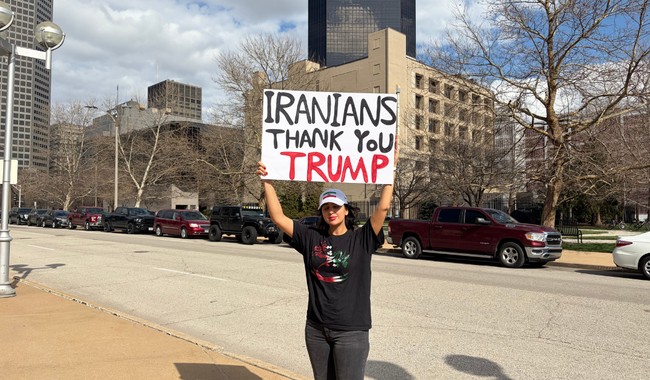
The article reports on a rally of Iranian-Americans outside a federal courthouse in St. Louis where roughly 50 people urged Senator Eric Schmitt to support Reza Pahlavi for leadership during a potential transitional period in Iran, while attendees shared personal stories of repression, loss, and hopes for a free future for their homeland.
On Friday afternoon a group of Iranian-Americans gathered in downtown St. Louis to press their case to local offices and to make their voices heard about Iran’s future. The crowd, about 50 people strong, wanted to know if Sen. Eric Schmitt would back Reza Pahlavi as a potential leader during a transition away from the current regime. The mood mixed urgency with grief as people connected their pleas to real, painful experiences back in Iran.
A small delegation from the rally met with staff in Schmitt’s office, and while details were kept private, attendees described the meeting as meaningful and emotional. Several people recounted family tragedies and ongoing fears tied to the rule of Ayatollah Ali Khamenei. Those stories underscored why the group is pushing for a clear, pragmatic plan to replace the regime with a government committed to human rights.
One woman at the rally, Sheri, has lived in the United States for 41 years and learned that her cousin in Tehran died of cancer after being denied medical treatment because she was considered “too old.” Sheri’s cousin was 59 years old, and Sheri also said other family members who participated in recent protests were killed by the regime. Her account illustrated how state brutality affects ordinary families and turns private grief into public calls for change.
Amina Muhammedalipour, a local university physics instructor, said she is constantly worried about relatives in Tehran and became emotional while describing the situation. Her inability to speak without crying made the stakes painfully clear to those listening. These personal testimonies showed how exile does not sever the bond to a homeland where daily life can be a struggle for safety and dignity.
Another speaker at the rally, identified as Pastor Raymond, expressed an uncompromising view about the former regime, arguing that every member must be eliminated or the system will simply reconstitute itself. He connected his warnings to broader themes about European societies and migration, bluntly stating, “Europe is gone.” His remarks mixed historical references with a stark contemporary assessment of cultural and demographic shifts.
Raymond also pointed to a historical period under King Cyrus when Iranians, he said, experienced a society of relative freedom, human rights, and gender equality. He argued that the rise of Islam in the seventh century changed that trajectory and described Islam as “a cancer,” warning that similar developments could spread to the United States unless addressed. Those comments drew both strong agreement and quiet reflection from the crowd.
Ahdieh Coleman, a Baha’i who has lived in the U.S. for 30 years, described the discrimination she faced as a member of a minority faith in Iran, including being expelled from school twice. Her testimony highlighted the systemic persecution that religious and ethnic minorities endure under the current Iranian leadership. Many at the rally said that the experiences of people like Coleman show why a clear, rights-respecting alternative is essential.
Across interviews, two themes came up repeatedly: deep gratitude toward the United States and President Trump for efforts that attendees view as weakening the regime, and a unanimous preference for Reza Pahlavi to play a central role in a transitional government. Those priorities shaped the rally’s message and framed the delegation’s request to local officials.
Hearing these stories drives home how many Americans have little sense of what life under a repressive state can feel like—waking each day uncertain whether a comment, a choice of clothing, or an opinion will lead to arrest or worse. Attendees made a point of thanking supporters and emphasizing how much they value American freedoms, describing heartfelt gratitude for allies who have spoken up on their behalf.
Strangers hugged and offered thanks to those who came to listen, and many described Iranian people as warm, loving, and deeply attached to their homeland while committed to freedom. The rally was an act of political petition and a communal expression of mourning, hope, and determination to see Iran directed toward a more open, just future.
The voices at the courthouse reflected a broad set of experiences but a single urgent desire: to ensure a real transition that protects human rights, holds oppressors accountable, and empowers democratic leadership. For those who attended, backing a clear transitional figure and building international support are the next steps in a long, difficult effort to reclaim their country’s future.


Add comment