
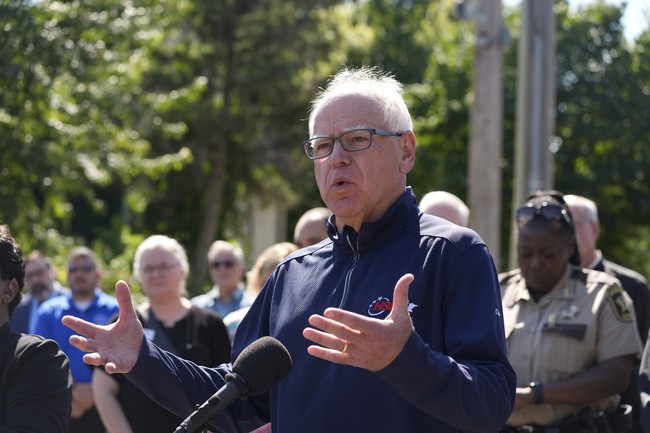
This piece examines Minnesota Governor Tim Walz’s public condemnation of Elon Musk alongside his decision to campaign for Maine Senate candidate Graham Platner, who once had a tattoo tied to Nazi imagery, highlighting the inconsistency between Walz’s rhetoric and his political choices.
Tim Walz publicly labeled Elon Musk a Nazi sympathizer after a hand gesture at a rally, presenting that claim as settled fact without evidence or qualification. That sharp moral posture became a recurring theme in his comments, setting a high standard for who gets called out in public life. When politicians speak so forcefully about symbols and intent, voters expect consistency in how those standards are applied.
Now Walz is traveling to Maine to campaign for Graham Platner, a Democratic Senate candidate who for nearly two decades had a Totenkopf tattoo, a skull and crossbones design that many associate with SS iconography. Platner covered the tattoo only after reporters began asking questions, and he has offered explanations about its origin and removal. The juxtaposition of Walz’s earlier certainty about symbols and his willingness to appear with Platner raises questions about selective outrage and political calculation.
“We knew that the implication and they’re throwing so much at us that we’re fatigued, you know, we spent three days, you know, debating, having them trying to debate that President Musk gave a Nazi salute. Of course he did.”
That quote, delivered on national television, framed the issue as settled and exhausting, leaving little room for nuance. Yet Walz’s choice to lend his voice to Platner’s campaign suggests a different tolerance when a candidate aligns with his party’s electoral needs. Observers on the right and independents see this as an example of the two-tiered standards politicians often apply when politics is at stake.
Platner has said the tattoo came from a drunken episode overseas in 2007 and that he did not understand its meaning at the time. He covered the image with new ink once reporters raised the issue, citing limited local options for laser removal and a rushed decision to conceal it. Platner has apologized and described the incident as part of a darker period in his life, a narrative some find plausible and others find insufficient.
Reporting also surfaced troubling online posts attributed to Platner, including comments that dismissed military sexual assault, stereotyped Black customers, and used homophobic slurs. A former political director resigned and stated publicly that Platner “knows damn well” what the tattoo means, deepening doubts about his past judgment. Still, Platner maintained momentum in the primary, drawing support from influential progressives and not losing endorsements immediately after the revelations.
Governor Janet Mills entered the race as an alternative backed by party establishment figures, yet she failed to overtake Platner and later suspended her campaign citing fundraising shortfalls. Despite internal divisions, party committees quickly moved to consolidate support behind Platner as the presumptive nominee to take on incumbent Senator Susan Collins. That rapid rallying illustrates how electoral priorities can override concerns about character and symbolism.
Collins’ campaign seized on the controversy, using the tattoo story to criticize Democrats and frame a narrative about hidden flaws. Her response compared the act of rebranding or covering up to trying to hide something unacceptable, suggesting voters are smarter than spin. With Maine’s large independent voter bloc, such attacks could matter, since independents make up a larger share of the electorate than either party.
Republicans point out the irony of Walz’s posture: he aggressively condemned a gesture he called a Nazi salute yet chose to campaign with someone who wore linked iconography. That contrast feeds a familiar critique that progressives sometimes police symbols selectively depending on who benefits politically. For voters looking for consistent moral clarity, actions matter as much as words, and alliances reveal priorities.
As the race moves forward, the Platner episode will likely continue to be a flashpoint in debates about accountability and political expediency. Candidates will be tested on whether they maintain the standards they publicly endorse or whether electoral calculations alter their moral calculus. In the end, the voters in Maine and beyond will weigh both past conduct and present promises when making their decisions.


Why isn’t his Criminal in prison; that is the biggest and most vital question!
*Typo Why isn’t this*
Of course pretty much anyone with any thinking ability knows the answer to this question!