
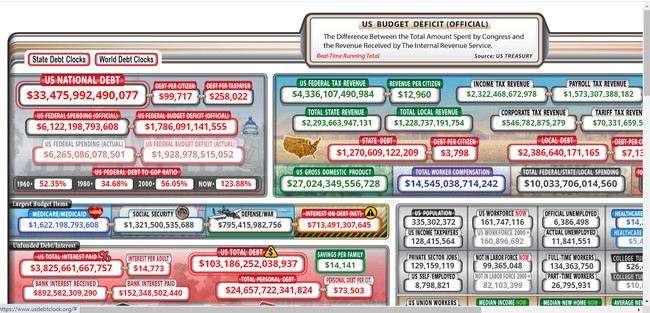
The Government Accountability Office reports the federal government paid more than $970 billion in interest in fiscal year 2025, a number that now eclipses Pentagon spending and creeps toward Medicare levels, and that projection forces a Republican perspective: fiscal discipline can’t wait while Washington debates which spending to protect.
The federal interest tab topped $970 billion in fiscal year 2025, according to the GAO, and that’s not money that buys services or strengthens defenses. These payments simply cover past deficits and funnel cash to holders of U.S. debt, both domestic and foreign. For conservatives, this is a clear signal that unchecked spending and persistent borrowing are weakening American resilience.
In fiscal year 2025, the government spent more than $970 billion on interest to domestic and foreign holders of U.S. debt (net of interest income). This cost was equal to 3.2 percent of GDP. Net interest spending is now one of the largest categories of federal spending. For example, the government spent more on interest than on national defense and nearly as much as on Medicare.
Debt held by the public reached roughly $30.2 trillion at the end of fiscal year 2025, equating to about 99 percent of gross domestic product. GAO projects that level will climb back to its historic peak by 2029 and could skyrocket to 251 percent of GDP by 2056 if policy doesn’t change. Those are not abstract numbers; they translate into higher borrowing costs for households and businesses and less fiscal room for crises.
The fiscal mechanics are straightforward and troubling: Washington spends more than it collects, covers the shortfall with borrowing, and then pays interest on that borrowing, which forces more borrowing. That cycle accelerates over time as interest costs compound. Conservatives view this feedback loop as a policy failure that demands immediate course correction.
Policy projections make the stakes concrete. Under current law, spending is expected to rise toward roughly 35 percent of GDP by 2056 while revenue hovers near 17 percent. The gap between outlays and receipts drives the accumulation of debt and invites higher interest rates, slower growth, and diminishing options for national emergencies. Those outcomes undermine both prosperity and national security.
Many watchdogs and fiscal groups warn that the combination of rising debt and rising interest costs creates a reinforcing cycle that becomes harder to reverse the longer lawmakers wait. From a Republican angle, that means delaying reform only magnifies the painful fixes needed later, whether through deeper cuts or significant tax increases. The math does not care about political convenience.
GAO projects that net interest will become the fastest-growing part of the federal budget and could overtake Social Security as the single largest spending category by 2044. That shift would crowd out discretionary priorities, including defense and border security, and reduce the government’s ability to respond to wars, financial shocks, or natural disasters. Conservatives see fiscal sustainability as essential to preserving those capabilities.
We project that by 2044 the government will spend more on net interest than on Social Security—currently the largest category of federal spending.
Rising federal debt also has real-world ripple effects: it can push up interest rates for families looking to buy homes, for businesses seeking to expand, and for entrepreneurs trying to hire. Higher public borrowing competes with private investment and can slow long-term economic growth. The case for trimming wasteful spending and enforcing budgetary discipline is a free-market, pro-growth argument as much as a fiscal one.
The GAO report does not prescribe a single solution, but it does underscore an unavoidable truth: maintaining today’s debt ratio would require durable changes in revenue, spending, or both, and waiting only raises the price of doing so. For Republicans, that points toward prioritizing spending restraint, entitlement reforms that preserve benefits for those who need them, and a rules-based approach to restoring balance in the federal budget.
Right now, the immediate figure demanding attention is $970 billion in interest payments last year—more than what the government spent on national defense. That reality should reshape conversations in Washington, replacing short-term political fights with serious, long-term planning. The longer leaders ignore the fiscal trajectory, the harder the eventual reckoning will be for taxpayers and for national priorities.



Add comment